However there is an extremely easy and cheap way to try out sous vide cooking for the first time without buying any equipment at all. You are limited in what you can do, but you’ll get an idea of what the process can do. All you need is a cooler, a kitchen thermometer, and a vacuum packed hunk of food from the grocery store.
\n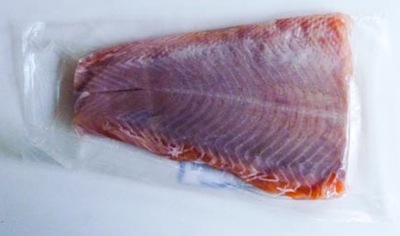
\nAs as example, we took some frozen vacuum packed fish from Trader Joes. First you defrost it.
\n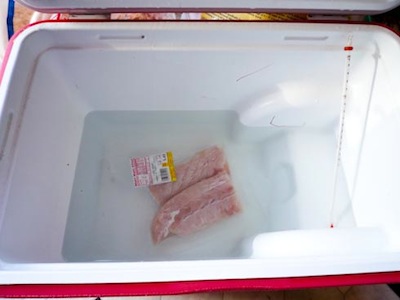
\nThen you fill up the cooler halfway or so with water heated on the stove to the appropriate low temperature (found in the book or online). In the case of fish it’s probably not much above the maximum temperature coming out of your water heater. Let the food steep in the water for the required time. (It can be up to hours for meat.) You may need to add some hot water if your thermometer shows the water cooling. Unwrap the finished fish and add sauce. <\/p>\n
If you like the results you can build your own bath, or purchase a home unit, and use this book to guide your exploration.<\/p>\n","protected":false},"excerpt":{"rendered":"
Low temperature cooking<\/p>\n","protected":false},"author":2,"featured_media":0,"comment_status":"open","ping_status":"closed","sticky":false,"template":"","format":"standard","meta":{"_monsterinsights_skip_tracking":false,"_monsterinsights_sitenote_active":false,"_monsterinsights_sitenote_note":"","_monsterinsights_sitenote_category":0},"categories":[39],"tags":[1320],"acf":[],"_links":{"self":[{"href":"https:\/\/kk.org\/cooltools\/wp-json\/wp\/v2\/posts\/5803"}],"collection":[{"href":"https:\/\/kk.org\/cooltools\/wp-json\/wp\/v2\/posts"}],"about":[{"href":"https:\/\/kk.org\/cooltools\/wp-json\/wp\/v2\/types\/post"}],"author":[{"embeddable":true,"href":"https:\/\/kk.org\/cooltools\/wp-json\/wp\/v2\/users\/2"}],"replies":[{"embeddable":true,"href":"https:\/\/kk.org\/cooltools\/wp-json\/wp\/v2\/comments?post=5803"}],"version-history":[{"count":1,"href":"https:\/\/kk.org\/cooltools\/wp-json\/wp\/v2\/posts\/5803\/revisions"}],"predecessor-version":[{"id":9861,"href":"https:\/\/kk.org\/cooltools\/wp-json\/wp\/v2\/posts\/5803\/revisions\/9861"}],"wp:attachment":[{"href":"https:\/\/kk.org\/cooltools\/wp-json\/wp\/v2\/media?parent=5803"}],"wp:term":[{"taxonomy":"category","embeddable":true,"href":"https:\/\/kk.org\/cooltools\/wp-json\/wp\/v2\/categories?post=5803"},{"taxonomy":"post_tag","embeddable":true,"href":"https:\/\/kk.org\/cooltools\/wp-json\/wp\/v2\/tags?post=5803"}],"curies":[{"name":"wp","href":"https:\/\/api.w.org\/{rel}","templated":true}]}}