
Free Wins Against Malaria

"Nothing free can be valuable" say some critics. That is, giving away things devalues them. This is obviously untrue in the digital realm, but what about physical things? The fear of the free was especially an issue in charity. If, with good intentions, you give medicines, or pumps, or solar panels, to the needed for free, won't they neglect, or trade off, or ignore these gifts?  In particular, if you give long-lasting insecticide-impregnated mosquito nets to families in malaria territory, would they just use them for fishing, or sell them? Maybe you should sell them the nets originally for a small amount?

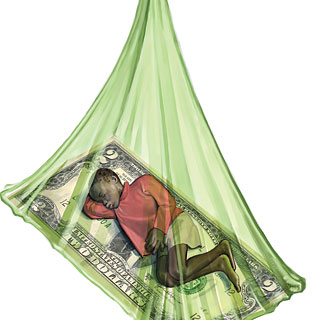
Turns out after many years of testing, that the free nets are incredibly effective in reducing malaria. Free wins! The story by Jeffery Sachs is here in Scientific American. Or you can read the PDF for the academic paper on the experiment.

Free or not, nets are a great idea and better than malarial drugs. If you want to fund a net ($10), there's a number of places that help  you do that, including Nothing But Nets.
Good-News-On-Malaria-Control 1


3 Comments

#1 | Sun, 07-26-09 11:49 | Endy Daniyanto

"Free or not, nets are a great idea and better than malarial drugs"

Definitely better than drugs. And definitely better than being taken advantage of drug companies that may misuse the situation.

Cheers,

http://endydaniyanto.blogspot.com

 
#2 | Mon, 07-27-09 12:04 | eddie

Hi KK,

This is a great example of Free == Good.

This could be because (to use a Classic Economy term) this good/product gives maximum utility (in this case, survival from disease) even though its free.

This snapshot is regarding something that's happening now. How about recent history?

I would be interested to know if anyone had studied the effects one of our (mankind) largest effort at free-giveaways -- basic education?

Also, another possible scenario to study/analyse, post WWII Britain started the ball rolling to allow commonwealth countries to achieve independence. This intention was followed thru by many "free" giveaways from scholarships to technical trainings to vaccinations-plans to legal consultancy (that all included materials and tools). How did the effects of those free-things went? What worked? What didn't? What are its effects/legacy today (i.e. forgotten or celebrated etc.)?

Appreciate if anyone could dig into old reports and post some data. Or share on personal/family experiences.

Many thanks.

Ed

 
#3 | Mon, 07-27-09 11:32 | vanderleun

"Free or not, nets are a great idea and better than malarial drugs."

Better still might be the use of DDT and other chemicals that kill off the mosquitos that transmit the malaria in the first place. Might actually give those infected a chance to avoid being bitten during those moments in their lives when they are not under a net. But that would rob the humanitarians of the world of the chance to give away free netting.

It's heartening that this sort of intervention is working but it's hardly a cure-all or an elimination of the problem... unless you have an inordinate fondness for malaria and mosquitoes.

In the conclusion the article notes, "First, the poorest of the poor are in such dire straits that failures to help can lead to needless mass suffering and deaths."

Well, fine, but limiting your methods to one vector alone such as this one only leave the poorest of the poor in perpetual dependency on the mosquito net supply chain; on the kindness of strangers.


Leave a Comment

Your Name:


Thanks for your comment. The words in the CAPTCHA box come from old book texts that are being scanned and stored by the Internet Archive. By entering the words in the box, you prove you are not a bot and also you help proofread the books. If the sample you see is too hard to read, simply click the recycle button to get another two. Don't forget to put a space between the words.


Archives - This site operates under a Creative Commons License.