


Protopia


[For over a decade I have been talking about protopia, but I have never written out my description of it. What follows is my best case for this idea, which I first coined in 2011.]
Protopia is a plausible, desirable future, marked by small measures of improvement. It is positioned in contrast to a utopian future at one extreme and a dystopian future at the other.
Utopia is that mythic future that has no, or at least, reduced problems. The idea is that through our collective efforts we can eliminate the fundamental causes of problems in life. Maybe through the powers of AI we can identify and correct the ailments and inadequacies of current processes, and over time overcome basic problems like scarcity, inequality, conflict, and even accidents. The scale of problems would decrease over time. The results for humans would be both levels of prosperity unknown previously, but importantly, a world crowded with benefits and diminishing new problems. Yet the prospect of utopia is both impossible, and also undesirable. Undesirable, because it would become boring fast. A utopia embeds a uniformly optimized value, but one person’s utopia will become another person’s prison. We are fickle beings, constantly changing what we think is most important.
Utopia is also impossible because it is friction which propels progress. Without the pressure of new problems, there is little reason for advancement. Some people think of utopia not as a destination but as an ideal, but even that is misleading because utopia ignores the inherent tradeoffs in every benefit. We don’t get better without also earning some new problems. Problem-free is a stagnant death zone, and nothing we should aim for.
At the other extreme, we have dystopia – a world of all problems. No sane person wants dystopia, yet when we are asked to imagine the future, the images that come most easily to us are dystopian. It’s reckless uprisings, a long dark age, the collapse of institutions, climate disasters, a black mirror of stunted humanity descending into chaos. Today – or the year when you were 10 years old – would be viewed as the golden age, and it’s all downhill from there.
Dystopias are easy to imagine because of the severe asymmetry in entropy. There are millions of ways to break something that has only a few ways to get right. It takes far less energy to destroy a skyscraper than to build it. The paths to success are far fewer than the myriad paths to failure. For all these reasons[,] hundreds of crumbling dystopian futures are very easy to imagine. In addition, a dystopian future is far, far more exciting. The demise is always cinematic. In short, dystopias make much better stories. If you want to write a popular science fiction story about the future, a dystopia is needed to [heighten] the drama for the heroes. The result of this bias is that virtually every movie that has ever been made about the future contains a dystopia, with very few exceptions. If there are robots and AIs involved, the story does not end well. This relentless dystopian viewpoint is our education. We have been trained by a century of incredibly high-production visualizations to have only one vision of the future: it’s a mess.
We really could be headed for a dystopia right now. There is a greater than zero chance it could happen in our lifetimes. But obviously we should not aim for it. However, if utopia is also not a possible future, then what kind of future should we hope and plan for?
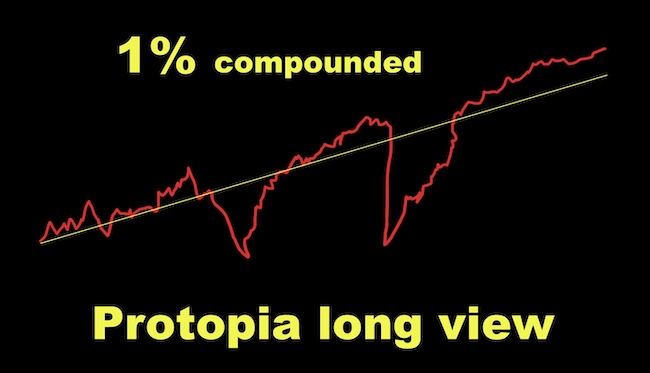
Aim for Protopia. A protopian future is one that is only a little tiny bit better than today. Maybe it is one or two percent improved since last year. But that one or two percent is compounded year by year, and that compounding in the past is what has made civilization today. All the good things we share today – like our road systems, libraries, laws, literacy, our health system – have accumulated slowly with only a few percent betterment each year. We currently live in protopia. If we can just keep creating only 1% more than we destroy each year, we can have progress.
That means that the world can be 49% crap, horror, hurt, destruction, bad, and the worst. The disgust of half bad can be overwhelming, which makes it hard to notice the 51% that is good, true and beautiful. For sure, the 1 or 2% difference between the good and bad is so small as to be invisible. It would be hard to detect that difference except in retrospect. And in fact, civilization is most visible in retrospect. It is primarily when we look behind us into our past that we can see the long arc of progress. The betterment over the long term is legible, indisputable.
Protopia is a slow, steady improvement that is more a direction than a destination. The “pro” comes from the “pro” in progress, and the “pro” in proceed – to move forward. It is the positive affirmation in Pro vs Con, and also the “pro” in prototype, to create incrementally, without stopping. Unlike utopia, it is not a place you ever arrive at. The “pro” in protopia stands for a process, an ongoing system that will create not only new benefits but new problems as well.
Protopia is slight progress that also has problems. Every successful invention solves an existing problem, and creates new problems. Ships create shipwrecks, cheap food creates obesity. The more powerful the invention, the more powerful the new problems. Industrialized farming – the solution for subsistence agriculture – hatched a storm of immense problems. AI is the most powerful technology we have invented and it will generate the greatest problems we have ever had. Each cycle of new problems requires another cycle of novel innovations to solve, and those new solutions will quickly birth yet more novel problems, round and round. This system does not decrease our problems, which is why it is not utopian. You could say it replaces existing problems with new ones.
If that is all inventions did, we’d be stuck on a dreadful treadmill going nowhere. However in every cycle of problem-solution-problem-solution we expand our choices and possibilities – by a small amount. Every cycle we accumulate a few percent more ways to make a living, a bit more choices in methods to express ourselves, or more tools to match our talents, additional places to reside, further opportunities to explore. When we look back we can see this. Three hundred years ago, there were only a few occupations most people in the world could be: a farmer or farmer’s wife, maybe a blacksmith or baker. Today hundreds of millions of people migrate from their farms to big cities because they have the possibilities to be a driver, a chef, a mathematician, a musician, a web-designer, a prompt engineer. In a protopian world, next year there will be a few more choices that don’t yet exist, maybe a robot repairperson, or genetic coach.
We don’t need a singularity to have a better world. We can have a world of abundance by creeping towards it bit by bit. Protopia is the good-enough future. The key is to make sure we expand the good by increasing options at every turn, and avoid decreasing options. Choosing wars is one way to decrease options; investing in science is one way to increase them.
Dystopia leans into problems; utopia leans into progress; protopia leans into problems and progress in unison. It acknowledges there is no progress without problems, and problems propel progress. Dystopia runs on fear, and utopia runs on faith. Protopia runs on facts: the fact of real problems, and the facts of real progress. Most people have no issue with facing up to the problems we are creating today, but they take issue with the idea of real progress. They can believe half of the world is rotten but have trouble seeing the 1% better difference. This is where a long view can help.
An impartial analyst of our past, especially the last 300 years, will reveal inarguable progress has been made in almost every domain we care about. That invisible 1 or 2% incremental betterment shows up in every measurement of our safety, health, longevity, rights, treatment of others, literacy, and opportunities. If we extend our view beyond our own lifetime, the fact of progress is very real. In the same way, if we take a long view into the future, incredible things can be accomplished if we give it ten years or more. Tribulations that seem monumental now can be overcome by compounding forces working over decades. Even the most horrible disasters [and] terrible wars can be superseded in the long term by increasing returns. Many of the most powerful novelties at work in the world today are still just infants; LLMs are mere toddlers; it will take decades before we understand both their true benefits and actual drawbacks.
The long view of protopia is not just for peace of mind. It’s how we steer. We constantly monitor the world we have already made, measuring its benefits and harms, and inventing new things to remedy the wrongs when detected. Then through daily use of the new solution, we begin to measure the benefits and harms created by this new remedy. New harms are always compared to old harms, since there is no invention without harms (even the oldest, most familiar ones), no remedy without its own poison, no solution without its flaws. The long view is required to keep the new problems in perspective.
Protopia only works if the compounding is not interrupted. A catastrophic discontinuity like an asteroid strike, or nuclear world war, could halt the march of civilization and set it back ages. Dystopian visions do serve a purpose: we need to continue to build functioning institutions, and planetary cooperation, such as asteroid tracking and nuclear monitoring, climate relief, and hundreds of other systems to make sure the dystopian disasters don’t ever happen. In fact, we create many of our new inventions to ensure we avoid the easy disasters we can imagine.
To arrive at protopia is primarily a labor of imagination. We need to imagine the few hard ways that things can go right. Not perfectly right; just a little better than today. If we can imagine protopia, that increases our chances of going in that direction.
Forget utopia, and dismiss all the dystopian futures packaged by storytellers as to where we are headed. We don’t need an unblemished, impossible future where problems disappear. Neither should we believe in the easy futures full of all the ways things can fail. In their stead, we can imagine a future that is a tiny bit better than today. Not by much, but enough. In this protopia, our improvements will generate new problems we didn’t expect. But this future will still be a little better, not because these new problems are not as large as we thought, but because our ability to solve problems is greater than we thought.
