


Most Improbable Agent of You

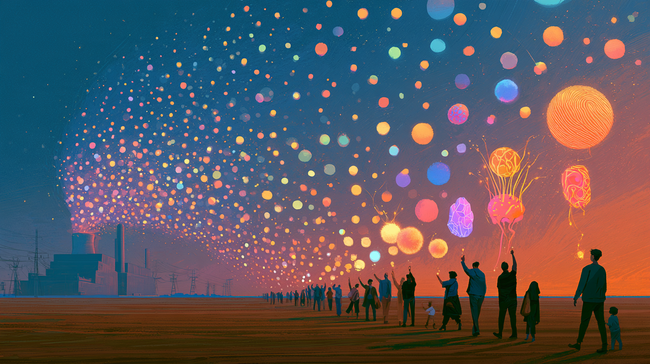
It is commonly said that AI today is the worst it will ever be. This is true. AI today is probably the most centralized it will ever be as well. Currently the most reliable way we know how to make AIs smarter is to make them bigger. This principle is called the scaling law. To improve the current best AIs, which are transformer neural nets, we need to increase the scale of their training data, the scale of their compute, and the scale of their inference, or delivery. That scaling results in massive computer processing centers, running millions of chips, with trillions of parameters, powered by gigawatts of energy, costing tens of billions of dollars. Very few can afford this scale of system, so this AI power is concentrated into a very few organizations.
On the other hand, each one of us runs a very powerful (better than most AIs), very tiny (big as your skull), very energy efficient supercomputer running only on 25 watts at the end of our necks. There are some 8 billion of these tiny supercomputers spread around the planet, interconnected via the internet. We have an existence proof that biological intelligence does not need to be centralized.
Today, because of rapid innovation in AI architectures and training formulas, the amount of compute an AI needs to deliver a given capability has been cut roughly in half every 8 months. Combine that with the hardware gains of Moore’s Law, and the cost per capability halves roughly every 6–7 months. Assuming Moore’s Law continues, within a few years, a model as capable as today’s leading LLM – let’s call it Opus – could run on a device you own. Within about a decade, the cost of training one from scratch would be affordable by an individual, and fine-tuning your own copy would cost far less.
That means everyone could own and control an AI like today’s Claude or ChatGPT or Gemini. You would not have to ask permission to do things, or be obligated to train it with certain guidelines, nor have to accommodate the preferences and sensitivities of others. The AI could reflect you.
This kind of shrinkage should not surprise us. It seems insane that a multibillion-dollar data center occupying a vast brown field could be reduced to an orb that sits in your hand, but consider what has already happened inside your phone. Twenty-five years ago, the graphics chip alone in today’s iPhone would have filled a large room. Your phone’s AI chip would have required acres of computer cabinets. It is likely that the entire controversy around massive data centers disappears because they disappear; they were a temporary scaffolding needed for the first round of tech, just a blip in the history of technology.
Of course in 10 years, you would be stuck with today’s AI – which as I began – is the worst it will ever be. But at some point in the very near future the amount of AI that you need for 99% of most jobs could be provided by a local device. It is similar to bandwidth. At a certain point, most tasks you have can be done with a gigabit connection. And once you have a gigabit connection, you are happy. Maybe when we have the metaverse, or the mirrorworld, or augmented reality, we’ll elevate that minimum, but the point is that it will be good enough. At some point the smartness of consumer AI will be good enough for 99% of what you need, and that smartness will be able to run in something you own and could also train.
Many of the issues that people have with AI today would be resolved if the AI were not only available from a huge massive monopolistic tech company, but instead was generated, delivered, overseen, and maintained by individuals. A lot of the criticism of AI today is really just a criticism of capitalism. There is the question of who benefits from the value being created, who controls who gets what (the best AI models may be kept for internal use by some companies), who gets to train the AI mind, and supervise what it is trained on, and who decides what it is used for.
Not all issues are resolved by individualized AIs (they will still have tricky trust issues), and some new problems are created. But I find a vision of a billion AIs running the world much preferable to 3 or 4 of them running the world. Decentralization spreads power, but more importantly it can deliver something a central AI never can: an AI as unique as you. Here is my ideal hope:
I hope that every person born (and yet unborn) can be on a path through their lives to become the most improbable version of themselves. (See my manifesto Your Most Improbable Life). The idea is that you become unique, with a unique set of talents and experiences, occupying a niche in the world that you create. You slowly invent your job. You are not the best, you are the ONLY.
This kind of self fulfillment is possible because we have technological agents that relieve us of the tasks anyone can do, leaving us with the tasks only we can do. While there will be billions of ordinary and commodified agents (bots and robots) that perform these everyday tasks, the best of the AIs will be those we tailor to ourselves.
I want a personal AI that I have trained myself on all my life’s experiences, all the influences I have had, all the work I have done, and all the people I most admire. There will be advice and schools for training your personal AI to become the most useful to you. In fact there will be teacher AIs who educate personal AIs, and people will hold opinions on the best way to educate your personal AI and what kind of AI teachers you want. You want the teachers weird but not too weird. You may want to train your personal AI on the classics, rather than everything. The current frontier models are trained on everything and they are aimed at everyone for all problems. They are by default, generalists hitting the average in the middle of the mainstream.
But we want a personal AI, an exoself, that is as unique as we are. We don’t want the best AI, we want the ONLY AI. We want an AI that is as improbable as we are, and improbable in the same unique direction that we lean. We’ll want to curate the education of our AI.
At least I do. I want to work with my exoself AI agent to co-create, co-manage, co-invent my life. I don’t want to use the same AI that 8 billion other people use. How can that help me to be unique? In order to be creative, my AI exoself also needs to reflect my own uniqueness, doing its own AI thing with distinction. It should be as weird as I am.
The art of training your own personal AI to be weird yet useful will become one of life’s skills. An entire section of YouTube and self-help programs will be dedicated to cultivating the Agent of You. The ultimate goal of this Agent of You is to help make you the most improbably unique person you can be.
Mainstream will never go away. And for much of life the ordinary is more than fine. There may be big-tech janitorial agents, and brand name clerical bots, and exclusive alien genius bots, but the AIs that can serve creators should be as weird and personal as we are.
