


Still Out of Control


[First posted in 2021; updated May 2026]
I published Out of Control 32 years ago (1994). I started writing it in 1989, which is a long time in the past for a book that promises to talk about the future. A lot in our world has changed in that time, including our attitudes about the future. Far too much has happened in the world of technology to be summed up in this note. But it is fair to wonder: how well has my book held up for the past 32 years? Is Out of Control still valid? Is it worth reading today? And what might I have written differently given what I know today? What, if anything, would I change?
My biggest regret is the title of the book, which is just the wrong title. “Out of Control” is a negative vibe, and it captures only part of what the big book was about. It is not about losing control, but more about a new kind of para-control, and decentralized bottom-up power, and about emergence, and good things that come from complex systems. I was not overjoyed with this title at the time, but despite trying very hard, I could never come up with anything better. Even today, I still don’t know what I would call it. I kind of tolerate the title.
Beyond some typos in the text there is nothing I feel the need to retract or correct. The principles I labored so hard to describe and explain are still valid and still useful. In fact, I think they are more useful now than ever before. Today we are creating dozens of new synthetic systems each year—especially AIs—and the knowledge I collect in Out of Control can serve as helpful guidance. The biggest change in the last 27 years is that the benefits for decentralized systems, for distributed power, and for mechanical smartness is much clearer now. Whereas before the topics in Out of Control — such as emergence, beehives, hive minds, ant algorithms, social robots — all seemed like cute esoteric ideas that belong in a philosophy class. Now they are correctly perceived as essential, utilitarian, foundational notions at the heart of modernity. Two decades ago when I spoke of these things they seemed far away and speculative; now when we speak of them, they seem almost cliched. For instance now everybody knows that the wisdom of the crowd can be useful.
The fault of the book is what it missed, what it does not talk about. There was a chapter I started to write about how the economy is an artificial distributed system, almost like a video game, and almost like an organism. I had notes for the chapter, but it was too big for an already too big book. I didn’t explore or deal with the system of news and information, or social networks, which now seems like a huge oversight. That would have been a logical thing to do, although data was scarce. If I was rewriting the book today, I would include a chapter about the ecology of information.
One thing that really surprises me is that Out of Control is not more out of date than it is. In most fields of science, a technical book written 32 years ago would be horribly out of date. While I am happy that the examples and the specific cases I used to tell the story of emergence still work, my stories only do so because the field itself has not advanced as much as I would have expected. Today in 2026 in each of the 24 chapters in the book, I could now add an equal amount of new material to bolster my arguments. For instance many ideas that were mere notions in a notebook are now in research labs, and many of the ideas in research labs are now commercial products. But weirdly, there have been no major breakthroughs, or hugely disruptive ideas, in these departments in the last many decades. The one exception is the refinement of neural net deep learning (aka LLMs), which has worked much better than anyone predicted it would. I should add that if I were writing the book today, I’d devote several chapters to neural nets (which I did briefly mention) because they have become so important to the chief new technology in the world: artificial intelligence. In fact, in case it is not clear, neural nets are the prime example of bottom-up, distributed, decentralized, emergent systems. They are a perfect example of all the things I wrote about 32 years ago in Out of Control.
Despite the great success of neural net deep learning, most of the other things that we did not understand 32 years ago we still do not understand today. We have the same holes in our theory. We still do not have good grasp on how to build systems that can bootstrap — or upcreate — their own complexity to greater levels. For instance, while we seem close, we have not yet made an AI that can make itself smarter. We don’t know how to program evolutionary systems to evolve their own evolution. We don’t even have a decent theoretical idea of why exotropic systems work — that is why they endure and grow. We don’t have working measurements for complexity, or even a working framework for making artificial life. Had you asked me when I was writing Out of Control in the late 1980s and early 1990s, I would have guessed back then that we would have answered at least one of these questions by now. But alas, these are still unknown.
We do know some things better now. I feel confident to say that overall one big thing we collectively know now is that the nine principles of how to make complex things that I describe in the last chapter of Out of Control really do work. We really can make complex things built from simpler things that work, as one example. It is clearer to even non-scientific people that complicated machines have many similarities to living organisms, and that we prefer it that way. Again and again in the past two decades we’ve seen how very basic decentralized bottom-up systems have succeeded and progressed much further than we guessed. Even if a completely decentralized system may not take you all the way to what you want to accomplish, the bottom-up is usually the best way to start. These are the kind of lessons that have seeped into the culture and are taken for granted today.
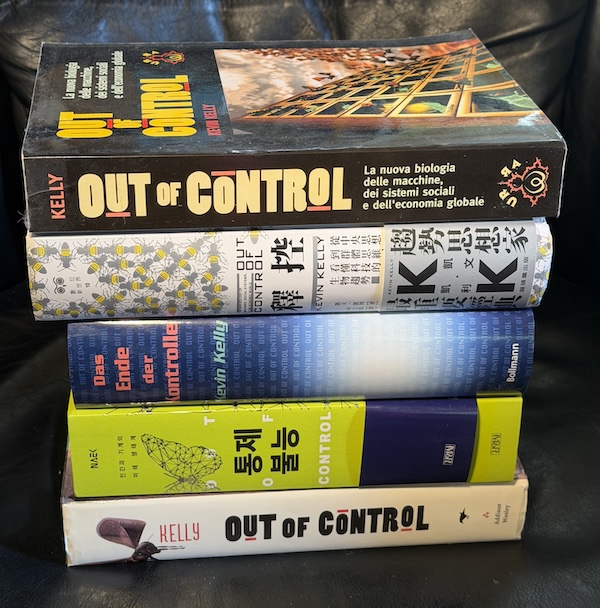
I think Out of Control played a part in getting these kind of ideas accepted and mainstreamed. I am particularly grateful that a Chinese language edition of this book arrived in China when it did. It was extremely lucky perfect timing. The Chinese edition came at a time when Chinese entrepreneurs began to make large complex systems from scratch, and the deep research I drew upon was helpful to them as they experimented. Because of that, it became a best-selling book in China. However, in America my book arrived too early. It was published before the internet really started. It got very few book reviews in the US and was ignored at that time because technology was considered boring and unimportant. There were few tech reporters. Some years later, by the time the internet was first growing rapidly, the book was forgotten. Now is a different era because people have been educated to appreciate emergence. Also other books by other authors have been published on these ideas. The notions in Out of Control are now much more digestible and so the book sells more copies than when it first came out.
There is a saying in the publishing world that the shorter the book is the more it sells, and the longer the book is the shorter the sales. Out of Control is a long book, too long. It would have sold twice as better if it were at least half as long. However if I were to re-write it today it would need be even longer, because of more evidence and more domains to include. So I am very grateful to any and all of my readers who stuck with this long book. It is dense, not easy to read. I thank you for staying on this journey with me to the conclusion. I trust I was useful. And to new readers, I wish it was shorter!
Out of Control was the first in-copyright book to be posted on the web for free. (The backstory is that I retained the digital rights long before any publisher knew the value of digital rights.) You can find it here for free as an illustrated PDF. Or you can get a printed-out version delivered to your mailbox, almost overnight, via Amazon, here. Kindle, too.
