


The Unpredicted vs the Over-Expected


It is odd that science fiction did not predict the internet. There are few stories and no vintage science fiction movies about the world wide web, nor movies that showed an online world as part of the future. Science fiction stories gave us picture phones, and online encyclopedias, visual tablets, and world brains on a screen, but not the internet — a web of linked documents, and shared messages, and decentralized content posted by anyone. The closest forecast was a technical memo by the scientist Vannevar Bush in 1945 that imagined a device that held all science documents connected together. Beyond that little-read memo, there was no expectation of the internet. As a society we missed it. Given how pervasive the internet later became this omission is odd.
On the other hand, there have been thousands of science fiction stories and hundreds of movies predicting artificial intelligence. And in nearly every single one of them, AI is a disaster. Either the robots take over, or they cause the end of the world. The commonest story is that their super intelligence overwhelms our humanity, and we are toast. With very few exceptions, there are no Hollywood movies where AI turns out to be a good thing for society.
This ubiquitous dystopia of our future with AI is part of the reason why there is general angst among the public for this new technology. The angst was there even before the tech arrived. The public is slightly fearful and wary of AI based not on their experience with it, but because the only picture they have of it in their mind is the negative one. Call up an image of a smart robot and you get the Terminator or its ilk. There are no examples of super AI robots working out for good. We literally can’t imagine it.
Another factor in this contrast between predicting AI and not predicting the internet is that some technologies are just easier to imagine. In 1963 the legendary science fiction author Arthur C. Clarke created a chart listing existing technologies that had not been anticipated widely, in comparison to other technologies that had a long career in our imaginations.
Clarke called these the Expected and the Unexpected, published in his book Profiles of the Future in 1963.
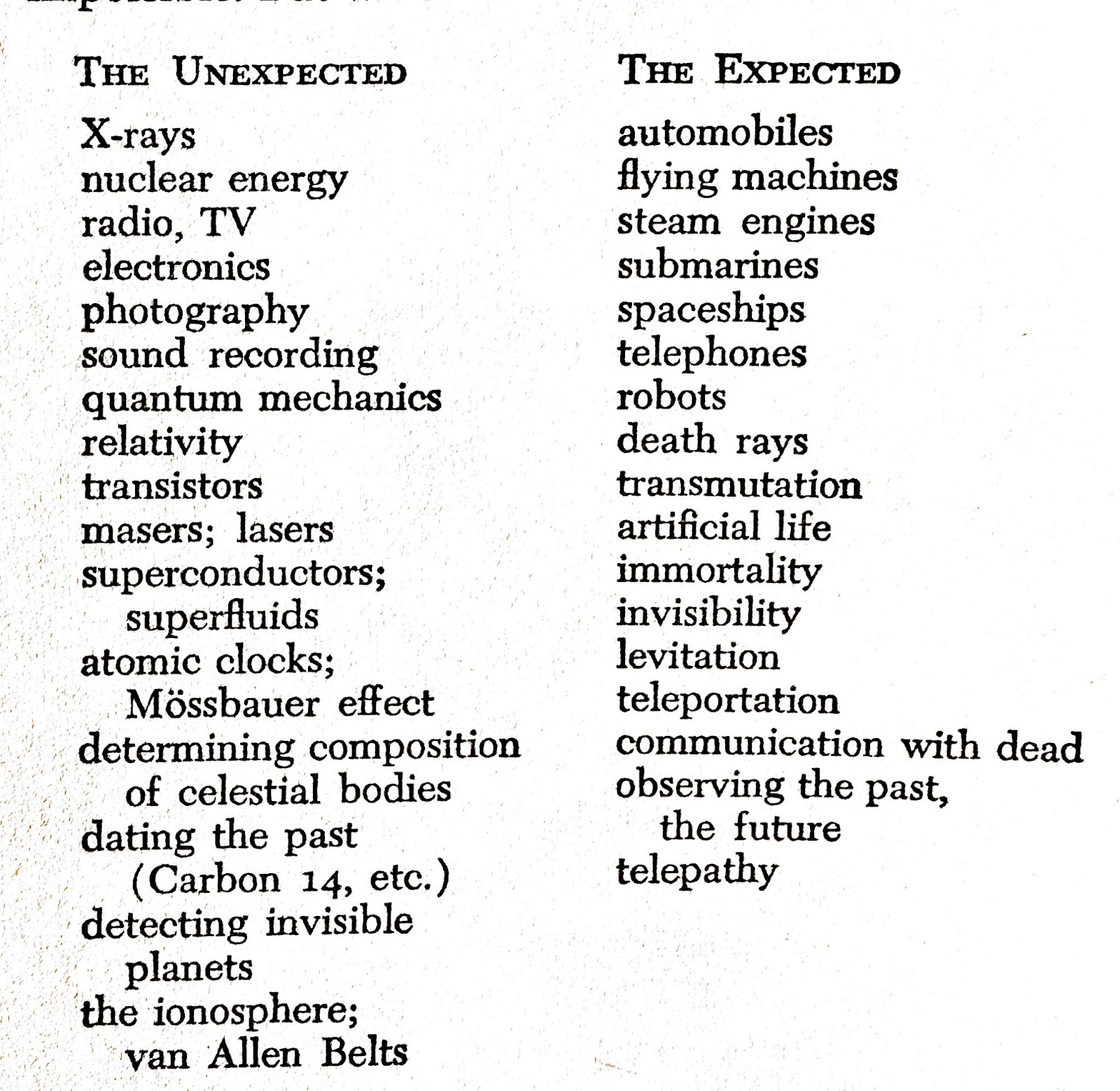
Clarke does not attempt to explain why some inventions are expected while others are not, other than to note that many of the expected inventions have been anticipated since ancient times. In fact their reality – immortality, invisibility, levitation – would have been called magic in the past.
Artificial beings – robots, AI – are in the Expected category. They have been so long anticipated that there has been no other technology or invention as widely or thoroughly anticipated before it arrived as AI. They are what I would call Over-Expected. What invention might even be second to AI in terms of anticipation? Flying machines may have been longer desired, but there was relatively little thought put into imagining what their consequences might be.
Whereas from the start of the machine age, humans have not only expected intelligent machines, but have expected significant social ramifications from them as well. We’ve spent a full century contemplating what robots and AI would do when it arrived. And, sorry to say, most of our predictions are worrisome. So far, AI has not manifested huge visible improvements in people’s lives. Some of the best current work of AI operates in back offices, doing boring work that is not visible to us. The amazing answers of LLMs are welcomed, but seem like the expected improvement upon Google search. AI generated images and text are fun and astounding, but so far have not become something that people yearn for. The single possible example of AI that is really cool and that we want more of, is a self-driving vehicle like Waymo. Everyone who has ridden in a Waymo gets their many benefits, and would like to use them near where they live.
Outside this exception, now that AI is beginning to finally hatch, we are not embracing it as fully as we did with the internet. There are attempts to regulate AI before it is even operational, in the hopes of reducing its expected harms — because harm is all we ultimately expect. While it has good intentions, this premature regulation is unlikely to work because we simply don’t know what harms (and what benefits) AI and robots will really bring, even though we can imagine quite a lot of harms. This is the drawback to an extended expectation: it mostly breeds expectations of harm, because it is always easier to imagine harms rather than benefits.
This lopsided worry, derived from being Over-Expected, may be a one-time thing unique to AI, or it may become a regular pattern for tech into the future, where we spend centuries brewing, stewing, scheming, and rehearsing for an invention long before it arrives. That would be good if we also rehearsed for the benefits as well as harms. We’ve spent a century trying to imagine what might go wrong with AI. Let’s spend the next decade imagining what might go right with AI.
Even better, what are we not expecting that is almost upon us? Let’s also reconsider the unexpecteds.
