


The Oil and Water Planet


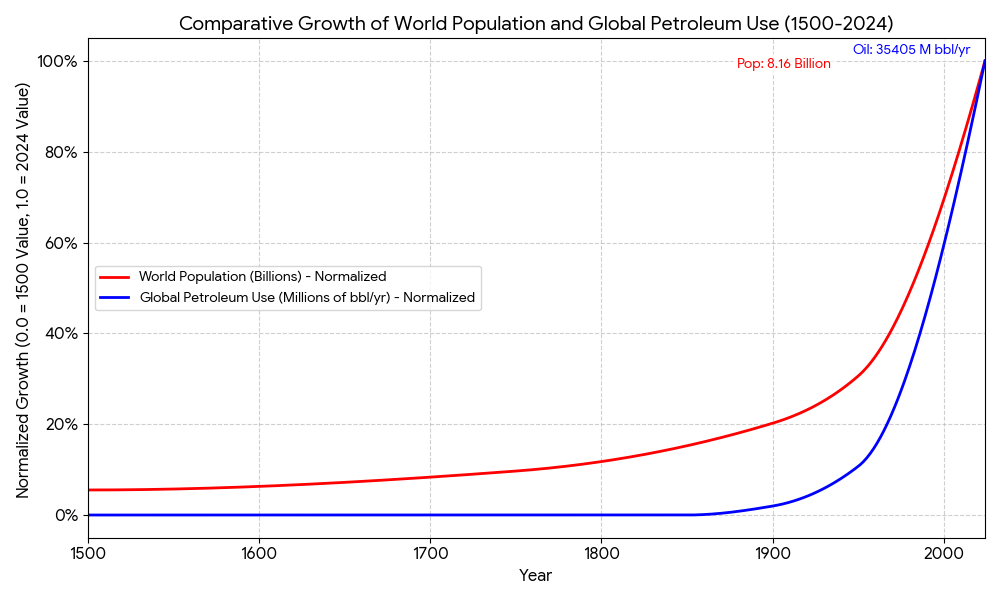
One of the most worrisome graphs in the world is the correlation between the rise of cheap oil and the rise of living standards — or what we might call progress. Almost all the modern trends we tend to applaud, from rising population, to lengthening lifespans, more leisure, more choices, all depend to some extent on cheap energy. If we didn’t have an accessible 200-year source of cheap energy we would not have been able to feed billions of people, build tall buildings, or run factories, or fill roads with cars and trains.
The graph here is just one example: it shows the parallel normalized growth in world population and oil use. Both domains have grown in a similar fashion. They are mutually reinforcing. Plentiful energy enables more population; greater population enables more energy use.
Thought experiment: imagine our planet had no significant natural reserves of coal or oil. To build any structure we would need to use wood or earth and muscle power, either animal or human. We could make some windmills and watermills to harness wind and hydro power. We could make some wood-fueled steam powered engines, and build primitive factories. These resources are both limited in power and limited in the amount of fuel that can be gathered each year. We probably would have discovered electricity without oil, but without cheap power to generate it at scale, it would have been extremely difficult to smelt enough copper for miles of wires, or to make motors, and of course even harder to supply the power to run them. Motors might have remained in laboratories.
Earth has other sources of non-carbon energy such as nuclear, and solar, that are relatively unlimited. The question is, could science — and the development needed to support it — have progressed enough in a wood-world to achieve the mastery of nuclear power without all the easy wins that hydrocarbons and oil produced? Could you make enough equipment and metallurgy, and other equipment needed without cheap energy, in order to discover the principles of nuclear power? Same for wind energy. Would there be a viable path in a wood-steam-punk world to reach cheap solar panels?
In other words: is oil needed for progress? Can we imagine a planet in another galaxy that has no hydrocarbon fuels ever reaching advanced science? We might imagine a planet that for some geological reasons has tons and tons of steam geysers, or waterfalls every block. Perhaps you could extract enough cheap power in this centralized way to reach nuclear or solar. But maybe the power is not portable enough. Perhaps for civilization, you need not just a water planet, but a water and oil planet. This would be a great conceit for a science fiction saga.
It is clear to us now that you can run an advanced civilization without burning hydrocarbons; in fact, we’d now say that any advanced civilization would not be burning hydrocarbons at all. In fact a hydrocarbon-less economy is almost our current defintion of an advanced civilization. Plentiful oil and coal is just a scaffolding technology on the way to a civilization that can then run without them. The question is whether cheap fossil fuel — or its equivalent — is a necessary scaffolding, or just a convenient one.
Our tiny blue dot of a planet in the black vastness tells any distant observer that life has a good chance of blossoming there. The signal of life derives from the inordinate amount of oxygen present in our astmosphere. Our high concentration of oxygen would otherwise burn and oxidize everything on the planet without being constantly replenished by life. But if we wanted to ascertain whether a distant planet was capable of developing a technological civilization, we may need some way to detect whether the planet itself contains internal hydrocarbons.
BTW, there is a minority theory that the huge deposits of oil on this planet are not biogenic — that is fossilized life — but rather geogenic — that is created by non-living planetary processes. The chief proponents of that theory, called the Deep Hot Biosphere, are Thomas Gold and Freeman Dyson. Whether this theory is true or false does not change the seemingly vital necessity of plentiful hydrocarbons on this planet in our own story of progress.
I suspect that on average, we’ll find higher forms of life on planets that have plenty of water, and that planets with advanced civilizations will only be found on planets with deep reservoirs of natural cheap energy, whether fossilized organic life or not. So in our search for intelligent alien life we should be looking for not just water planets, but oil and water planets.
