


Myth of the Lone Villain


[Translations: Japanese]
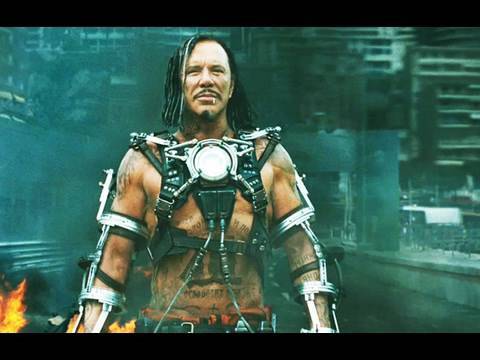
A classic Hollywood trope is the evil genius madman who is using new technology he just invented to murder (or threaten to murder) a large chunk of humanity. The lone evil genius always works in a high tech haven, hidden from others, all by himself. He is often surrounded by advance technology that he invented himself. At this point, the scenario has to be total fiction because no one can run all that technology by themselves. It is hard enough to keep three computers and a network going all by yourself. It is absolutely impossible if the madman just invented all this stuff and it works perfectly. The madman’s electronic door hatch probably crashes once a month. Is it possible you can keep the new death ray operational? No. Way.
The reality is that no solo genius can destroy mankind. That kind of power takes cooperation.
In fact, I offer a new theorem: The power of an individual to kill others has not increased over time.
To restate that: An individual — a person working alone today — can’t kill more people than say someone living 200 or 2,000 years ago.
At first this seems to fly against all the other trends in technology, but I think this law is true for the same reasons that overall violence is diminishing over time, as author Steven Pinker points out.
I did some basic research to see if my hunch was correct, so I asked weapons experts about the kill power of solo weapons. How many enemy can they kill by themselves? The answer is several hundred dead. I did not find any weapons that moved the number out of the ordinary order of magnitude of 10^2 people killed. That is, a person can use old technology like fire and poison, or sinking a boat or airplane to kill many hundreds, and new technologies like drones or machine guns also give similar results. Wikipedia helpfully has an extremely long list of historical Rampage Killers, using all different methods, and none of them managed to kill more than 100 people. I have been unable to find any example of a single person killing more than hundreds of people.
It turns out it is hard to kill thousands even using modern technology.
While I am pretty certain this trend holds true for individuals, it may hold true for teams as well. This is trickier to prove because of defining where teams end. For instance 19 hijackers killed 3,000 plus people in the 9/11 attacks, which is at most 150 killed per person involved, and much less when you include the many more Al Queda leaders and support than just 19 hijackers involved.
I suggest you’ll get similar numbers if you take the number of deaths per team member for mass killings. For instance there were between 100,000 and 400,000 people who died in the atomic bombs at Hiroshima and Nagasaki. The Manhattan Project employed 130,000 people, so that ratio works out to be in the neighborhood of one person killed per one person involved, and certainly no more than 10. People sometimes blame individuals like Mao or Hitler for massive deaths, but of course those deaths required many helpers involved.
I think there are two reasons that technology — so far —has not increased the lethality of a rampage killer: 1) People are hard to kill, and the greater number you want to kill at once, the more complex it becomes, requiring much more social cooperation. The totally false myth is that a lone rogue bad guy can kill everyone. And 2) More social cooperation also generates more social resistance, making it more difficult to recruit resources for the project.
We COULD invent a mass killer that would allow any single person to strike down more than thousands of people, but the financing, and engineering needed would be subject to so much social pressure against doing that, that it has not happened and probably won’t happen. The engineering problems are formidable: how do you make this weapon “safe” until it is triggered, and so on. The problems of a safe weapon of mass destruction is one reason I don’t buy the idea of a rogue scientist making a lethal bio infection, a la a Small Pox mutant. This kind of achievement is very hard science to do; you have to keep testing to make sure it will work (but how do you test by yourself?), and all without killing either yourself or your loved ones. Can it be done? Yes, but not by one person. You’ll need many smart people, and money, and both of those come with built in forces acting against the idea.
It requires a lot of power to kill many at once. How about you ignite a nuclear bomb in a sports stadium? That would kill a lot. But the truth is this is very hard to do by yourself. Getting a bomb, and getting it to ignite when you want it to is not easy. Do you know how to arm a nuke? That info is not on the internet. The more powerful a tech is the more people you need to operate it. The more people you need to operate it, the more resistance it will gain against using it to kill.
The current big idea is that cheap superhuman AI will supplant the hundreds of people a lone villian would otherwise need for their villany. AI could solve all the technical problems of weaponizing viruses, or inventing new kinds of bombs, or maybe even being smart enough to generate the cash all this work requires. This may be possible, but as it becomes possible, the same superhuman AIs can be used by society to identify, block, and prevent this kind of abuse.
Forget new technology, what about subverting an existing technology, already developed, and weaponizing it? That was the genius of the 9/11 hijackers who weaponized a plane into a bomb. (But even they did not achieve a higher kill/killer ratio.)
The lesson of “what technology wants” is that any technology can be weaponized, so this idea of subverting existing technology would seem to fertile ground. While it is not hard to weaponize a technology to be a chronic low-level killer, I think our society is built for the purpose of making it hard for technology of any sort to kill us massively. We do everything we can think of to prevent it from being dangerous as we deploy it. We are very sensitive to this possibility of bite-back, and as the technology is being realized and refined we are removing as many options for mass destruction as we can. We do that in simple ways like where we allow them to be built, or stored, or used. For instance things that can explode we keep far from homes. Drones are now going to go through this process in the coming years. Weaponized drones will be able to kill hundreds, but society will work to prevent them from being able to kill thousands or more; and if they can kill thousands, that will mean hundreds of people will have worked on them and operate them, not just a single person.
Well what if an entire country or tribe decides it wants to collectively use technology to kill a lot of people? That happens and it is called war. But as Steven Pinker has proven, the physical violence of war — the number of killed per event — has been diminishing and continues to diminish over time. I have not made the calculation but I suspect that the kill/killer ratio in war has been dropping and will continue to drop even as the remaining war becomes higher tech.
The myth of the lone evil genius claims that a motivated individual can make complex technology all by themselves without the infrastructure of a society. You can’t, at least in the beginning. Because more powerful technologies require more social support, this increased social pressure keeps the technology in check. Crazy rogue geniuses with caves full of death technology ticking down to blow up the world make great villains on the big screen, but there is no evidence at all in the real world that anything like that has ever happened.
It is very easy to imagine all kinds of ways we might subvert new technology to empower a lone individual, but these are all fictions so far. We should not ignore these fictions; in fact we should work hard as a society to make sure they don’t happen. But we also should not fall under the spell of the lone villain myth. The evidence so far is that they have no superpowers.
[I posted this in 2012, and just updated it a bit for an AI world.]
