Human Dimension & Interior Space

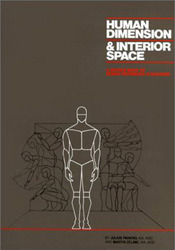
When designing a space or wearables for humans, you’ll need precise measurements of our size. How high to put a door knob, the circumference of our necks, how far we can reach overhead? There’s no such thing as an average person, so you’ll also need to know what the variances are, too. There’s a number of good sources for this data, but the most complete set, with the greatest clarity, and most affordable price is Human Dimensions. This data set was distilled from ergonomic research started by NASA for designing space capsules and broadened over the years to include the ergonomics of wheelchairs and crutches, bathtubs, workplaces and public spaces among many other everyday situations. I prefer its very graphic presentation. Good for architects, costume designers, gadget makers, interface designers, and interior decorators.

-- KK  

Human Dimension & Interior Space

Panero and Martin Zelnik

1979, 320 pages

$27

Available from Amazon

Sample Excerpts:

Figure 1-4. The human body and the Golden Section

*

*

*

*

*

Adapted from Human Factors Engineering, U.S. Air Force Systems Command Handbook, DH1-3, P. DN2B11, 19.


Money Rules

I didn’t think another book on finance smarts would add anything new to the wisdom of the previously reviewed books Your Money, and Five Rituals of Wealth. But this one takes the great advice found in those and reduces it all to 100 maxims that you can read (and reread) in an hour or less. There is one simple paragraph of hard-won advice per page. This small book’s chief benefit is that busy people will actually READ it.

This is also the best money guide for young adults. I think it is perfect to start with even for elementary kids. It is less about finance and more about developing a common sense about money. Works as a refresher and reminder for adults too. I found myself in total agreement, having done well over the years using the same principles.

If you need convincing on any point, or want the details on how to execute an idea, you can delve into the aforementioned books.


-- KK  

Money Rules: The Simple Path to Lifelong Security
Jean Chatzky
2012, 128 pages
$11

Available from Amazon

Sample Excerpts:

The four most powerful words in any negotiation: “Can you do better?”

You’re sitting in the office of the person who’s dying to be your new boss. He’s just offered you a job that you really want with the title you’ve been craving. The only hitch: The salary isn’t where you’d hoped it would be. Don’t commit–at least not neil you ask, “Can you do better?” It’s the perfect haggle. You sound as if you know there’s wiggle room, and you’re willing to let him work his magic. And note: This works just as well when you’re on the phone with the cable company, at the mechanic for an oil change, talking to a mortgage rep about in a “refi” rate. It even–I know from experience–works with teenage kids.

*

There’s no such thing as chump change.

$100 is not a lot of money. Save it every week, however, and invest it in a retirement account where you earn a conservative 6 percent, and keep doing it for 30 years and you’ll have $433,557. In 40 years, you’ll have more than twice that. And that is a lot of money.

*

Saving is more important than investing.

Next time you stress about the stock market, remember this: The amount of money you manage to sock away is much more important than the return on that money. You can take my word for it. Or you can consider this eye-opening example: You save $250 a month, which you then invest. If you earn 6 percent on that money, a year from now you’ll have $3,267. If you earn 10 percent, you’ll have $3,311–$44 more. But what if you waited a month to start saving? Then even at 10 percent you’d have $3,052–$215 less. What if you saved $200 a month instead of $250? Then, again at 10 percent, you’d have $2,649–$618 less. As your nest-egg grows and gets into the six figure range, the return on investment starts to matter more. But you can’t get to that level if you don’t start to save now. Right now.

*

Your retirement trumps their tuition.

You know when you’re on an airplane and they always tell you to put your oxygen mask on first before assisting a child? Saving for long-term financial needs is the same. If you don’t save for your own future first, you won’t be able to help your children when they need it. Worse, they may be forced to help you just when they’re trying to put their own kids through school. There is no financial aid for retirement. There is plenty of financial aid for college. Don’t feel guilty about this.

*

The best cost-cutting tool is a good night’s sleep.

With the possible exception of prescription medication, flashlight batteries, bottled water (under the pressure of a hurricane), and a few other true necessities, there is nothing you need to buy that can’t wait until tomorrow. So when you’re faced with a discretionary purchase, do your wallet a favor and sleep on it. If you’re not still thinking about it–whatever it happened to be–24 hours later, you didn’t need or want it anyway.

*

Don’t shop hungry.

This is not just a rule that applies in grocery stores. Do you know why they ply you with samples at warehouse stores? Because exciting your mouth–literally making you drool–makes you spend more money not just on food, but on everything. It primes the same part of your brain that responds to the rewards you really want. So maybe you went to the store to buy diapers but now that your brain is active, you buy the tent. (That shopping trip is legend in our family. I should tell you: we don’t camp.) Oh, and when your favorite little boutique offers a special evening sale with wine and cheese? Steer clear. Alcohol not only primes the pleasure pump, it inhibits self-control.


The Insider’s Guide to Peace Corps

The ultimate volunteer option (for Americans) is the Peace Corp. You get paid, medical coverage, and 3-months of language training, for a 2-year commitment helping others in a far off place. (There is even an option to combine a tour with getting a masters degree.)

I did not serve in the Peace Corp myself but I stayed with many PC volunteers in distant countries while traveling, and have many Peace Corp friends, and they all say the same thing: “I don’t know how much I’ve changed this country, but boy, it sure has changed me.” And it does. I have never met a Peace Corp graduate that did not impress me. More than college or the military, the 2-year tour nurtures an intense global awareness and life-long resourcefulness.

The Peace Corp is really the ultimate education experience for a life in a connected world. This book, now in a second edition, is an extended FAQ compiled by former and current volunteers. You get intelligent, helpful, and honest answers to the most frequent questions of how the program works and what you can expect. It is a useful tool, probably dissuading more folks than it persuades, encouraging the realistic stance needed to get hard things done.


-- KK  

The Insider’s Guide to Peace Corps
Dillon Banerjee
2009, 192 pages
$15

Available from Amazon

Sample Excerpts:

How hard will it be to learn the language? What language(s) will I learn?

The Peace Corps approach to language learning has been hailed as one of the best in the world. Rather than the conventional method of starting with vocabulary drills, verb conjugations, and personal pronoun memorization, trainees engage in direct dialog with native speakers from day one. Before you know it, you’re making connections and picking up vocab tenses just by hearing them used correctly the first time around. The instructors are generally excellent, guiding you and correcting you, encouraging you and lauding your efforts regardless of your accent or speed. Every week or two you are reevaluated and placed in different groups depending on your progress. At the beginning of the day, you’ll go around the room and answer basic questions like “How did you sleep?” and “Tell us something that you did last night with your homestay family.” You’ll get to hear how others answer and figure out ways to communicate your own thought so you are understood, even if you aren’t “textbook” correct.

*

How will I wash my clothes? Do my dishes? Clean my house?

If you’re into it, do it yourself. If not, hire someone. Peace Corps volunteers routinely hire locals to clean, cook, and wash for them. Don’t gasp–it’s not as paternalistic or colonial as it may sound. It’s offering someone in your village a job with wages that will pay their way through school or afford them the means of purchasing medicine for their children. In fact, when word gets out that you are in search of a house helper, there will be a line outside your door that winds around the village block.

*

What if I’m vegetarian?

True to the stereotype, many Peace Corps volunteers are vegetarian, and many who are not convert once they arrive overseas. You shouldn’t have a problem preparing nutritious and balanced meals if you are a vegetarian, but you should pay careful attention to your protein intake.

You may be wondering why meat eaters would be inclined to become vegetarian once they join the Peace Corps. In many cases, it’s because they are posted to remote villages where the only meats available are taken from surrounding forests and savannah–animals like monkey, bat, and antelope–and they don’t care for the taste or idea of eating them. In other cases, they visit the market in their villages and see the proverbial cow head and body parts hanging from hooks in the open air, flies and other bugs gorging freely.

*

Will I get sick?

Yes, you will get sick. As with my response to “Will I be lonely?” irrespective of where you are or what you’re doing in any given two-year period, you are guaranteed to get sick at least a few times. The difference, and the real worry, is whether or not you’ll be sick for the whole two years (or for a good part of it).

I was one of the most anal volunteers around when it came to hygiene and attempts to ward off diseases that commonly afflicted my fellow PCVs. I washed my hands before every meal, I let my clothes dry for three days before wearing them (to kill any mango-fly eggs), I boiled and filtered my water, I took my malaria prophylaxis religiously, I soaked my veggies in iodine before eating them, and so on. Yet, within my two years, I still managed to get giardiasis, bacterial dysentery, amoebas, malaria, chiggers, turbo worms, fevers, diarrhea, and strange bites, marks, scratches, and rashes that came and went with the winds. I’m not trying to scare you; I only wish to convey to you how how common, bearable, and in many ways unavoidable getting sick in the Peace Corps is. In fact, PCVs often perceive illness as more of an inconvenience and a hot topic of conversation than anything else.


Monoculture

monoculture.jpeg

Years back, in CS Lewis’ essay ‘On The Reading of Old Books,’ I encountered a suggestion that has stuck with me ever since. Lewis posited that each generation of humanity takes certain things for granted: assumptions that go unexamined and unquestioned because they are commonly held by all. It was Lewis’ opinion that reading books written by prior generations would help us to see around these generational blind spots.

In her new book, Monoculture: How One Story Is Changing Everything, FS Michaels suggests that just such a blind spot has, over the course of generations, come to dominate the narrative and values that our society lives by. From education and the arts to how we eat, think, and play, Michaels asserts that we have been steeped in a single point of view, the economic, where value is reduced to what can be sold and worth is determined by financial expediency. Michael’s writing is clear and sharp as she brings the impact of this pervasive global philosophy down to the personal level, showing how it affects our lives in the everyday.

Michaels spent years researching this book and it shows. This book is packed full of observations and opinions from a wide range of economists, artists, philosophers and scholars, and Michaels introduces each new section of the book with a concise historical context outlining how things once were, how they developed, and how we arrived where we are. Michaels presents a clear argument without resorting to soapboxing, emotional appeals, or badgering. There is no guilt trip here, just a careful deconstruction of philosophical assumptions that too often go unquestioned. And while it is intellectually satisfying, Monoculture is no overbearing academic tome. Michaels’ writing is engaging and accessible for readers with a wide range of ability and interest. This is not a pounded pulpit, but a door opening into a discussion that we as a society badly need to have.

In a time of seemingly constant budget cuts and belt-tightening, this book is a valuable tool in provoking thought and discussion about how we as a society value the arts, education, and health. This is a book I have found myself recommending and lending out time and again as I talk with friends about what constitutes quality of life and what we each seek to gain from life and the world around us. Regardless of your political or philosophical point of view, Monoculture is a valuable discussion-starter in considering the shape of our world.

-- David Shepherd  

Monoculture: How One Story is Changing Everything
F. S. Michaels
2011, 202 pages
$16

Available from Amazon


Rules for Radicals

rules for radicals.jpeg

Herein are pragmatic tactics for radicals and wannabe radicals of all stripes. Originally written for hippie revolutionaries in the 1970s, today both Tea Party and Occupy folks are quoting and studying it. The “rules” really work, but they are pretty ruthless. Think of this advice as anti-state Machiavelli.

-- KK  

Rules for Radicals
Saul D. Alinsky
1971, 224 pages
$11

Available from Amazon

Sample Excerpts:

I present here a series of rules pertaining to the ethics of means and ends: first, that one’s concern with the ethics of means and ends varies inversely with one’s personal interest in the issue. When we are not directly concerned our morality overflows; as La Rochefoucauld put it, “We all have strength enough to endure the misfortunes of others.” Accompanying this rule is the parallel one that one’s concern with the ethics of means and ends varies inversely with one’s distance from the scene of the conflict.

*

Those who opposed the Nazi conquerors regarded the Resistance as a secret army of selfless, patriotic idealists, courageous beyond expectation and willing to sacrifice their lives to their moral convictions. To the occupation authorities, however, these people were lawless terrorists, murderers, saboteurs, assassins, who believed that the end justified the means, and were utterly unethical according to the mystical rules of war. Any foreign occupation would so ethically judge its opposition. However, in such conflict, neither protagonist is concerned with any value except victory. It is life or death.

*

For an elementary illustration of tactics, take parts of your face as the point of reference; your eyes, your ears, and your nose. First the eyes: if you have organized a vast, mass-based people’s organization, you can parade it visibly before the enemy and openly show your power. Second the ears; if your organization is small in numbers, then do what Gideon did: conceal the members in the dark but raise a din and clamor that will make the listener believe that your organization numbers many more than it does. Third, the nose; if your organization is too tiny even for noise, stink up the place.

Always remember the first rule of power tactics: Power is not only what you have but what the enemy thinks you have.

The second rule is: Never go outside the experience of your people. When an action or tactic is outside the experience of the people, the result is confusion, fear, and retreat. It also means a collapse of communication, as we have notes.

The third rule is: Wherever possible go outside the experience of the enemy. Here you want to cause confusion, fear, and retreat.

The fourth rule is: Make the enemy live up to their own book of rules. You can kill them with this, for they can no more obey their own rules than the Christian church can live up to Christianity.

The fourth rule carries within in the fifth rule: Ridicule is man’s most potent weapon. It is almost impossible to counterattack ridicule. Also it infuriates the opposition, who then react to your advantage.

The sixth rule is: A good tactic is one that your people enjoy. If your people are not having a ball doing it, there is something very wrong with the tactic.

The seventh rule: A tactic that drags on too long becomes a drag.

*

The twelfth rule: The price of a successful attack is a constructive alternative. You cannot risk being trapped by the enemy in his sudden agreement with your demand and saying “You’re right–we don’t know what to do about this issue. Now you tell us.”

The thirteenth rule: Pick the target, freeze it, personalize it, and polarize it.


Low-tech Magazine

low tech.jpg

I immediately thought of Low-Tech Magazine when I saw the previously reviewed Millers Falls Boring Machine. The web based magazine publishes a lushly illustrated and researched article every few months highlighting a technology from the past that is no longer used, but could still be very useful. The articles, in describing the history of tools, is a valuable tool in itself.

Some recent examples include Gas Bag Vehicles, Human Powered Cranes, and Hoffman Kilns.

-- Stephen Balbach  

Low-tech Magazine
http://www.lowtechmagazine.com/
Free


Universal Principles of Design

designer1.jpeg

This is a fantastic catalog of design guidelines that apply to almost anything you might want to design. These 125 principles are not infallible rules, but rather recurring patterns that are found in the best designs. This tome is sort of a “pattern language” for industrial, graphic, and system designers. The different patterns can be combined and recombined in many ways. It will be most useful for engineers, architects, product designers, inventors and prototypers. It can be used in tandem with the previously reviewed 40 Principles, which is a “pattern language” of engineering principles.

-- KK  

Universal Principles of Design
William Lidwell, Kritina Holden, Jill Butler
2010, 272 pages
$17

Available from Amazon

Sample Excerpts:

Contour Bias: A tendency to favor objects with contours over objects with sharp angles or points.

…This seems consistent with the kind of innate response one would expect from potential threats and suggests a tradeoff between angular and contoured features: Angular objects are more effective at attracting and engaging thought; contoured objects are more effective at making a positive emotional and aesthetic impression.
designer2.jpeg

From the top left to bottom right, the Alessi il Conico, 9093, 9091, and Mami kettles arranged form most angular to most contoured. At the extremes of this continuum, the il Conico will be most effective at grabbing attention, and the Mami will be most liked generally. The 9093 and 9091 incorporate both angular and contoured features, balancing attention-getting with likeability. Historically, the il Conico and 9093 are Alessi’s best-selling kettles.

*
Interference Effects: A phenomenon in which mental processing is made slower and less accurate by competing mental processes.

designer 3.jpeg
In populations that have learned that a traffic arrow always means go, the introduction of a red arrow in new traffic lights creates potentially dangerous interference.

*

Law of Pragnanz: A tendency to interpret ambiguous images as simple and complete, versus complex and incomplete.

The law of Pragnanz is one of several principles referred to as Gestalt principles of perception. It asserts that when people are presented with a set of ambiguous elements (elements that can be interpreted in different ways), they interpret the elements in the simplest way. Here, “simplest” refers to arrangements having fewer rather than more elements, having symmetrical rather than asymmetrical compositions, and generally observing the other Gestalt principles of perception.

Therefore, minimize the number of elements in a design. Note that symmetrical compositions are perceived as simpler and more stable than asymmetrical compositions, but symmetrical compositions are also perceived to be less interesting. Favor symmetrical compositions when efficiency of use is the priority, and asymmetrical compositions when interestingness is the priority.

designer 4.jpeg
Low resolution images (let) of a rock formation on Mars led many to conclude that intelligent life once existed there. Higher-resolution images (right) taken some years later suggest a more EArth-based explanation: Humans tend to add order and meaning to patterns and formations that do not exist outside their perception.

*

Mapping: A relationship between controls and their movements or effects. Good mapping between controls and their effects results in greater ease of use.

designer 5.jpeg
The relationship between the window control and the raising and lowering of the window is obvious when it is mounted on the wall of the door (good mapping), but ambiguous when mounted on the surface of the armrest (poor mapping).

*

Recognition Over Recall: Memory for recognizing things is better than memory for recalling things.

The advantages of recognition over recall are often exploited in the design of interfaces for complex systems. For example, early computer systems used a command line interface, which required recall memory for hundres of commands. The effort associated with learning the commands made computers difficult to use. The contemporary graphical user interface, which presents commands in menus, allows users to browse the possible options, and select from them accordingly. This eliminates the need to have the commands in recall memory, and greatly simplifies the usability of computers.


iPod

ipod.jpeg

Love it, or hate it, the iPod is a quintessential cool tool. That scrappy white-and-chrome mp3 player forged a legacy that permanently shifted the direction of personal technology in the 21st century.
 
I was first given a second-generation iPod as an early birthday present in 2002, almost a year after they were launched. It had yet to become an icon, but I was an instant convert. At 16, it was the first piece of technology I had owned that redefined what technology could be. It was perfectly functional, easy to use, and way ahead of the pack. It made technology beautiful and human.
 
I used that iPod every day for the next five-years (until the hard-drive inevitably and heroically failed). I learned to love music, in part, because it was always with me. While many may wax poetic about the glory days of vinyl, I will always remember building the perfect playlist on my iPod, and the comfort I found in knowing that no matter how long the bus or plane ride might be I’d have my music.

That yellowing, scratched-up, almost antique-looking iPod remains one of my most cherished possessions. It converted me into a Mac-user and a tech nerd. It was my first cool tool, and one that played no small part in cementing my passion for finding the best tools out there.  
 
Thank you, Steve Jobs, for finding beauty and joy in technology. You will be missed.

-- Oliver Hulland  

iPod classic
$250
Available from Apple


Weather.com Text Alerts

weather-texts.jpg

I used to be a weather idiot. When it was going to rain, I usually found out by getting wet or by seeing everyone else holding an umbrella or rain coat on public transportation. I wanted something that informed me when it was going to rain (but not something that I had to look for). I wondered if there was a text message alert system for when it rained.

I did some searching and found weather.com’s text message alerts. I signed up for Rain Alert’s and get a text message at 4 pm anytime rain is expected the next day (you can customize the time). It’s fantastic. You can have them send a rain alert for “Any Rain (which I use),” “Moderate or Heavy Rain” or “Heavy Rain only.” I also get the daily forecast every morning at 6, which gives me enough time to grab a jacket before heading to work if the text says I need one. You can sign up for e-mail or text or both messages, and customize times. They have a bunch of other options as well, like pollen alerts, extreme heat or cold alerts, surf conditions. The alerts are free, but you have to pay whatever text message fees your phone company regularly gouges you for. The alerts do seem to get messed up by an hour when the time changes (as do I, I suppose) and I have to go online and change them on my account.

I’ve been using this for two years now and am now better prepared (and happier) when it does rain (plus I get to impress my friends if my pocket buzzes at 4 by announcing it’s going to rain tomorrow). I don’t know if another service like this exists, but I couldn’t find another one when I looked before.

-- Matt Salazar  

Weather.com Text Alerts
Free

Available from Weather.com


What Technology Wants

whattechwants-cover.jpg

I’m breaking all the rules of Cool Tools here. I am going to review my own book, and it is not 100% toolish. But the book does have a lot to do with technology, and some readers may find it personally useful in helping them decide what kind technology to embrace. I promise to unleash this kind of self-promotion only once every ten years, so I’ll keep it interesting.

My book, What Technology Wants, presents an unconventional view of technology. I inspect the world through the eyes of technology as if it were an autonomous system. Here are some provocative things I see through its point of view:

* Technology is the most powerful force on the planet.
* Technology is an extension of evolutionary life, best thought of as the 7th kingdom of life.
* Humanity is our first technology; We are tools.
* Technology is selfish; as a system it exhibits its own urges and tendencies.
* Technologies cannot be banned, and none go extinct.
* The progression of technologies is inevitable.
* Because technologies are inevitable we can prepare to optimize their benefits.
* Technology is not neutral but serves as an overwhelming positive force in human culture.
* We have a moral obligation to increase technology because it increases opportunities.
* The origins of technology lie in the Big Bang.
* Technology preceded humans and will continue beyond us.
* Among the things technology wants are increased diversity, complexity, and beauty.
* Technology may be as much a reflection of the divine as nature is.
* Technology is an infinite game, a grand story we can align ourselves with for greater meaning.

What I learned from writing this book is that I want to minimize the amount of technology in my own life while maximizing it for others. I want the largest pool of choices possible so that I can select a minimal set of highly-evolved tools that will optimize my gifts. At the same time I have a moral obligation to maximize the amount of technologies in the world at large so that others may also select their minimal set from this ever growing pool of possibilities.

I hope what you get from reading What Technology Wants is a useful framework for understanding what technology means in our lives — a way to anchor your own self in the face of ceaseless accelerating technological change.

(I think of this book as the second part of a conversation that began with my research postings in The Technium. I’ve taken those rough posts, improved by readers’ comments, thrown out half of the material, and then refined the best into a readable book much better than the blog. I’ve set up some forums for discussions, and a Facebook page where you can “like” it. I’ll be on the road speaking about the book in October, November and January. My schedule and more can be found at the book’s webpage.)

Oh, and one more thing: Starting with the premise that technology is selfish and slightly autonomous, I lay out a dozen or so long-term trajectories inherent in the technium. Taken together these giga-trends inform the development of technology investment and the choice technological expressions today. These “wants” of technology provide a long-horizon framework for business — your business. I’ll be doing as many talks at companies and organizations about “what technology wants” as I can in the coming months.

-- KK  

What Technology Wants
Kevin Kelly
2010, 416 pages
$21

Available from Amazon

Sample Excerpts:

We are not the same folks who marched out of Africa. Our genes have co-evolved with our inventions. In the past 10,000 years alone, in fact, our genes have evolved 100 times faster than the average rate for the previous 6 million years. This should not be a surprise. As we domesticated the dog (in all its breeds) from wolves and bred cows and corn and more from their unrecognizable ancestors, we, too, have been domesticated. We have domesticated ourselves. Our teeth continue to shrink (because of cooking, our external stomach), our muscles thin out, our hair disappears. Technology has domesticated us. As fast as we remake our tools, we remake ourselves. We are co-evolving with our technology, and so we have become deeply dependent on it. If all technology-every last knife and spear-were to be removed from this planet, our species would not last more than a few months. We are now symbiotic with technology.

*

We have domesticated our humanity as much as we have domesticated our horses. Our human nature itself is a malleable crop that we planted 50,000 years ago and continue to garden even today.

*
As we refined this stuff through generations of technological evolution, it lost much of its hardness. We began to see through technology’s disguise as material and began to see it primarily as action. While it inhabited a body, its heart was something softer. In 1949, John von Neumann, the brainy genius behind the first useful computer, realized what computers were teaching us about technology: “Technology will in the near and in the farther future increasingly turn from problems of intensity, substance, and energy, to problems of structure, organization, in- formation, and control.” No longer a noun, technology was becoming a force-a vital spirit that throws us forward or pushes against us. Not a thing but a verb.

*
whattechwants2.jpg

A Thousand Years of Helmet Evolution. The American zoologist and medieval armor expert Bashford Dean sketched out this diagrammatic “genealogical tree” of the evolution of medieval European helmets starting in the year 600.

*

There is a more precise way to say this: Of all the sustainable things in the universe, from a planet to a star, from a daisy to an automobile, from a brain to an eye, the thing that is able to conduct the highest density of power-the most energy flowing through a gram of matter each second-lies at the core of your laptop. How can this be? The power density of a star is huge compared to the mild power drifting through a nebulous gas cloud in space. But remarkably, the power density of a sun pales in comparison to the intense flow of energy and activity present in grass. As intense as the surface of the sun is, its mass is enormous and its lifetime is 10 billion years, so as a whole system, the amount of energy flowing through it per gram per second is less than that in a sun- flower soaking up that sun’s energy.

*

I make the case in this chapter that the course of biological evolution is not a random drift in the cosmos, which is the claim of current text- book orthodoxy. Rather, evolution-and by extension, the technium- has an inherent direction, shaped by the nature of matter and energy. This direction introduces inevitabilities into the shape of life. These nonmystical tendencies are woven into the fabric of technology as well, which means certain aspects of the technium are also inevitable.

*

From this single omnipotent quasicrystal [of DNA] the awesome variety of life in all its unexpected shapes springs forth. Subtle rearrangements along its tiny, ancient spiral will produce the majesty of a strolling sauropod 20 meters high, and also the delicate gem of an iridescent green dragonfly, and the frozen immaculacy of a white orchid petal, and of course the intricacies of the human mind. All from such a tiny semi-crystal. If we acknowledge no supernatural force working outside evolution, then all these structures-and more-must in some sense be contained within the structure of DNA. Where else could they come from? The details of all oak lineages and future species of oak are resident, in some fashion, in the original acorn of DNA. And if we acknowledge no super-natural force working outside evolution, then our minds–which all descended from the same original first cell–must also have been encoded implicitly in DNA. And if our minds, then what about the technium? Were its space station, Teflon, and internet also dissolved in the genome, only to be precipitated later by constant evolutionary work, just as an oak tree is finally manifested after billions of years?

*

Homo sapiens is a tendency, not an entity. Humanity is a process. Always was, always will be. Every living organism is on its way to becoming. And the human organism even more so, because among all living beings (that we know about) we are the most open-ended. We have just started our evolution as Homo sapiens. As both parent and child of the technium-evolution accelerated-we are nothing more and nothing less than an evolutionary ordained be- coming. “I seem to be a verb,” the inventor/philosopher Buckminster Fuller once said. We can likewise say: The technium is a tendency, not an entity. The technium and its constituent technologies are more like a grand pro- cess than a grand artifact. Nothing is complete, all is in flux, and the only thing that counts is the direction of movement. So if the technium has a direction, where is it pointed? If the greater forms of technologies are inevitable, what is next?

*

Technologies are like organisms that require a sequence of developments to reach a particular stage. Inventions follow this uniform developmental sequence in every civilization and society, independent of human genius. You can’t effectively jump ahead when you want to. But when the web of supporting technological species are in place, an invention will erupt with such urgency that it will occur to many people at once. The progression of inventions is in many ways the march toward forms dictated by physics and chemistry in a sequence determined by the rules of complexity. We might call this technology’s imperative.

*

Extrapolated, technology wants what life wants:
Increasing efficiency
Increasing opportunity
Increasing emergence
Increasing complexity
Increasing diversity
Increasing specialization
Increasing ubiquity
Increasing freedom
Increasing mutualism
Increasing beauty
Increasing sentience
Increasing structure
Increasing evolvability