Zeo Personal Sleep Coach

zeo-headband.jpeg

You know nothing about nearly a third of your life. Sure, you think you have some sense of how you sleep, but you really don’t. We’re notoriously inaccurate in estimating how long it takes us to fall asleep, how long we’re awake in the middle of the night, how long we dream and how much deep sleep we get. And the total hours you sleep are only one factor of many in determining the quality of that sleep and the restorative effect it will have on you. Even worse, if you want to improve the quality of your sleep, all you’ve got to go on is general advice, while the one thing we know about sleep is that we’re all different.

What you need is data. That’s what Zeo provides. It’s a clock-radio-sized device that sits on your bedside table, with a comfortable wireless headband that you wear while you sleep. The headband measures electrical signals from your brain and can distinguish between four states: awake, light sleep, REM sleep and deep sleep. The base station records all this, and displays all the data in easy to understand charts, as well as recording it on a SD card that you can plug into a computer to upload to a very good website for tracking and analysis. (It’s also a great alarm clock, which can wake you at the time when you’re most ready to wake, which may be some minutes before the set time)

I was given a Zeo when it first came out last year, and I’m hooked. I knew I was a poor sleeper who is plagued by too-vivid dreams, but here’s what I found out with Zeo: 1) I get very little deep sleep (often less than 10%), which is the most restorative type. My wife, meanwhile, usually gets more than 25% deep sleep over the same period. 2) When I think I’m tossing and turning all night, I’m usually not. The wake periods are typically short, and I am actually asleep between them. 3) There are simple things I can do to improve my sleep, even if I’m not sleeping any more hours.

To that last point, Zeo is all about running experiments on yourself. Take a couple weeks of baseline data to measure day-of-week cyclicality, and then start changing things. For me, the difference between one glass of wine and two a night is an average of five points of “ZQ” score (I average around 80). Cutting off screens (email, web, even reading on the iPad) a half-hour before bed and turning to a paper book also adds about five points. I’d hoped that exercise would add to my score, but it didn’t. Three milligrams of melatonin before bed has a small but positive impact, which may well just be the placebo effect. 11:30 is better for me than 12:00, but 11:00 is no better than 11:30. And so on.

If you’d like better sleep and want to be smart about how you go about it, Zeo is the perfect tool. And even if you don’t have one, subscribe to the Zeo blog, which is full of smart data- and science-driven advice and discussion about sleep quality and how to improve it.

[Wired's Chris Anderson graciously wrote a review of the Zeo that several commenters mentioned, replacing the previously reviewed and now unrecommended WakeMate. --OH]

Zeo Personal Sleep Coach
$370

Available from Amazon

Manufactured by Zeo

Sample Excerpts:

OkiPolyphasicSleep-1.png
A Zeo user’s graph tracks his experiment with polyphasic sleep patterns


This tool has been UNRECOMMENDED and is now in the DEAD TOOLS category. See the FAQ for more info.

Wakemate

phone-band.png

[Update: This tool has been unrecommended given several negative responses from commenters who have had difficulty getting the product to work on both Android and iOS, and have had little or no response from the manufacturer. Several readers have commented about alternatives and a review is forthcoming.--OH]

The WakeMate is a wristband that tracks movements in your sleep and when paired with an iPhone, Android, or Blackberry app serves as an intelligent alarm that wakes you at an optimum time in your sleep cycle based on actigraphy, a method of monitoring sleep through tracking movement.

To use the device you wear the wristband, sync it via Bluetooth on your iPhone, Android, or Blackberry phone, open the WakeMate app, and set the alarm to a certain time which provides you with a 20-minute waking window. For example, I set my alarm within the WakeMate app to 6:42 AM, and that means it will wake me between 6:22 AM and 6:42 AM.

The band uses your phone as the alarm that goes off at the predicted optimum time based on movements in your sleep, in effect waking you when you aren’t about to dive into deep sleep but instead are coming out of it.

In addition to waking you at optimum times, the application also provides useful analytics detailing how long you slept, how long it took you to sleep, and how many times you awoke, and uses this information to produce a sleep score on a scale from 1-100 (I average about a 71, and this goes up and down based on the hours of sleep I got).

I bought WakeMate after reading about actigraphy and sleep tracking. I’ve used it since February 8. So far, with few exceptions, I’ve noticed that I wake up feeling more refreshed than I did before using it. Most importantly I like how easy and comfortable it is to use. For example, although this might be obvious, if I sleep any less than 5 hours, my sleep score significantly decreases. And if I sleep over 6 it keeps going up until I get about 10 hours of sleep. Outside of using it as an alarm, the ability to quantify the quality and quantity of sleep has more than likely contributed to the quality of my rest.

-- Robert Dawson  

Wakemate
$60 for the wristband
iPhone/Android/Blackberry/Web app included

Available from and manufactured by Wakemate


WiThings Blood Pressure Monitor

Withings - Blood Pressure Monitor.jpeg

I’ve been using the Withings (same manufacturer as the previously reviewed Withings Wi-Fi Scale) Blood Pressure Monitor for several weeks now and find it better than other monitors I’ve been using for years.

There are three aspects of the monitor that I prefer over other monitors. The cuff is amazingly easy to put on your arm. It has a stiff plastic or metal curved piece that holds the cuff in place on your arm while you wrap the arm band around your arm. It’s the first cuff I’ve used that is easily placed single-handed and shipped with a cuff large enough for my arm without needing to purchase a larger cuff.

The air inflation and sensors are in a small tube on the cuff itself and are battery powered, forms a nice handle to aid positioning on your arm. No tubing to manage and worry about the cat puncturing. No outlet connections needed.

The iOS software is easier to use than other monitors. Plug-in the monitor, the app auto-launches and press start. Offers options to run repeated readings and then average them together. Keeps track of all your readings and provides charts without having to do data entry. Data can be exported to many formats.

The monitor has two downsides. The first is cost. At $129 it’s double many of the common upper-arm monitors. However, it’s worth it to me because it’s so much easier for me to use that I’m better about taking my daily measurements. The second problem is that it is iOS only. The monitor will only plug into an iOS device to work. This isn’t a wi-fi device like the Withings scale. The single cable on the device is an iPod connector cable. Works with iPod Touch, iPhone and iPad.

The software currently does not work with the cuff plugged in on a device running the beta iOS 5 firmware from Apple. I’m running it with an old iPod Touch for readings. The software works on iOS 5 without the cuff so I can still see my results on my other iOS devices.

-- Kevin van Haaren  

WiThings Blood Pressure Monitor
$116

Available from Amazon

Manufactured by WiThings


Marvy Rubber Shaving Mug and Horsehair Brush

Marvy and brush.jpg

The Marvy Rubber Shaving Mug is large and deep, ideal for the sort of vigorous brushwork required to create a creamy lather from shaving soap with a shaving brush. In my search for the perfect lather I have also found that the Vie-Long Gonzalo 04102 shaving brush, a combination of white horsehair and boar bristle, is an ideal brush for creating a good lather from shaving soap. The Gonzalo has a resilient knot with a good loft and excellent capacity, and it also has a brass ring around the handle just under the knot.

However, when you are brushing vigorously, it’s easy to strike the side of your shaving mug with the ring, and the sound when using a porcelain mug is unsettling. With the Marvy hard rubber mug, unbreakable and a good idea in the bathroom where hard surfaces abound, the sound is muted and the worry is absent.

The Marvy mug is designed for the specific purpose as a shaving tool, and the bottom is ridged to hold the soap puck securely. The steep sides make it easy to work the developing lather back into the brush. The Marvy is a truly skookum tool for a specific purpose, as is the Vie-Long Gonzalo, which sells at an extremely reasonable price: $18 in the US, €8.55 in the EU.

-- Michael Ham  

Vie-Longo Gonzalo Shaving Brush
$18

Available from BullGoose Shaving Supplies

Marvy Rubber Shaving Mug
$10

Available from Amazon

Manufactured by Marvy


Andis Improved Master Professional Clipper

Andis.jpeg

I’ve kept my hair short for 15 years. My hairline has “matured” to the point where frequent trips to the barbershop are required to keep things in check. I’ve had the same barber for 10 years but a recent house move has turned a 20 minute haircut into a Saturday afternoon excursion. I bought the hair clippers along with a pack of 7 combs. Within minutes of using them I wished I’d made the purchase a long time ago.

It’s easy to cut your own hair. It’s a very similar skill to using a power tool such as a jigsaw. The hardest part is overcoming the fear that you’ll mow a nice bald strip across your head within a seconds of switching it on.

The combs prevent you from cutting hair shorter than their size. The 7 comb pack contains the following: 1/16″ size 0, 1/8″ size1, 1/4″ size 2, 3/8″ size 3, 1/2″ size 4, 3/4″ size 6, 1″ size 8.

The bare clippers can be adjusted between size #000 (1/100″) to size #1 (1/8″). This amount of adjustment can also be applied when the combs are attached. I used all of the combs to gradually get a feel for the clippers. If you just want a #2 all over, it’s as easy as attaching the #2 comb and running the clippers over your head until you have an even cut. It’s a little more work to achieve a fade but I was able to get a decent fade from a #0 (side burns and neck) to #1 (back and sides) to #4 (on top).

I’ve read complaints of them being too heavy and becoming too hot. My experience is that the aluminum construction makes the clippers feel solid without feeling heavy. They do gradually warm up during use but never become hot.

I’m going to miss my old barber but it’s a great to be able to cut your own hair whenever you want and save money too.

-- Mike Lamb  

[Note: This replaces the previously reviewed but unrecommended Remington Shortcut. --OH]

Andis Improved Master Professional Clippers
$89

Available from Amazon

Andis 7 Comb Pack
$10

Available from Amazon

Manufactured by Andis


Withings WiFi Body Scale

Withings - Wifi Bodyscale.jpeg

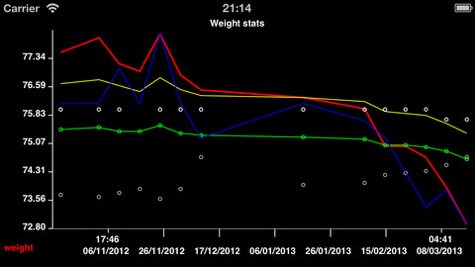
I’ve been using my Withings WiFi-enabled scale since 5 Dec 2009, at which point I weighed 246.9 lbs. Today, I weigh 183.5 lbs, and this scale helped me reach my goal. It shows weight, percentage or lbs of body fat, and BMI. Because it’s WiFi-enabled, the readings are picked up and displayed graphically on my Web page (password protected) at their site with the option to share it with other web-based weight loss sites. Moreover, I can use the data locally by downloading the readings in a format suitable for a spreadsheet.

I weigh daily, and the graph has greatly helped in my weight-loss efforts. Now I can easily see the trend, which helps manage it. I’ve had a series of scales that measure both weight and percentage body fat, including a couple by Tanita. As part of my weight loss effort, I did have some professionally administered body-fat measurements, and the Withings readings were consistent with that, within the limits of accuracy with respect to one’s daily weight fluctuations. If you have multiple people using the scale, it’s easy to set up multiple accounts (it has a maximum of 8 users).
suiviImageTop.png
One warning: I got a Roku, and in trying to get it set up with my router, I changed from G to N format, and for a few weeks lost readings from the scale because I wasn’t checking so regularly at that time. I used their support forum to diagnose the problem and reconnect my scale to my router. I would rate their support as excellent: they monitor the forum and respond immediately with answers.

The Withings was the first WiFi-enabled scale I found, and other than my own error in changing the router without thinking how it would affect my bathroom scale (you can understand that oversight, I hope), my experience with it has been uniformly positive. Highly recommended.

-- Michael Ham  

[Note: Withings recently released the WiScale application for iOS and Android that allows for remote viewing of data.--OH]

Withings WiFi Body Scale
$150

Available from Amazon

Manufactured by Withings


Omron HJ-112 Pedometer

omron-sm.jpg

I saw that the previously reviewed pedometer was unrecommended and thought I would recommend this one made by Omron. This pedometer is nice as it stores a week of data so you can see how you are doing the whole week if you wear it all the time. It is simple to clip on, and comes with an included safety leash for easy carrying.

Unlike some that have reset buttons that can get pushed inadvertently, I’ve never reset this one by mistake. The Omron also keeps track of aerobic steps.

I accidentally put mine through the washer and then dried it with a hair dryer and found that it still worked and remains a durable step tracker.

– Audrey Watson

Omron HJ-112 Pedometer
$22

Available from Amazon

Manufactured by Omron


Available from Amazon


Starting Strength

startingstrength.jpg

A barbell is the best training tool an athlete can use. The weight can vary from 10 lbs to over 1000 lbs in increments as small as 1/2 lb, and the set of available exercises is limited only by the lifter’s imagination. This makes training with a barbell suitable for pretty much anyone, regardless of age, sex, or experience.

Studies detailing injury rates show weight training to be as much as orders of magnitude less likely to cause injury than sports like running, cycling, football, and especially the most dangerous sport in America: soccer.

It can help prevent injuries by strengthening joints and bones, and creating more resilient tissues. With judicious use it can speed recovery from injuries that do occur. And it has even been shown to be effective in treating nagging ailments like back pain and certain kinds of arthritis. Being stronger also makes ordinary tasks much easier to accomplish. Everything from bringing in the groceries to playing with your kids to getting out of bed in the morning becomes easier as you get stronger. All of which means weight training may even be safer than not training at all.

That’s all great, but there’s a catch. Training with barbells has a skill component. To get the maximum benefit with minimum risk it’s best to understand and use good technique. But even before the invention of machine-based “health clubs” in the ’70s, instruction in the barbell lifts was best described as questionable, and most exercise instruction from luminaries like Bill Star and Mel Siff assumes proficiency with the barbell and works to create programs to allow people to continue to get stronger, or simply pushes people toward the “easy to use” but mostly useless machines.

With their book Starting Strength, Mark Rippetoe, a strength coach with almost 30 years experience in teaching novice lifters and a former competitive powerlifter himself, and Lon Kilgore, a competitive weightlifter and associate professor of kinesiology at Midwestern State University, are working to provide that missing information.

They cover five basic lifts — squat, bench press, deadlift, overhead press, and power clean — in amazing, well-illustrated, and readable detail. The chapter on the squat spans over 60 pages and covers not only technique but why to squat and how to identify and fix problems as they come up. The other exercises are covered in no less impressive detail, including some stellar and original thinking on the deadlift, and an effective basic training program to put everything together.

The authors even deal with such fictions as “squats hurt your knees” and “lifting weighs will make you bulky.” The simple answers to those objections are that if your knees hurt when you squat, you’re squatting wrong (or you have an existing injury), and that getting “hyooge” takes years of hard training, big eating, and, for many men and nearly all women, anabolic supplementation — i.e. steroids.

The now-out-of-print first edition was geared toward coaches, but because of the book’s cult popularity the second has shifted focus to self-instruction. Much of the book was rewritten to this end. It also includes an additional 100 or so pages on supplementary lifts and updates to the introductory weight training program.

I bought the first edition in the spring of 2006 and after a couple years using it, and now the expanded edition, to teach myself and friends and family to lift, I’ve found I don’t agree with the authors on some technical details of certain lifts. But without this book I wouldn’t have gained the knowledge to make those kinds of judgments.

As a budding Olympic-style weightlifter and former competitive cyclist, it’s the best $30 I’ve ever spent toward my training. And from Amazon to specialty weight training sites like EliteFTS, the reviews of this book are universally positive.

Save whatever you were going to spend on sports drinks over the next few weeks and buy this instead. It’s one of those books that belongs in everyone’s library.

-- Chris Roth  

Starting Strength
Mark Rippetoe and Lon Kilgore
2011, 3rd Edition, 347 pages
$30

Available from Amazon

Sample Excerpts:

startingstrength2.jpg

The back angle during the drive up form the bottom [of the squat] is critical to the correct use of the hips. The correct angle is produced when the bar is just below the spine of the scapula and directly vertical to the middle of the foot, the back is held tight in lumbar and thoracic extension, the knees are parallel to the correctly-placed feet, and the correction depth is reached, as discussed later.

*

startingstrength3.jpg

Incorrect (left) and correct (right) use of the hands and arms. Elbows should be elevated to the rear with the hands on top, not placed directly under the bar where they intercept part of the weight.

*

The vast majority of people will prefer to grip the bar with the thumbs-around grip. At lighter weights, this is fine since the load presents no problems to keep in place. But when heavier weights are being used — and, theoretically, they eventually should be — the thumbs can create problems.

The thumb should be placed on top of the bar, so that the wrist can be held in a straight line with the forearm. Most people have a mental picture of the hands holding up the weight, and this usually ends up being what happens. The bar sits in the grip with the thumbs around the bar, the elbows end up directly below the weight, and nothing really prevents the bar from sliding down the back from this position. People that do this will have sore elbows, a horrible, headache-like soreness in the inside of the elbow that makes them think the injury occurred doing curls. If the elbows are underneath the weight, the force of the weight is straight down (the nature of gravity is sometimes inconvenient), then the wrists and elbows will intercept some of the weight. With heavy weights, the loading is quite high, and these structures are not nearly as capable of supporting 500 lbs, as the back is. If the thumb is on top of the bar, the hand can assume a position that is straight in line with the forearm, wrist, and hand, and all of the weight is on the back. A correct grip can prevent these problems before they start. If you learn to carry all of the weight of the bar on the back before your strength improves to the point where the weight becomes a problem, you’ll have no problem at all.


BodyMedia FIT Armband

bodymedia-sm.jpg

I’ve been using the BodyMedia FIT armband for the past 3 months and it is the only diet and exercise system that I’ve found that really works. The system works through the use of an armband that you wear on your left arm throughout the day. As you go about your regular routine the armband measures your caloric burn. The armband uses four sensors to track over 9,000 variables from heat to sweat to steps to calories burned every minute of every day.

You can track your daily burn and steps taken through an optional display, but the real power is in syncing the armband to the BodyMedia web site which allows you to see charts of calories burned per minute, steps taken, exercise levels, sleep cycles, etc. You can also track your weight measurements in the tool. The great thing about the online tools is that it lets you enter your daily caloric intake (just search for a food and add it to a meal), and compares your incoming calories to outgoing calories. By entering your calories on a daily basis you can ensure a realistic caloric deficit which is guaranteed to help you lose weight safely. It’s very helpful for making sure you don’t starve yourself by eating too little, or conversely, that you don’t go crazy and eat too much.

Since I started using the armband I’ve dropped 20 pounds that I’ve managed to keep off with almost no trouble. It’s become pretty simple for me. I can eat a healthy but normal breakfast and lunch, then I check my calorie burn before dinner and make sure to eat the appropriate amount to ensure I maintain my target calorie deficit.

What I love about this tool is that it eliminates estimation. Everyone has different basal metabolic rates depending on what they do during the day. Whereas most diet systems target a fixed number of daily calories, those fixed amounts could mean anywhere from a 500-2500 calorie deficit depending on the person. Anyone who’s dieted knows that when you get into high calorie deficits you’re body stops losing and you go into the so called starvation mode where your body actually holds onto the weight. With this that never happens. If I have a lazy day at work and am on target to burn 3200 calories then I know I can eat 2200 and maintain my 1000 calorie deficit. But say, I go for a long run on the weekend and do some yard work I could get up to 5500 calories burned. If I stuck with a 2200 calorie diet, my body (and my willpower) would rebel. However with BodyMedia, I know that on those 5500 calorie days I can eat 2000 more calories and still be on target for weight loss.

Long story short – I absolutely love this system.

-- Marc Ryan  

[Note: There is an even more thorough review of the system over at Ars Technica.-- OH]

BodyMedia Fit System
$150 (includes 12 month subscription to the BodyMedia site)

Available from Costco
Manufactured by BodyMedia


Kettlebells

kettlebells.jpg

Kettlebells are used for exercise and training. They look like a cannonball with a handle, come from Russia, and provide a great workout focused on whole-body exercise (rather than muscle isolation), with great benefits for strength, cardio, stamina, and flexibility. Unlike regular weights, the kettlebell’s center of mass is extended away from the hand which is optimized for a variety of different movements including swinging.

I specifically like exercises that work the entire body. The kettlebell does that and allows a continuous routine of various exercises without having to stop and change equipment. Moreover, you can do quite fine with a single kettlebel. You can start with a 1-pood (16.6 kg, or 35 lb) or lighter kettlebell and for many that will be enough. These weights take up little room, will not break down or wear out, and require no batteries.

-- Michael Ham  

[The founders of Cross Fit have published a useful guide for proper kettlebell swinging form.-- OH]

J FIT Cast Iron Kettlebell
$54 (30 lbs)

Available from Amazon

Manufactured by JFIT