



The Sun: Rise and Fall

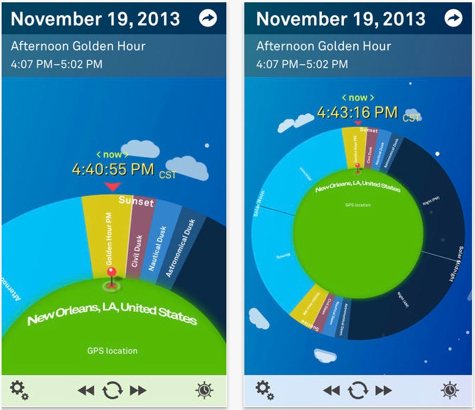
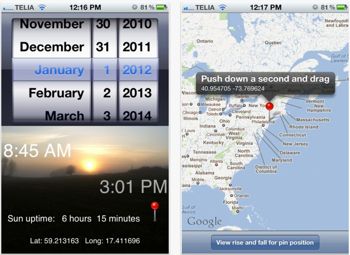
This is a dead-simple iOS pp, whose sole function is to tell you what time the sun rises and sets. It has a scroll wheel in the upper right hand corner you can use to scroll backward and forward to see the sunrise and set times on a given day. It also shows the time until sunset during the day, and the time until sunrise at night, as well as the total hours of sun uptime. You can set it to show moonrise and fall, as well as the phase of the moon. There’s an icon for the current weather, and the highs and lows for your area are displayed as well. It’s not as useful as a full-fledged weather app though, but it does give you a nice idea of what it’s like out there.

I find it useful for knowing when to let my very spoiled pet chickens out of their coop, and getting some idea of when they’ll stop laying for the winter, and start up again in the spring. You can localize it fairly easily. If you are traveling and need to know the various rise and fall times for, say, scenic Ulan Bataar, you touch the map icon and move the pin there. Sure, I can look out the window and find out what’s happening now, but for precise information for other times and places, this app is marvelous. And I can do things like discover when the actual equinox is at my house. Turns out that we get 12 hours of daylight and 12 hours of night on March 17th.

-- Amy Thompson  

The Sun – Rise and Fall for iOS
Free


Indoor/Outdoor Humidex Thermometer

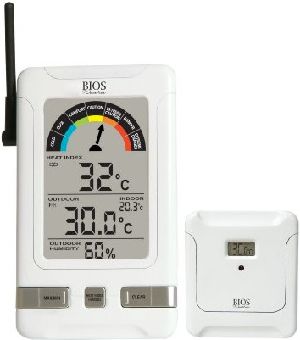
We plan activities around weather forecasts. However, the information is often from sensors far from our location. I want data from my backyard with the convenience of not having to go outside to read it. I have been using the wireless Indoor/Outdoor Humidex Thermometer for over two years. It is perfect for my needs. I have placed it in a central location in the house and I take a glance at the readings every time I pass it (at least ten times a day).

Setting it up is a snap. First insert two AA batteries into the back of the monitor and two more into the remote outside sensor. Press the reset button on both and you should begin receiving data which is displayed on the monitor. Look for a suitable place to locate the sensor. A shady area is recommended for accurate readings. The maximum transmission range is 45 meters but that is in open spaces. Walls will cut down on the separation distance. A signal detector icon indicates how strong the connection is between the two devices. Using this will help you find the best place to put each of the two gadgets. The remote sensor is splash proof but it should not be exposed to heavy rain. I have put mine under the eaves of my garage. The monitor can be mounted on a wall or placed on any flat surface.

This particular model is perfectly suited for cold Canadian weather. The remote temperature sensor is good for -50°C to 70°C (-58°F to 158°F). The main difference between this monitor and the competition is that this model provides decimal temperature readings, which is a rarity. A temperature of 16.6°C to 17.4°C would register as 17°C on most monitors. I appreciate this precision because I am sure I can tell the difference between these two readings. On the monitor there is a battery indicator icon, letting you know when the power is starting to go. The batteries should last about 12 months.

Besides the indoor/outdoor temperatures, the monitor also displays the outside humidity and a “Humidex” index to indicate how comfortable/uncomfortable the temperature really is outside.

-- Marcel Dufresne  

Thermor Bios Indoor/Outdoor Humidex Thermometer
$32

Available from Amazon

Manufactured by Thermor


Manual of Field Geology

geology in the field.jpeg

This book is an essential guide to how field geology should be practiced. It is simple, clear, and written in a style which is accessible to students and amateurs. Jargon is limited to the irreducible and there is no effort to obfuscate. I have been using this all my professional life of more than 30+ years.

Using this manual and a fairly rudimentary set of basic geologic skills, outcrop and contact geologic maps can be produced, complete with cross-sections. There is no better resource for those interested in learning more about field geology.

-- Edward Bryant  

[For those interested in a narrative take on American geology, look no further than John McPhee's epic and accessible Annals of the Former World. A worthy read!--OH ]

Geology In The Field
Robert R. Compton
1985, 416 pages
$60

Available from Amazon

Older editions available used for $1 from Alibris

Sample Excerpts:

Lithologic Patters For Stratigraphic Columns and Cross Sections.jpg
Appendix 8. Lithologic Patterns for Stratigraphic Columns and Cross Sections

*
Geology in the Field appendix 8.jpg
Appendix 3. Percentage Diagrams For Estimating Composition By Volume (p. 366)


WeatherSpark

weatherspark.jpg

WeatherSpark is a website that has changed how I look at the weather. Like most other weather sites it provides a local forecast based on a variety of data sources including NOAA (there are international data sources for those outside the US). Unlike some other sites, like Weather Underground or Weather.com, WeatherSpark is built on the idea that the user should control what data is displayed using either real-time data or historical trends.

The user interface, while at times overwhelming in the number of options it provides, is straight forward and very useful. You can quickly expand or reduce your date range from hourly to daily to weekly to monthly and even to years. While this may not seem particularly useful on a daily basis, it is incredibly useful when planning trips and events in the future (and while it won’t predict the weather, the historic trends are useful for having a “best guess” of what the weather will be like).
weatherspark 2.jpg
Not only can you control the timeline, but you can also toggle maps (with radar), text-based weather reports, and climate trends. They offer a plethora of graphed weather variables including dew point, wind direction, precipitation amount, precipitation rate, humidity, sun rise/set, and pressure among others. For those people who just want to know if it’s going to rain, the level of customizability in the data visualization will be overkill. Conversely, this site may not be hardcore enough for weather nerds more interested in data mining than visualization.

For me, WeatherSpark has proven to be a powerful tool, and one I use on a weekly basis to assist my environmental intelligence. I’ve used it to compare precipitation amounts and average night time temperature in multiple locations in order to predict mushroom fruiting patterns (and I imagine if I were a gardener it would be just as indispensable for starting beds). Not only that, but my fiancée and I are now using it to pick a date for our outdoor wedding in Wisconsin in order to minimize the chance of a washout (or heat wave). For those interested in digging a little bit deeper into weather systems, I can’t recommend WeatherSpark strongly enough.

-- Oliver Hulland  

Sample Excerpts:

pacifica weatherspark.jpg
The diversity of weather variables that one can graph is impressive, and made even more useful by little things like the clever icons used to indicate wind direction.


Western Birds’ Nests + Eastern Birds’ Nests

kknests.jpeg

The baskets and fabrics made by birds are as admirable as their feathers. For years I’ve collected bird nests (a few in the image above) without knowing much about them. It took one obsessive Hal Harrison to find and photograph all of the nests and eggs of the birds in North America before I could begin to identify them.

Unfortunately, there is no real taxonomy for nest types, so identification is still a somewhat trial and error visual match. Environmental context — where a nest is found — is a bigger ID factor. But with some sleuthing in this book (two volumes, east and west) I’ve begun to identify species of nests. That has enlarged my appreciation of birds.

Oh, and these catalogs of many hundreds of nests also serves as splendid inspiration for human weavers.

-- KK  

Peterson's Books.jpg
Western Birds’ Nests
Hal H. Harrison
1979, 279 pages
$14
Available from Amazon

Eastern Birds’ Nests
Hal H. Harrison
1998, 288 pages
$13

Available from Amazon

Sample Excerpts:

The site at which the nest is located is often diagnostic. While some species will choose a variety of sites, many are highly specialized, and this is important in identification. Water Pipits nest on the ground in tundras; Chimney Swifts nest in chimneys, and White-throated Swifts nest in steep cliffs; all wood-peckers nest in tree cavities and so do Prothonotary Warblers; storm-petrels, kingfishers, and Bank Swallows nest in burrows; MacGillivray’s Warblers nest in low bushes while Olive, Hermit, and Townsend’s Warblers nest high in conifers; orioles build beautiful hanging baskets but Poor-wills build no nest at all.

*
The nest itself is described in detail. Material used will vary with availability. For some species this has been noted, but readers should bear in mind that Spanish Moss would be no more available to a bird in Montana than spruce needles would be to a bird in the Rio Grande Valley of Texas. The basic structure of the next of most species is so uniformly true to type that even though the materials used may vary, the format generally does not. An American Robin’s nest in Washington or Oregon with mosses built into it still looks very much like a Robin’s nest in Arkansas with mud and grasses predominating.
*
nest types.jpeg


Mushrooming Without Fear

mushrooming-wo-fear1sm.jpeg

Can you tell the difference between a head of cabbage and a head of lettuce? Then you can safely pick and eat some wild mushrooms. The key is to learn to identify a few easily identifiable delicious species, and then stick with these easy ones for a while. This book does a fantastic job of holding your hand every step of the way. It gives you reliable rules for learning 10 or so yummy and safe mushrooms. I wish I had this book when I was first starting out. It is a great substitute for going out with an expert.

-- KK  

Mushrooming Without Fear
Alexander Schwab
2006, 128 pages
$10

Available from Amazon

Sample Excerpts:

Rule number 1: never, never take a mushroom with gills!!! This is our life insurance.

Rules number 2: Only take mushrooms with tubes, spines and ridges and the mavericks portrayed in this book. This means thoroughly understanding the information on pages 18-27 of this book.

Rule number 3: Only eat mushrooms which you have clearly identified with ALL of the positive ID marks. The mushrooms you take must be a certain size in order to show all the identification marks. In their baby stage, so to speak, some deadly and poisonous mushrooms are almost indistinguishable from harmless species.

*
mushrooming-wo-fear2sm.jpeg
These are summer ceps. However all ceps, summer or autumn, show a fine white network on the top of the stem right underneath the tubes.
*
mushrooming-wo-fear3sm.jpeg


Meteorite Hunting

meteorite-hunting1sm.jpeg

Who can resist the search for alien specimens from space? Most meteorites are small pebbles; they drop all over the planet but are most easily detected in deserts, or in fallen clusters. Finding them requires metal detectors, maps, jeeps, software simulations, chemical analysis, airplane tickets, patience and a lot of luck. The practical lore in this slim how-to manual was previously known only by the close-knit club of professional meteor hunters. As far as I can tell, this is the only book on how to find meteorites; even the web doesn’t contain the useful details this guide does. Its 84 color pages discuss the gear, the techniques, and the logical tricks needed to find and excavate a metallic needle in a geographic haystack.

The author is one of the stars of Meteorite Men, a TV series which documents the adventures of he and his buddy as they hunt for meteorites in exotic photogenic locations around the world. While meteorite hunting is rarefied hobby right now, it is becoming increasingly regulated as it gains in popularity. Meteorites fall to the ground everyday, but statistically the ones you find will be ancient – a fossil in fact, like gems. You need to obey the local laws even though space rocks are just sitting on (or below) the ground waiting to be picked up. The hard part is still finding them, which this guide will help.

-- KK  

Meteorite Hunting
Geoffrey Notkin
2011, 84 pages

Available from author’s site
http://meteoritehunters.tv/
$25

Sample Excerpts:

If you are going to start hunting for meteorites, the one thing I can guarantee is you are going to find meteorwrongs. Your metal detector can only tell you so much; you need to do the rest.

Metal detectors that are used for hunting meteorites are calibrated to return a signal when they find iron. Sophisticated modern hand-held detectors such as the Fisher F75, a personal favorite of mind, have the capability to distinguish between different types of metal.

Picking a meteorwrong from the surface is one thing; digging one up from several feet underground is another. It can be tiring and discouraging to spend half an hour toiling through hard ground with a muddy shovel only to reveal a foot of rusty pipe. That is why, when people ask me what you need in order to be a successful meteorite hunter, I say: “Determination.” Be prepared to dig up a lot of trash on your way to finding meteorites, especially in areas that have been farmed, mined, or were once settled.

*

A “hot rock” is a terrestrial stone that sets off a metal detector. It is an old gold prospector’s phrase that has been adopted by meteorite hunters. Is is very important to remember that there are many different types of earth rocks that contain iron, so if your target turns out to be stone, rather than man-made iron trash, do not automatically assume that it is a meteorite.

meteorite-hunting2sm.jpeg

The common terrestrial iron oxide hematite is often mistaken for meteorites b novices. Hematite typically does not show any attraction to a magnet and will usually leave a red streak on a white ceramic tile, while an iron meteorite will leave little or no streak. The surface features on some hematite specimens also have a visual resemblance to regmaglypts.

*
meteotite-hunting3sm.jpeg
Excavating a complete 870-gram stone meteorite in the Gold Basin strewnfield. While the exposed surfaces had weathered considerably, fusion crust and regmaglypts were present on the buried sections. It turned out to be the best-preserved fusion crust we had ever seen on a Gold Basin specimen.

*
The glowing fireballs we see in the sky are caused by atmospheric pressure and friction, but meteors stop ablating while they are at least seven miles high. If you are lucky enough to witness a bright fireball, and it begins dark flight while approaching you or directly overhead, it is possible that meteorites will land nearby. When a fireball apparently lands in the vicinity what we are usually seeing is it arcing away over the horizon, still high up in the atmosphere. Due to the curvature of the earth, the fireball may seem to hit the ground, but has in fact just moved out of our field of view and gone beyond the horizon. because of their extreme brightness, fireballs can appear — to our human eyes — to be much closer than they really are. It is something I, myself, have been fortunate enough to witness a couple of times, which can be frustrating because it does look as if meteorites landed “just over there.” If anything made it to the ground, however, it probably landed hundreds of miles away.

*
meteorite-hunting4sm.jpeg

A new Nevada stone meteorite lying exactly where it was found. Note the relatively fresh, black fusion crust, indicating a fairly recent fall.


Kaufman Field Guide to Insects

kaufman-insects-sm.jpg

This is the all-around best one volume field guide to insects in North America. It employs retouched photographs for the images and includes representative profiles at actual sizes, which are very handy. The most difficult task for a guide like this is helping you find your way through 2,350 pictures of bugs. Its solution is a rough categorization of 13 body types, which are fairly easy to browse visually, so generally we’ve been able to identify most of what we find to the genus level. (Species level identification of an insect often requires more information and a microscope. This book assumes you are doing “naked eye” identification.) It is more up-to-date and comprehensive than other equivalent guides. It is also backpackable and ruggedly made. All-in-all a solid dependable guide to this vast kingdom of life.

-- KK  

Kaufman Field Guide to Insects of North America
Eric R. Eaton, Kenn Kaufman
2007, 392 pages
$13

Available from Amazon

Sample Excerpts:

kaufman-insects2sm.jpg

*

kaufman-insects3sm.jpg


The Sibley Guide to Trees

Naturalist David Sibley, like Tory Peterson before him, made his reputation painting and annotating birds before expanding to other biological realms. Sibley’s guides to birds and bird behavior (recommended on Cool Tools) are the best all-around guides to the birds of North America. Sibley’s beats out Peterson’s, and the dozens of others published today. Sibley’s newest book, also written and illustrated by him, is the best all-around guide to the trees of North America, again displacing the many other field guides to trees in print.

Sibley’s illustrations are clear, crisp, and accurate. He manages to maintain distinctions in tree types where species get fuzzy, like in the oaks, or firs. His maps are specific. He includes more parts of the tree than most guides — buds, bark, branches, seeds, silhouettes, flowers, cones, etc. — which really help in identification. And he includes not only native trees but many feral varieties, and even widely planted ornamentals. One detail I appreciate: he lists alternative common names to trees, since trees seem to have local names.

With Sibley’s guide I’ve been able to identify more trees than with other guides. However the book is big, not at all pocketable, or the kind of thing you are likely to take with you into the field on a hike. Perhaps future editions might remedy this. I use this quality softcover edition (a delight to browse) by taking samples and photos outside and returning home to identify.

-- KK  

The Sibley Guide to Trees
David Allen Sibley
2009, 426 pages
$24

Available from Amazon

Sample Excerpts:
Sibley7.jpg

*

Sibley143.jpg


KozyFill

I sent one of these to a friend who lives in Tasmania. She has a wonderful assortment of southern hemispherical birds that she likes to feed and provide water for, but she travels on a regular basis, and the birds empty the bath in a day. She tried various home-brew ideas for automatically filling the bird bath, but none really did the trick for her. Also, this one’s the most aesthetically pleasing I could find, as the reservoir sits separate from the bird bath.

kozyfiller2sm.jpg

I sent her the KozyFill, she set it all up, fine-tuned the height of the various tubes, and voila! She’s got a yard full of happy Eastern rosellas, wattle birds, the occasional cockatoo, and other sundry birds of the Antipodes. Watching the birds beats TV any morning: you’ve got drama, conflict and humor in dazzling color right outside the bedroom window.

-- Rick Turner  

KozyFill Automatic Bird Bath Filler
$54

Available from Amazon

Manufactured by Allied Precision

[Plans for a homemade automatic bird bath purger-filler by James M. Clark here. –es]