Become a Patron!Support our reviews, videos, and podcasts on Patreon!
Cool tools really work.
A cool tool can be any book, gadget, software, video, map, hardware, material, or website that is tried and true. All reviews on this site are written by readers who have actually used the tool and others like it. Items can be either old or new as long as they are wonderful. We post things we like and ignore the rest. Suggestions for tools much better than what is recommended here are always wanted.
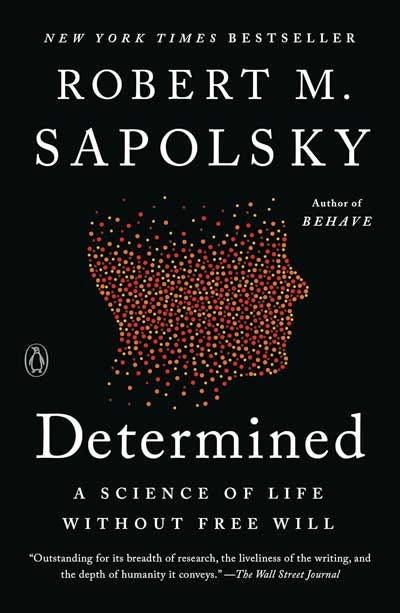
Stanford neuroscientist Robert Sapolsky mounts a full-frontal assault on free will, arguing that every choice you’ve ever made — from the mundane to the momentous — was the inevitable result of biology and experience you didn’t choose. Far from nihilistic, Sapolsky shows how accepting this reality could make the world more humane.
Core Principles
You Are the Sum of Luck You Didn’t Choose
We are nothing more or less than the cumulative biological and environmental luck, over which we had no control, that has brought us to any moment. Your genes, your prenatal environment, your childhood, your hormones at breakfast, the neuron that fired a millisecond before your decision — none of it was chosen by some separate “you” standing outside the causal chain.
Your Brain Decides Before “You” Do
Neuroscience experiments show that brain activity precedes conscious awareness of decisions by hundreds of milliseconds. By the time you feel like you’re choosing, your neurons have already voted. What we call “free will” is just the biology that hasn’t been discovered yet — another way of stating that we’re biological organisms determined by physical laws.
Childhood Sculpts the Adult Brain
Essentially every aspect of your childhood — good, bad, or in between — sculpted the adult brain you have. The person who exercises remarkable self-control and the person who can’t resist temptation aren’t making different choices with equal willpower. They have different brains, shaped by factors neither one selected. It’s impossible to successfully will yourself to have more willpower.
No Justifiable “Deserve”
If behavior is determined by factors beyond our control, the concept of moral blame becomes questionable. There is no justifiable “deserve” — you are no more entitled to have your needs met than any other human. This doesn’t mean abandoning consequences, but it means rethinking punishment, praise, and the stories we tell about success and failure.
Try It Now
Think of something you’re proud of — a success, an achievement, a good habit. Now trace backward: What circumstances, people, genes, and luck made that possible? How much was really “you”?
Notice the next time you judge someone — including yourself — as lazy, weak, or bad. Pause and ask: Am I assuming they had a choice they may not have had?
Consider one area where you struggle with willpower. Instead of blaming yourself, ask: What environmental change could make the desired behavior easier?
Reflect on whether accepting determinism feels threatening or liberating. What would you lose? What burden might you set down?
Quote
“We are nothing more or less than the cumulative biological and environmental luck, over which we had no control, that has brought us to any moment.”