Book Freak #217: The Nature of the Physical World
Arthur Eddington on the Strange Gap Between Science and Experience
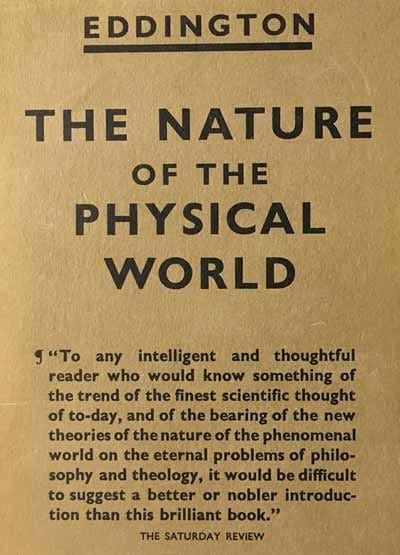
Get The Nature of the Physical World
The Nature of the Physical World was written by the astrophysicist who confirmed Einstein’s relativity. It explores how modern physics has dissolved the solid world we thought we knew into something far stranger, and more connected to mind than we imagined. You can get it for free from Project Gutenberg.
Core Principles
1. You Are Sitting at Two Tables
Eddington opens with a famous thought experiment: he is writing at two tables. The first is the familiar one: solid, colored, substantial. The second is the scientific table—mostly empty space pervaded by electrical particles rushing around at great speed. Both descriptions are true. The solid table you lean on is, at the atomic level, almost entirely nothing. We live in both worlds simultaneously.
2. The Physical World Is a World of Shadows
In removing our illusions, physics has removed the substance, for substance was one of our greatest illusions. What remains is a shadowgraph performance of familiar life. The shadow of your elbow rests on the shadow table as shadow ink flows over shadow paper. It’s all symbolic. Then comes consciousness, which transmutes the symbols into experience.
3. Mind Is the First and Most Direct Thing
It is difficult for the matter-of-fact physicist to accept that the substratum of everything is mental in character. But no one can deny that mind is the first and most direct thing in our experience, and all else is remote inference. We start with mind and infer matter.
4. The Stuff of the World Is Mind-Stuff
Eddington’s most provocative claim: the stuff of the world is mind-stuff — something more general than our individual conscious minds, but continuous with our mental nature. The physical world is abstract and without actuality apart from its linkage to consciousness. Actuality, like beauty, requires a mind to be known.
Try It Now
- Look at the table or desk in front of you. Hold both truths at once: it is solid to your touch, and it is mostly empty space. What does this do to your sense of certainty?
- Notice that everything you know about the “external world” comes through your consciousness. Can you find anything you know that doesn’t?
- Consider: physics describes relationships and patterns, not ultimate substances. What would change if you stopped assuming there must be “stuff” underneath it all?
Quote
“It is difficult for the matter-of-fact physicist to accept the view that the substratum of everything is of mental character. But no one can deny that mind is the first and most direct thing in our experience, and all else is remote inference.”
Book Freak is published by Cool Tools Lab, a small company of three people. We also run Recomendo, the Cool Tools website, a YouTube channel and podcast, and other newsletters, including Recomendo Deals, Gar’s Tips & Tools, Nomadico, What’s in my NOW?, Tools for Possibilities, Books That Belong On Paper, and Book Freak.
07/10/26