Book Freak #221: Ways of the Six-Footed
Anna Botsford Comstock on the Dignity of Life’s Upward Struggle
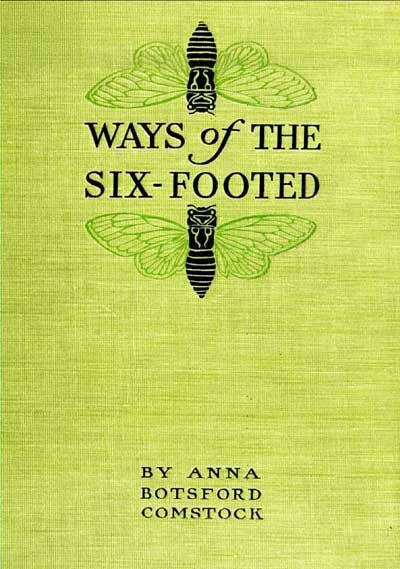
I came across Ways of the Six-Footed, a collection of essays by Anna Botsford Comstock, Cornell’s first woman professor, while visiting the Museum of Jurassic Technology in Los Angeles. The museum has a nice reading library, and I was drawn to the book’s design and title.
I read it for about an hour, captivated by Comstock’s portraits of bees, ants, crickets, and caterpillars and the ways they solve the problems they face. I went home and ordered a copy, and it has stuck in my memory for over a decade.
Core Principles
1. Every Life Confronts Problems
The young Viceroy caterpillar eats a leaf down to its midrib and rests on the bare stem during the day, where birds could find him. “He fastens with a silken thread a little bunch of débris to the bare stem between his feeding-place and his resting-place. This is a clever performance; for if one of his foes should be hunting on this leaf and should start out on the denuded stem it would meet with this empty and worthless mass and would naturally be discouraged from further investigation.”
2. Observe the Humble to Learn the Grand
The Little Carpenter Bee nests inside a broken twig of elder or sumac. “Our heroine, with the aid of her mandibles or jaws, commences to excavate a tunnel in the branch by removing the pith mouthful by mouthful… we might compare her to a man who should attempt to dig a well three or four feet wide and two hundred feet deep, and with no tools except his hands with which to remove the earth.”
3. The Individual Serves the Whole
A young ant’s first job after it emerges is to care for the colony’s larvae. “When the ant babies are hungry they stretch up like young birds, and their nurses regurgitate partly digested food into the gaping, hungry mouths… When the sun shines hot on the nest in the morning the nurses carry their charges to the lower compartments, but toward night they carry them again to the upper nurseries.”
4. Go Back and Do Your Part
Comstock pried the maple-leaf cutter caterpillar’s tiny leaf tent loose and left it upside down, to see what he would do. “He crawled halfway out upon the leaf and by a dexterous lift of the rear end of his body he brought the tent down right side up and at once began pegging it down… He had spun his silken cords so they formed an X.”
Try It Now
- Go outside and observe a spider, insect, or other small creature. What problem is it trying to solve?
- Think about your own behavior. What are you trying to solve? The next time you face an overwhelming problem, think about how a solitary or social insect works through its problems one step at a time. How could you break your big problem into a set of smaller ones?
- If you’re waiting for conditions to be perfect before you act on a project, think about how animals build shelter from whatever materials are at hand. What do you have at hand, physical, conceptual, or social, that you could use?
- Some insects succeed through sheer persistence. That might be the only thing you need to add to solve your problem.
Quote
“I felt inspired to go back and serenely do my own little part as well as I could, trusting that somehow, somewhere, and to Some One the net proceeds of struggle are greater than the cost.”
Book Freak is published by Cool Tools Lab, a small company of three people. We also run Recomendo, the Cool Tools website, a YouTube channel and podcast, and other newsletters, including Recomendo Deals, Gar’s Tips & Tools, Nomadico, What’s in my NOW?, Tools for Possibilities, Books That Belong On Paper, and Book Freak.
10/9/26