Book Freak #229: The Social Construction of Reality
A discusion betweem the authors of “The Quantified Self” and ”The Great Remembering”

In the early 1990s, I was an editor at Wired. It was an exciting time because the internet was new to most people. My colleagues were young, creative, curious, and smart, but two of them stood out: Gary Wolf and June Cohen.
At Wired, Gary wrote some of the magazine’s best long-form features, including the incredible saga of Ted Nelson’s Xanadu hypertext system, which I mentioned in The Magnet. At Hotwired, June developed many of the templates and best practices for the early web that still shape the web today. She later co-founded TED Talks.
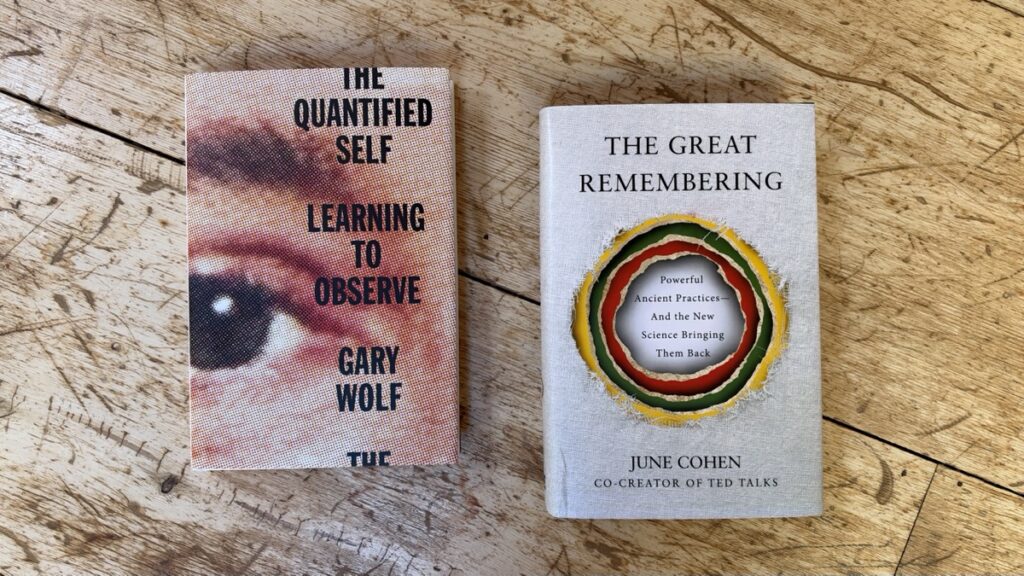
On November 4, June and Gary came to Village Well Books & Coffee in Culver City to talk about their new books. Gary’s is The Quantified Self: Learning to Observe. June’s is The Great Remembering: Powerful Ancient Practices — and the New Science Bringing Them Back. The books have fascinating things in common, and that’s what Gary and June talked about that evening. They also took questions from the audience.
Below is a cleaned-up transcript of their talk, along with the audience questions.
JUNE: Could you define the quantified self for people here?
GARY: The quantified self originated in a community that came together to share how they were learning about themselves through their own data. Self-tracking, self-measurement: what do you do, how do you do it, and what do you learn? Over time, it became a knowledge-sharing community. Quantified self practice, which we also call personal science, brings a scientific mindset to everyday life.
Why so much science?
GARY: Ancient practices don’t necessarily need science. They didn’t originate with science. Why is there so much science in this book?
JUNE: First of all: It’s funny to be talking to you about the past, because my whole life I’ve been a girl in the future. I put TED Talks online when YouTube was three months old. But I stopped believing that technology could solve the world’s problems, and I started wondering what the ancients could teach us about how to live today.
Second… I didn’t set out to write a science book. I set out to write a book on ancient wisdom. It was probably a year in, and I was like, “Oh, I think I’m writing a science book.” So many of the practices I was looking at are validated by new science. They weren’t superstitions or even traditions. They were very specific solutions.
Scientists in Finland were the first to prove, only about 12 years ago, the profound health benefits of the sauna and the cold plunge. Before that, it was actually thought that the sauna was really dangerous for your heart. In fact, it’s great for heart health, your lungs, and preventing dementia. Scientists in Japan, around 15 years ago, were the first to prove the physiological benefits of forest bathing, or time in nature. If you spend just 20 minutes in the green space of a park, not even wilderness, you will lower your cortisol, your inflammation, your blood pressure. You’ll improve your mood and your sleep. If you increase it to an hour, you’ll increase your working memory by 20 percent.
Science is how we skeptical Westerners believe what we know in our bodies. I grew up in a house surrounded by trees that my dad planted with his own hands. When I read the forest bathing studies, I was like, I know in my bones that that’s true. And now science tells me it’s true. I can prescribe it to myself now.
Science belongs to all of us
JUNE: How are you talking about science in your book, Gary?
GARY: In your everyday life you’re not submitting your ideas to peer review, nor are you waiting 5 or 10 or 15 years for them to become consensus knowledge. So I use science as a synonym for empirical practice: observing, reasoning, and explaining.
Science is a skilled practice. There are concert pianists; there are people who make money playing sports. You have professional scientists with tremendous skills. But if nobody did music unless you were a professional concert musician, there would be no cultural foundation. People use empirical practice to troubleshoot all kinds of things, like when they’re putting their hand on a child’s forehead. But when it comes to our health, we ofust stay in trial-and-error mode.
One of the things that’s really troubling about trial and error is that you do something, and it works, and it makes you super happy. Then, after a while, it stops working. Now you have a question. Did it not really work? Or did it work for a while and then stop because something else changed? That’s where a scientific mindset can really help.
Why cold water feels so good
GARY: I was interviewing a man on the very northern coast of Poland, on the Baltic, in January, when there was snow on the beach. He said, ” Okay, now we’re gonna go swimming.” I thought, ” Today is my day; I’m going to die. He said, “You had a very big chance of dying on the road behind that farm equipment, but going into this water, you’re not going to die.” So I went in, and I experienced the most intense euphoria. It’s in the top ten most euphoric experiences I’ve ever had in my life. Could you explain why?
JUNE: We think of the sauna and the cold plunge as pampering. But to the ancients it was a revolutionary, life-saving technology. It appeared for at least 10,000 years across five continents in exactly the same form: the Finnish sauna, the Russian banya, the Japanese mushiburo, and the Native American sweat lodge. And always paired with cold water. High heat kills microbes. Cold kills inflammation. It also fills you with a flood of good feelings.
After the pandemic especially, everyone was cold plunging and saying it was great for their depression, their anxiety, their trauma. And there was no science. None. Science had only been asking: “Can cold water kill you, and how fast?” Not, “Can cold water cure your depression?”
I lay out in the book about ten things that happen when you get into cold water that help your mental health. If you have ruminating thoughts, cold water immediately pulls the plug on them. Try it in a cold shower. Then you have this flood of adrenaline. Colors seem brighter, and sounds are louder. You feel super alive. Then you have a rush of endorphins, your body’s own pain reliever. But endorphins don’t only relieve physical pain. They relieve mental pain. They calm your fear center and give you a sense of elation. It’s why endorphins cause the runner’s high. And you’ve also done something really challenging, so you have that emotional triumph.
I went to Europe for the wild saunas, perched on riverbanks, in Oslo harbor, and on Brighton beach. Going from a sauna on a river’s edge, with the smell of the cedar and the prickly heat, into a river where it’s cold and loud and it hurts. I hate the cold. But then you get out, and you’ve never felt more alive. That’s one of the top two experiences of my life.
Small discoveries
JUNE: Tell us a few stories of how people do personal science.
GARY: There’s a story in the book about a computer scientist who’s tracking his diet. He changes a few things, and he loses weight slowly, nicely, effectively over a couple of years. Then, for unexplained reasons, his weight starts to come back. He has calendar entries showing where he’s working: part-time in Pennsylvania and part-time in California. He finds out that he gains weight entirely when he’s in California. California is supposed to be healthier than Pennsylvania, but in this case it was not. Then he finds out he gains all the weight when he spends weeks at a certain desk in the building. He hasn’t changed his habits, but he’s around different snacks at the snack station.
Another one I love is a soccer coach who is also a high school counselor and ends up concussed. One symptom is irritability, and you can’t be irritable if you’re a high school counselor. She goes to psychotherapy, and they get into what’s making her angry, but she knows that’s probably not the answer, because it only happened after her concussion. She kept very good but relatively simple notes about when she felt the most irritated. They were almost all in the late afternoon, in the winter in the Southwest. Where she works, there are big windows, and very harsh light came in starting around three o’clock.
Nobody’s going to win a Nobel Prize for discovering “I’m especially irritable around these open windows at three o’clock in the Southwest.” But it’s extremely important, because you could go down a completely different path and spend a long time on it without making any progress.
I can’t resist one little anecdote. A psychology professor, Allen Neuringer, kept track of his research ideas on index cards. He noted on the back whether he was sitting down or walking around when he had the idea. He put them in a drawer and waited months. Then he pulled them out, only looked at the front, and put them in two piles: still a good idea, no longer a good idea. You have better ideas when you wander around.
Learning to observe
GARY: The book’s subtitle is “Learning to Observe.” There are an infinite number of things you could observe, so the skill is deciding what to observe. Headaches seem really obvious. You feel them. But how long do they last? If I had one for a while and then noticed it again, is that one headache or two? One solution is for people to track how many aspirins they take.
A lot of people in quantified self had scientific and technical skills, and sometimes their skills actually got in their way. They’d say, “I have a digestion problem; I’m going to track everything I eat.” It’s a big ask. After a couple of weeks of trying to track every single thing you put in your mouth, you’re very likely to give up. So focus on what you can track that’s relevant, varies a little, and is noticeable and measurable. If you can keep track of that, you’re really on your way.
JUNE: It reminds me of a saying I’ve heard from a Chinese medicine doctor I go to: 80 percent is perfection. If you try to do everything, you’ll exhaust yourself and burn out.
From the audience
Q: I’ve heard just putting your face in cold water is helpful. Is that the same as a cold plunge?
JUNE: There’s something really interesting and weird about putting your face in water. It’s actually the exact opposite response. When you go into cold water, your body is asking, “How do I not die?” But when you put just your face in cold water, it’s called the mammalian diver response. When our distant ancestors would dive into the water, their bodies would calm so they could preserve their air. So when I do a cold plunge, I don’t dunk my head. But if you then dunk your face, it gives you this double action: awakening the body while calming it at the same time.
Q: What habits do you do differently?
GARY: I have this very easy background record-keeping. It’s just sitting there for when I need it later. People ask me what the value of wearable devices is, because they don’t actually tell you that much. To really learn something, you have to decide what you want to observe and ask your own questions. But they’re really nice for background data.
JUNE: What I’ve learned about endorphins has completely changed my life. We get double endorphins when we do things together. They tested rowers alone on a rowing machine, and when the whole team got on rowing machines, it doubled their endorphins. That’s why I can’t do yoga on my living room floor, but I love going to yoga class. They could have called it the choir singer’s high, because we get endorphins anytime we synchronize: when we sing together, line dance together, belly laugh together. So anytime I’m stuck or feeling despair, I ask, “What’s the human thing I need to do? Do I need to run? Do I need to sing? Do I need to call a friend?”
Q: What do you think is lost when these practices become consumer tech products?
GARY: I think a lot. What really makes personal science work is being able to articulate your own question. Did you take 10,000 steps a day? That’s a perfectly nice answer to have if you care a lot about taking 10,000 steps a day. But it doesn’t exhaust the possibilities of self-discovery. I’ve given talks to really well-informed audiences and had people say their approach to self-discovery is going to be: take a nap and wait for the next model. I just don’t see it. I think this is almost a tragic mistake being made right now. We need to hold on to our questions.
Q: How do you both think about the placebo effect?
JUNE: It’s sometimes framed as the villain in science. But it’s actually one of the most powerful tools we have for healing: the human body deciding it’s going to heal. If a patient in the hospital thinks pain reliever is coming in through an IV, their body will actually start to release their own endorphins. There’s a great book, a textbook literally called Placebo Effects, by Fabrizio Benedetti. I could read it all day.
GARY: I put the placebo effect in the bucket of all those things that make us doubt our observations. And the way you handle it is you do some more observations. If you try something and it works, you’re very happy about that. You’re not really going to worry about the placebo effect until it stops working.
Q: Tell us about how the quantified self community started.
GARY: My editor, Kevin Kelly, and I pulled together some people we knew were using their own personal data to reflect on themselves. They were all in a room at Kevin’s studio in Pacifica, and somebody walked in, and Kevin said, “Okay, you came in last; you go first.” Instead of introducing himself in a normal way, he opened his computer and showed a detailed time diary of everything he’d done in the last year, in 15-minute increments. And we were just like, what? At one point, there were over 100 independently organized meetings in 30 cities worldwide.
Q: What’s your dream impact from your book?
JUNE: For centuries, we’ve modeled ourselves after machines. We’re supposed to be productive, efficient, and logical. But humans aren’t machines. Our human operating system is fleshy, emotional, and illogical, and we’ve kind of forgotten how to operate it. But the beauty is it’s easy to remember, and it’s joyful. When we sing, dance, laugh, feast together, we literally bond with each other. I really hope we remember that we don’t have to agree on everything. We can go out, sing, dance, and laugh together, and trust each other more the next day.
GARY: We’re in a moment where machines seem really powerful, but I think they’re not as powerful as they seem. I’ve been reading a philosopher named Miranda Fricker, who wrote a book called Epistemic Injustice. She says being recognized as somebody capable of making knowledge and of reasoning underlies our other human rights. There’s a lot of joy in it. It’s very fun to think together about something. I don’t think we should give that up.
The books:
- The Quantified Self: Learning to Observe by Gary Wolf
- The Great Remembering: Powerful Ancient Practices — and the New Science Bringing Them Back by June Cohen (Authors Equity, October 20, 2026)
Mentioned in the talk:
- Placebo Effects by Fabrizio Benedetti
- Epistemic Injustice by Miranda Fricker
Book Freak is published by Cool Tools Lab, a small company of three people. We also run Recomendo, the Cool Tools website, a YouTube channel and podcast, and other newsletters, including Recomendo Deals, Gar’s Tips & Tools, Nomadico, What’s in my NOW?, Tools for Possibilities, Books That Belong On Paper, and Book Freak.
11/13/26