Music Production
Tools for Possibilities: issue no. 185
Best guide to music production
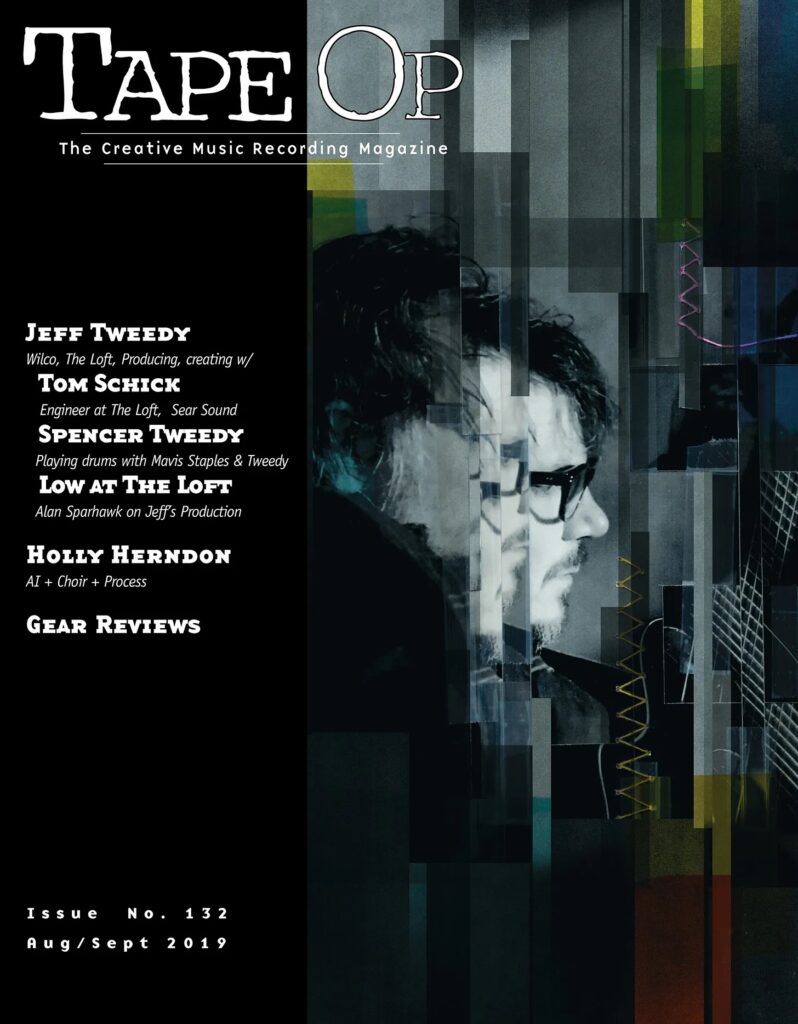
Tape Op is the only music geek magazine worth buying — and it’s free. Widely eclectic and ever encouraging, the main premise seems to be “Try, and trust your ears.” Pro, semi-pro, and DIY info sits comfortably side-by-side. Pros read it, hobbyists read it, some kids read it, all get something from it. Tape Op will give step-by step demos of, for instance, modding a certain low-cost microphone to get more bang for the buck written by a guy who sell his own mics for thousands. Or they talk to a guy with a barn full of home-made analog synths or someone who makes music out of sounds from antique recordings. The mag offers information in all kinds of directions, but it only wants you to do your own thing with it, what ever that is. Tape Op’s philosophy: use your ears and twist some knobs, learn all you can, then forget about it. Standards are explained, history is explored first-person, but rules might be thrown out the window. An undercurrent regarding how unrealistic and difficult it is to run a studio coexists with inspiring tales about the pleasure and pride that comes from recording music. The contributors work hard in their own studios and know what they’re talking about. A large community of recordists supports contributing articles and a lively online Q and A page (later edited and published). Recent profiles have run the gamut from legendary producers/engineers to seriously indie/outsider recordists; all have a jones for doing what they do their own way.
A recent, typical issue reviewed a mic you can buy for a steal on eBay for $40 and a mic that streets for $7,000. They don’t waste time writing slagging reviews; they review only what might be useful to someone on some level. On one hand, you can learn a lot by reading about something you may never be able to afford. On the other, you see that despite how amazing, desirable and beautiful that thing is — and this where most music mags stop — you don’t really need it. It might be a great tool for someone, but you don’t have to need it. Record reviews, written in the same “we like this” spirit, lean indie and outside, but might go anywhere. I always read about something I don’t know, but wouldn’t mind hearing. It’s independently published and paid for by ads from all kinds of audio-related concerns, but beholden to no one, so it’s neither slick nor slimy. Other recording magazines often seem to be trolling for sales or hyping an image. Their editorial decisions are suspect, noising on about last year’s retreads, repeating a press release, offering the same tutorials you could find in another magazine — or the library(!). The ‘net offers a lot of basic DIY sites you can learn from, but will they print an interview with Rupert Neve, as issue by issue, you learn about the products that riff on his designs? How about talking to Rudy Van Gelder (who recorded all the classic Blue Note jazz) about taping John Coltrane in the living room of his parent’s house in New Jersey?
I’ve been subscribing since 1997-8 when a producer I met turned me onto it. There is absolutely nothing out there like it. Nowadays my job is production manager/soundcheck and rehearsal substitute/backline tech for a three-time Grammy winning artist. I work with and have hired top-notch audio pros and I learn a great deal from them. Tape Op has often given me insight that keeps me apace in our discussions and what I learn from them takes me deeper into the magazine. However, Tape Op also has allowed me to nourish a side-line in sound designing/composing for theatre when I am off the road. When no one’s paying me and I’m home with the kids asleep, I record my music or occasionally, friends. That is where the knife really gets sharpened and what I have taken in from Tape Op gets put to the test. — John Stovicek
- I finished a session the other day where I went 10 hours without eating anything and kept suggesting breaks. It never happened.
It’s funny you brought that up. That happened to me last week. A person came in to record five or six songs for basic tracks in two days. It was that sort of scenario. It felt like if they weren’t doing something every second that an opportunity was being wasted. I can deal with that for two days or so. The longest session I worked on was 3 1/2 months. It was four people, and their mom, who never wanted to take any breaks. It was a trial. I remember saying, “You know, I’ll do this again but I need a significant amount of money.” The studio salary didn’t cut it.
You lost three months of your life!
Exactly. I broke up with a long-term girlfriend. Everyday was noon to midnight. It was a mixed blessing. Usually the types of bands that come in here are short and quick. They’re paying for everything themselves. We never got into that stride of a big studio getting big sessions that last for months and months. But our main fuel is bands that come in from three to twelve days. No one’s had to give up six months of his or her life to babysit. - Seating a new head
Here’s a good way to quickly seat a new drumhead (which allows the drum to better conform to the specific contour of the drum’s bearing edge): Put the head on and tighten it slowly, making sure to maintain even tension around the head. When the head is fairly tight (and evenly-tensioned), take a heat gun or blow dryer and slowly work your way around the outer edge of the drumhead, just inside the hoop and along the bearing edge. Don’t try to get the head hot, just warm to the touch. The heat will make the Mylar conform to the bearing edge almost instantly. Be careful not to get the head too warm, as too much heat buildup will deform the head in a destructive way. - Tape down one end of the Slinky inside the cone of an expendable speaker (eithera raw loudspeaker or one in a cabinet) – gaffer’s tape works well – and place thespeaker on the floor as shown in Figure 5. Clamp your contact mic to the otherend of the Slinky with a strong spring clip and attach this assembly to the end of a mic boom 3-6 feet up from the speaker, with the Slinky stretched between (Figure 6.) Plug the contact mic into your mixer or a guitar amp and pluck the spring to check your level. Now play some audio through the speaker and listen to the contact mic as the speaker shakes the Slinky – you may want to use headphones so you can distinguish the sound of the Slinky from the music coming directly out of the speaker.You should hear a “spoingy,” vaguely spring reverb-y cloud around your originalsignal.
Pocket-sized sound manipulator
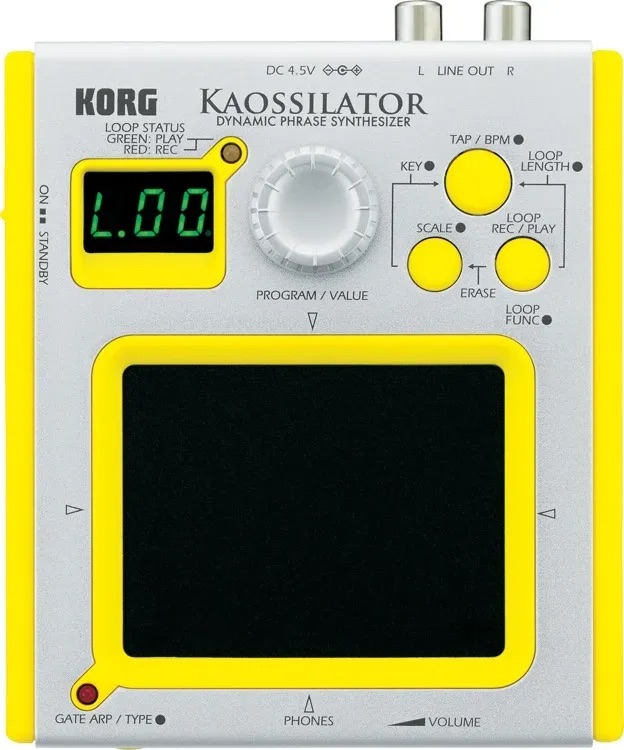
For a number of years I’ve been into sound art and electronics, but never had the cash and space for an ARP 2600. I recently acquired a Korg Kaossilator, a fabulous little dynamic phrase synthesizer, which, for all intents and purposes, now serves as my main musical device. Pocket-sized and touch-operated, the Kaossilator is comprised of 100 sounds: electronic beats, synth chords and pads, squelchy bass tones and the odd acoustic instruments. The Theremin sounds alone are worth the price tag. The fun part is creating 8-beat loops in which you can control the tempo and the scales of the instruments selected. I’ve already “composed” a few pieces using just the Korg and will most likely start incorporating it into GarageBand or, perhaps, Max/MSP once my visual programming chops get happening. My only complaint is you can’t edit or remove instruments/sounds as you layer them or control individual volumes. Still, I highly recommend the Korg for beginners and semi-pros that haven’t got a cache of gear and/or software. For standalone equipment, I don’t think there’s anything really comparable to the Kaossilator, except it’s cousin, the Mini Kaoss Pad, which is more for effects.
A hobbyist that was a session drummer in another life (before children), it’s limiting to how often I can make music. Drummers have to deal with the confines of noise volumes (the neighbors), the amount of space required and the portability of your gear. Plus, your output is restricted to mainly the rhythmic aspects of music as well as performing in the more traditional acoustic genres. With two small children, I don’t get to play with the Kaossilator as often as I’d like, but the one-year-old loves to see and hear it in action. While you can use the sounds to record with in your audio software, you can also just plug in headphones and experience your public transit commuting time diminish exponentially. I’ve taken it out of the house a few times. It runs on either a 4.5V adapter (not included) or 4 AA batteries (included). I have yet to really clock the amount of time used with just the batteries, but it’s been a lot longer than you’d get on a laptop. — Gord Fynes
Software synthesizer
I remember the first time I encountered a Moog Synthesizer: Switched-On Bach. I was all of 14-years-old and absolutely captivated. All those knobs and patch cords. And then there were the sounds that it made. To an adolescent boy growing up in the mid-late ’60s whose hero was Mr. Spock, it was like a futuristic dream come true — my own musical version of the Starship Enterprise and for only a few thousand dollars. The Last Whole Earth Catalog even featured a review of it by Wendy Carlos herself!
Then I learned how much a few thousand dollars actually was. I tinkered with resisters and capacitors, transistors and chokes, but I couldn’t do anything like that. But this is what led me inexorably to a career in music and recording. Well, and the Beatles helped, too. Flash forward 41 years and many synthesizers, guitars and amps later, I still could not seem to afford that big gleaming Moog dream.
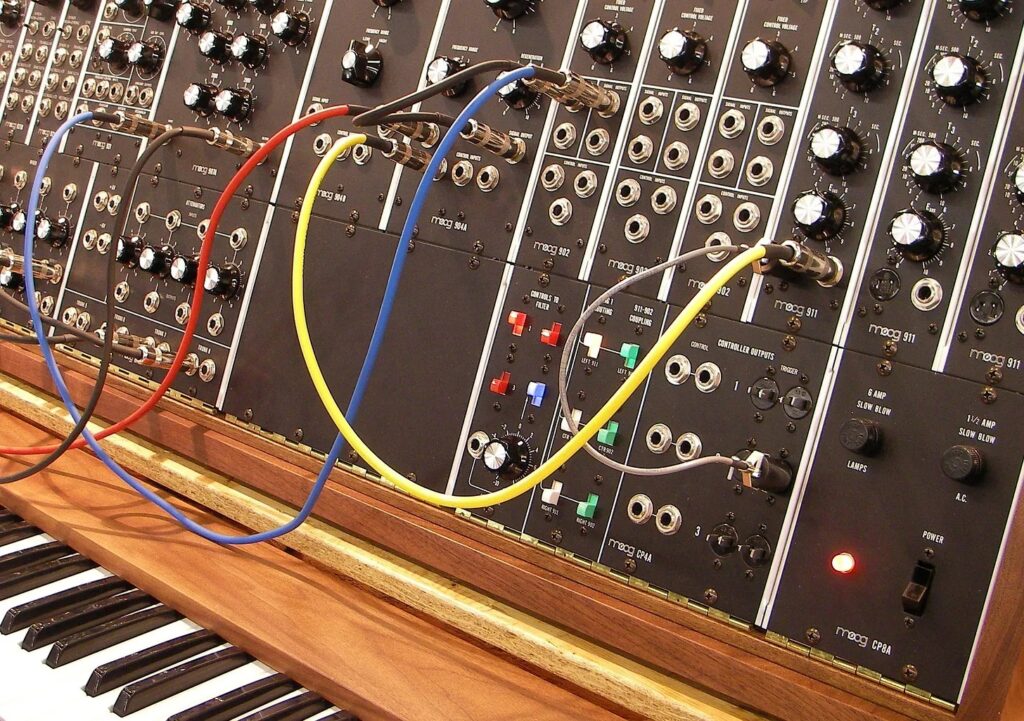
Then a company called Arturia released a virtual software version of my childhood Holy Grail, the Moog Modular V. And there were nine — count ’em, nine! — oscillators. Filters, envelope generators. A fixed filter bank. A sample and hold module. A bank of configurable mixers. And with enough computer firepower, I could finally make the sounds I’d heard Wendy Carlos make. The software even has stereo chorus and delay lines, a very neat addition to the package to fatten up your sound without having to use any outboard effects. And did I mention polyphony? Yes, unlike its hardware predecessor, the Moog Modular V offers up to 32 voices, if you have the processor power to deliver them.
I’ve been using this powerful, flexible piece of software for almost four years now and I have to admit that it does almost everything I ever wanted a music synthesizer to do. It does things the hardware version couldn’t even do. My only complaint is latency (delay). I would never use it live, but then again I haven’t been playing live these days, and if I did, I’d probably sample off the sounds I want to use and do it that way. The software can be used stand alone or as a plugin, for Mac or Windows OS. — Jeff Bragg
Once a week we’ll send out a page from Cool Tools: A Catalog of Possibilities. The tools might be outdated or obsolete, and the links to them may or may not work. We present these vintage recommendations as is because the possibilities they inspire are new. Sign up here to get Tools for Possibilities a week early in your inbox.
04/13/26