Unexplained & Unusual
Tools for Possibilities: issue no. 166
Science tourism hot spots
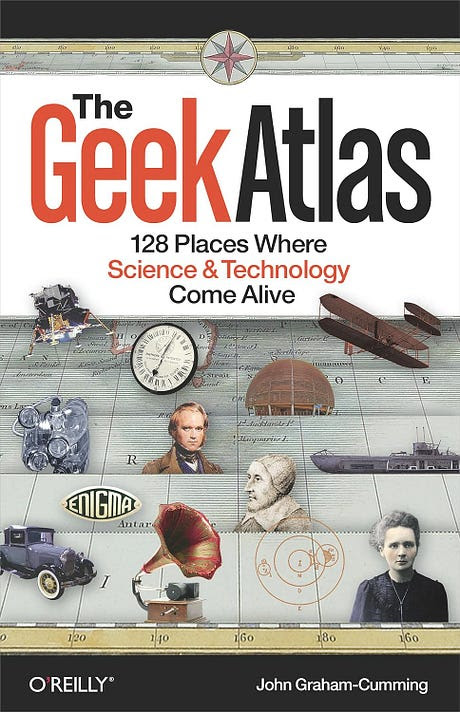
I am always looking for offbeat educational places to visit on my travels. The Geek Atlas has rounded up 128 great candidates from around the world. The Atlas calls them “places where science and technology come alive.” I think of these destinations as places that make you think. The possibilities run the gamut from birthplaces of famous inventors and scientists (yawn) to really cool tours of working technological systems (a nuclear power plant, a dam turbine, a solar furnace) to a spectrum of interesting but little known museums, to just cool places like the prime meridian. A lot of these destinations are in the US and UK, but a fair number hail elsewhere. In addition to a description of a destination, author Graham-Cumming writes up a page explaining the key concept behind each spot. I’ve visited a dozen of these science hot spots and they are well worth a short detour, or in some cases a trip just for the purpose. You could probably fill another volume of brainy tourist traps missed by this book: I predict a sequel. — KK
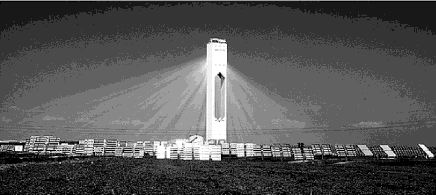
- Solucar PS10 Power Station, Sanlucar la Mayor, SpainThe tower is at the center of a field of heliostats (mirrors that track the movement of the Sun) that focus the bright Spanish sunlight onto a receiver near the tower’s top. The reflected sunlight is so intense that water vapor and dust in the air glow white. All that’s needed to complete the scene is a maniacal James Bond villain atop the tower.
This tower is at the center of the Solucar PS10 power station. At the top of the tower is a solar receiver that is heated by sunlight to create saturated steam at 257°C. The steam is then used to drive a turbine that generates electricity. Make sure you’re wearing sunglasses when you look up to the top; the tower’s brilliant white glow is very intense. - Taipei 101, Taipei, Taiwan
The 660-Tonne Golden Ball
The Taipei 101 is the tallest occupied building in the world, with 101 floors overlooking Taipei’s business district. But Taipei is prone to both typhoons and earthquakes, so the skyscraper contains a 660-tonne, gold-colored pendulum near the top to prevent the building from swaying and vibrating. It is the largest and heaviest such pendulum in the world.
Many skyscrapers contain such devices, called tuned mass dampers, for the same purpose, but the Taipei 101 pendulum is unusual because it is on public view. It hangs between the 87th and 91st floors, and there are public viewing areas on the 88th and 89th floors. It’s even visible from the restaurant and bar. Two other tuned mass dampers, located in the building’s pinnacle are not on display and are tiny by comparison: they weigh only 6 tonnes each.
The ball is made of forty-one 12.5-centimeter steel plates welded together for a total size of 5.5 meters. It is attached to the building by eight steel cables, each capable of supporting the ball’s entire weight. In normal use the ball can move up to 35 centimeters in any direction and cuts building vibration by 40%. In a major typhoon, the ball is designed to move up to 1.5 meters; hydraulic bumpers below the ball absorb its energy and prevent it from moving too far.
When the building sways in one direction, the ball opposes the movement by swinging the opposite way. The movement of the ball pushes (and pulls) on the hydraulic bumpers and causes them to heat up, absorbing the energy from the motion of the building. The pendulum is tuned by adjusting the length of the cables holding it. By changing the period of the pendulum (the time it takes to swing back and forth), it can be tuned to match the motion of the building.
- Nevada Test Site, NV
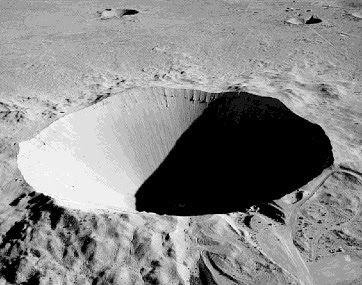
At the Nevada Test Site, more than 1,000 nuclear explosions were set off between 1951 and 1992. The site contains over 3,600 square kilometers of dry lake beds and mountains, about 100 kilometers northwest of Las Vegas. Once a month, the U.S. Department of Energy provides a free, day-long tour of the Nevada Test Site’s bomb craters, ground zeros, and test paraphernalia.
The tour covers around 400 kilometers of the nuclear explosion-pockmarked landscape: of the 1,021 nuclear explosions at the Nevada Test Site, only 126 occurred above ground; the rest were underground tests that left the site cratered. The largest crater of all, the Sedan Crater, is the highlight of the tour. It’s almost 400 meters wide and 100 meters deep.
Database of Anomalies
Corliss Sourcebooks
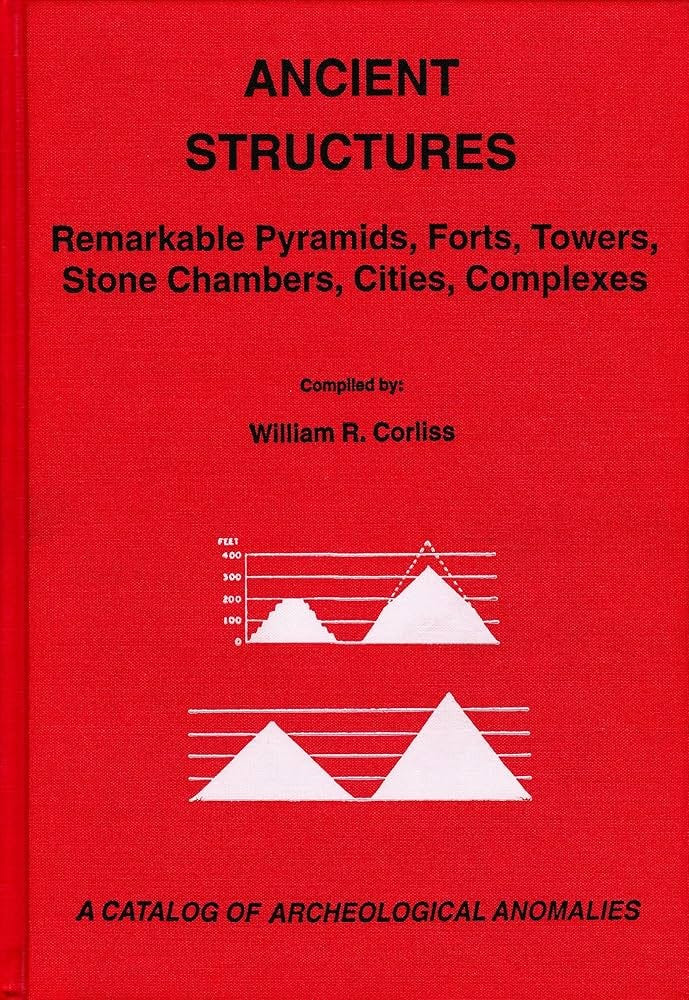
Frequently, insight begins with an unexplained anomaly — a novel phenomenon which upon diligent pursuit leads to a new way of doing or understanding. On the other hand most anomalies are just that — unexplained exceptions of no lasting import. Telling the difference is what science is about. But first these odd things must be acknowledged, and better, documented. This is what the Sourcebook Project does. William Corliss, a maniacal archivist working alone has steadfastly cataloged all reported anomalies in biology, chemistry, geology, archeology, physics, and the atmosphere. He lists everything: ball lightening accounts, out of sequence fossils, ancient glass lenses, geological deposits where they shouldn’t be, weird ruins, musical sands, unexplained radioactivity, out of place historical artifacts, unusual ancient buildings, strange weather formations, and anything odd that has no easy explanation.
Corliss clips primarily from old scientific journals, expedition reports, and society proceedings. The observers have some credibility. The anomalies are presented without interpretation — that is up to you. The work can easily be appropriated by cranks (and has been) but it is equally useful to others searching for new science frontiers.
A few words from William James, reproduced on the title page of Anomalies in Geology:
“Round about the accredited and orderly facts of every science there ever floats a sort of dust-cloud of exceptional observations, of occurrences minute and irregular and seldom met with, which it always proves more easy to ignore than to attend to…. Anyone will renovate his science who will steadily look after the irregular phenomena. And when this science is renewed, its new formulas often have more of the voice of the exceptions in them than of what were supposed to be the rules.”
For most of us this remarkable series of volumes will be a constant source of wonder, amazement, and re-thinking. Because each observation is offered without explanation (“just the facts ma’am”) in such volume (thousands and thousands), one quickly realizes the extent of our ignorance. So far Corliss has compiled 34 volumes, all items indexed according to his classification scheme. Confusingly these volumes overlap, and it is not easy to determine which are the latest, but those in his “catalog” series seem to be the most recent.
Corliss adds 1,200 new reports a year, and has only published 40% of the material he has compiled. Obviously this Catalog of Anomalies should be on the web, as an open source project. But for now these amazing tomes are only in paper, self published by Corliss himself, available via Amazon. — KK
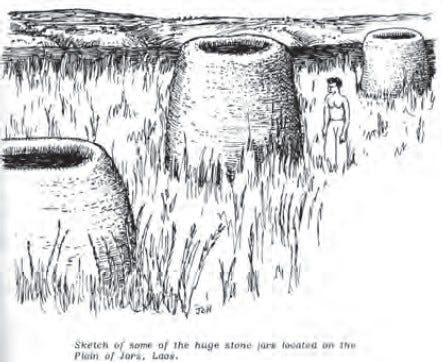
- The Laos Jars are mostly fashioned out of sandstone, although a few were laboriously carved from much harder red granite. Besides the 250 jars at Ban Ang, there are about 80 more at Lat Sen, 155 more at Ban Soua, 34 at Na Nong, and still more at Ban Hin, the latter group is made from red granite.
The natives in the areas where jars are located know nothing definite of their origin. It is customary to say the jars were made to celebrate a great military victory 1,500 yeas ago. Modern professional opinion is that they are funerary urns probably made more than 1,500 years ago.
From “Ancient Infrastructure: Remarkable Roads, Mines, Walls, Mounds, Stone Circles” - Blundellsands, England. June 5, 1902. “The evening was dull and grey, a strong northwesterly wind was blowing in from the sea and the tide was flowing in. In the distance we first saw smoke with frequent jets of fire bursting forth from the mud of a shallow canal. Drawing near, we perceived a strong sulphurous odour, and saw little flames of fire and heard a hissing sound as though a large quantity of phosphorous was being ignited. It was impossible to detect anything which caused the fire, only the water where the flames appeared had particles of a bluish hue floating on the surface. The area over which the tiny flames kept bursting forth was about 40 yards. A gentleman present stirred up the mud with his walking stick, and immediately large yellow flames nearly 2 feet in length and breadth burst forth. The phenomenon lasted some time, until the tide covered the part and quenched the fire.”
- August 17, 1876. Ringstead Bay, England. “Between 4 and 5 p.m. two ladies who were out on the cliff, saw surrounding them on all sides, and extending from a few inches above the surface to two or three feet overhead, numerous globes of light, the size of billiard balls, which were moving independently and vertically up and down, sometimes within a few inches of the observers, but always eluding the grasp; now gliding upwards two or three feet, and as slowly falling again, resembling in their movements soap bubbles floating in the air. The balls were all aglow, but not dazzling, with a soft, superb irridescence, rich and warm of hue, and each of variable tints, their charming colours brightening the extreme beauty of the scene. The subdued magnificence of this fascinating spectacle is described as baffling description. Their numbers were continually fluctuating; at times thousands of them enveloped the observers, and a few minutes afterwards the numbers would dwindle to perhaps as few as twenty, but soon they would be swarming again as numerous as ever. Not the slightest noise accompanied the display.
From “Lightning, Auroras, Nocturnal Lights, and Related Luminous Phenomena: A Catalog of Geophysical Anomalies”
Once a week we’ll send out a page from Cool Tools: A Catalog of Possibilities. The tools might be outdated or obsolete, and the links to them may or may not work. We present these vintage recommendations as is because the possibilities they inspire are new. Sign up here to get Tools for Possibilities a week early in your inbox.
12/1/25