Wealth Building
Tools for Possibilities: issue no. 174
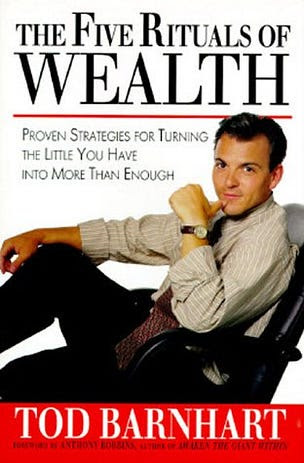
How to get rich slow
Wealth seems to grow out of a discipline, a habit, a practice that is applied daily and harvested decades later. Not everyone wants to accumulate a pile of money; but most people would like true wealth. This guide addresses that desire. I’ve gone through the entire New York Times bestseller list of how-to-get-rich books, and beyond. This is the book that most matches my own experience, and what I observe of the rich around me. It’s wise where there is often little wisdom, and yet practical, but not so practical it goes out of date. (For that kind of advice see Your Money) — KK
- The biggest lie people tell themselves about wealth is that if you make more money, you’ll be rich.
- Here’s the problem: Most of us have been taught little or nothing about wealth. Most people grow up believing they should pay all their bills first and then play with what’s left. There’s some sense to that strategy. Certainly, it teaches us responsibility as debtors. The thing is, we’ve never been told that we count as much as our creditors. No one has ever said it’s okay to save and pay ourselves first.
- All the time I hear people say, “If I just earned more money, then I could feel wealthy or pay my bills or use money as a tool to do good things, or save for my future.” The lists seem to go on forever, but believe me when I say: Before significant wealth will come your way and stay, you have to master the money you already control.
- When it comes to saving and investing for your future, the historical rule of thumb is 10 percent. Save 10 percent of your income every single month and you’ll grow wealthier than you dreamed possible.
- In some circles, budgeting is a plan for the future — not a record of the past. I prefer to keep track of my expenses as I spend, rather than plan a budget out to the year 2010. That just feels too constraining. I call my as-you-spend record keeping “take-control budgeting” and recommend it over forward-planning your expenses. I think there are just too many variables in our spending patterns to plan our future expenditures to the dollar. Furthermore, I think that most people find the money to buy the things they really want or need, so the goal here is to be aware enough of your cash flow to spend money only on things you really want. This awareness is accomplished by prioritizing your expenditures, which will be explained shortly. I think you’ll find, as I did, that if you just keep a record of your prioritized expenses and balance them every month against your income, you’ll instinctively know what to do next.
- So successful investing is not a matter of which new theory is hot lately, or when to buy low and when to sell high. It’s a matter of getting invested, staying invested, and reinvesting the dividends over time. The accumulation of wealth is virtually that simple if you side with time.
- To many people approach being a giver from the wrong perspective. They look at the resources they possess and invariably fail to see any “extra” they can part with. That’s wrongheaded thinking. Remember: If you don’t feel secure enough to give, you’ll never feel wealthy at the deepest level.
- ou can’t give just a tiny bit and sit back, waiting for your ship to come in. You have to give with selflessness. And, if you don’t feel like you can, then you must. It’s the only way you can break free. We’ve already established how wealthy you really are, regardless of your situation. You know that you’re wealthier than the majority of the world. You have to ask yourself: How rich is rich? How much is enough? How wealthy will I have to be before I become a good steward?
You know the answer: It all starts in the belief that you’re wealthy right now.
Realtime budget overview
This web-based dashboard gives me an elegant overview of all my financial accounts in one screen. I’ve been using Mint for the past 6 months and it is marvelous. It is super friendly, quick, and illuminating. It makes me smart.
Mint will aggregate any money or spending account with online access — which is basically all financial accounts by now. In ten minutes or less I added our bank, credit cards, mortgage, cars, 401k, credit union, checking, and Etrade accounts to Mint. That’s the last input I ever had to do. From then on Mint automatically updates all the accounts, sucking in their data with the correct passwords, and integrates this diverse information into a single unified realtime snapshot of our finances. At once glance I can see where we are spending too much, or how we actually allot our income. I no longer have to hunt for my password and numbers for different accounts, say checking our bank balance, or a credit card purchase. It is much much easier, and far more pleasant, to simply log into Mint, where I can see everything. There, in clear presentation far superior to most banks, are all my accounts informing each other. One window to watch them all!
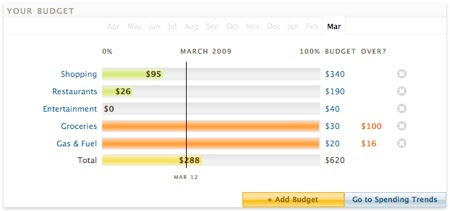
Mint is a read-only interface. There is no way to move money, or reconcile accounts, or pay bills, or calculate taxes (for now). That is also why it is safe. In fact it is probably safer than most banks because fancy algorithms at Mint similar to credit card fraud detection software will alert you when your finances show an unusual pattern. This is one of its cool features. It will gently inform you (at your choice) that say, based on your past months’ expenditures, you’ve overspent your grocery budget this month. It also makes a fairly good guess at categorizing your expenses on its own. It can then make comparisons of how your budget stacks up to other aggregate users in your area, and offer budget suggestions (which we have not followed). We rarely use cash for anything so Mint gives us a very complete picture.
Some people will not be convinced by any reasoning or proof that having a single window into your entire financial situation is safe. If you are of that type, don’t use Mint. But for the rest, who long ago realized that using credit cards online is far safer than using one in a store, Mint is a fabulous cool tool. And it is free. Available anywhere the web lives.
There are a couple of similar sites, such as Wesabe and Geezeo, which emphasize sharing budgets, sort of like a Weight Watchers for finances, but I find their interfaces far less elegant. However this niche is evolving fast, and features expand. Mint has a good head start, a winning design (I love the pie charts!), and a sizable user base, so I think it will be around for a while. (If it did disappear, no loss because it does not store any unique data.) — KK
Best introductory guide to money
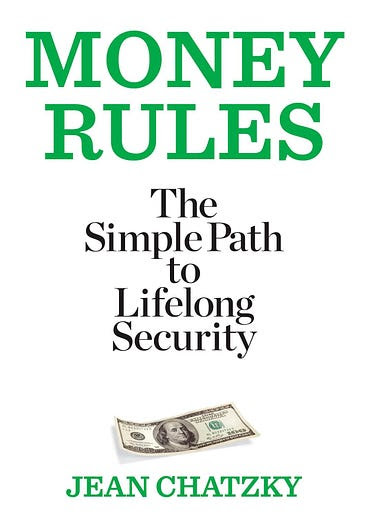
I didn’t think another book on finance smarts would add anything new to the wisdom of the previously reviewed books Your Money, and Five Rituals of Wealth. But this one takes the great advice found in those and reduces it all to 100 maxims that you can read (and reread) in an hour or less. There is one simple paragraph of hard-won advice per page. This small book’s chief benefit is that busy people will actually READ it.
This is also the best money guide for young adults. I think it is perfect to start with even for elementary kids. It is less about finance and more about developing a common sense about money. Works as a refresher and reminder for adults too. I found myself in total agreement, having done well over the years using the same principles.
If you need convincing on any point, or want the details on how to execute an idea, you can delve into the aforementioned books. — KK
- The four most powerful words in any negotiation: “Can you do better?”You’re sitting in the office of the person who’s dying to be your new boss. He’s just offered you a job that you really want with the title you’ve been craving. The only hitch: The salary isn’t where you’d hoped it would be. Don’t commit–at least not neil you ask, “Can you do better?” It’s the perfect haggle. You sound as if you know there’s wiggle room, and you’re willing to let him work his magic. And note: This works just as well when you’re on the phone with the cable company, at the mechanic for an oil change, talking to a mortgage rep about in a “refi” rate. It even–I know from experience–works with teenage kids.
- There’s no such thing as chump change.$100 is not a lot of money. Save it every week, however, and invest it in a retirement account where you earn a conservative 6 percent, and keep doing it for 30 years and you’ll have $433,557. In 40 years, you’ll have more than twice that. And that is a lot of money.
- Saving is more important than investing.Next time you stress about the stock market, remember this: The amount of money you manage to sock away is much more important than the return on that money. You can take my word for it. Or you can consider this eye-opening example: You save $250 a month, which you then invest. If you earn 6 percent on that money, a year from now you’ll have $3,267. If you earn 10 percent, you’ll have $3,311–$44 more. But what if you waited a month to start saving? Then even at 10 percent you’d have $3,052–$215 less. What if you saved $200 a month instead of $250? Then, again at 10 percent, you’d have $2,649–$618 less. As your nest-egg grows and gets into the six figure range, the return on investment starts to matter more. But you can’t get to that level if you don’t start to save now. Right now.
- Your retirement trumps their tuition.You know when you’re on an airplane and they always tell you to put your oxygen mask on first before assisting a child? Saving for long-term financial needs is the same. If you don’t save for your own future first, you won’t be able to help your children when they need it. Worse, they may be forced to help you just when they’re trying to put their own kids through school. There is no financial aid for retirement. There is plenty of financial aid for college. Don’t feel guilty about this.
- The best cost-cutting tool is a good night’s sleep.With the possible exception of prescription medication, flashlight batteries, bottled water (under the pressure of a hurricane), and a few other true necessities, there is nothing you need to buy that can’t wait until tomorrow. So when you’re faced with a discretionary purchase, do your wallet a favor and sleep on it. If you’re not still thinking about it–whatever it happened to be–24 hours later, you didn’t need or want it anyway.
- Don’t shop hungry.This is not just a rule that applies in grocery stores. Do you know why they ply you with samples at warehouse stores? Because exciting your mouth–literally making you drool–makes you spend more money not just on food, but on everything. It primes the same part of your brain that responds to the rewards you really want. So maybe you went to the store to buy diapers but now that your brain is active, you buy the tent. (That shopping trip is legend in our family. I should tell you: we don’t camp.) Oh, and when your favorite little boutique offers a special evening sale with wine and cheese? Steer clear. Alcohol not only primes the pleasure pump, it inhibits self-control.
Once a week we’ll send out a page from Cool Tools: A Catalog of Possibilities. The tools might be outdated or obsolete, and the links to them may or may not work. We present these vintage recommendations as is because the possibilities they inspire are new. Sign up here to get Tools for Possibilities a week early in your inbox.
01/26/26