Become a Patron!Support our reviews, videos, and podcasts on Patreon!
Cool tools really work.
A cool tool can be any book, gadget, software, video, map, hardware, material, or website that is tried and true. All reviews on this site are written by readers who have actually used the tool and others like it. Items can be either old or new as long as they are wonderful. We post things we like and ignore the rest. Suggestions for tools much better than what is recommended here are always wanted.
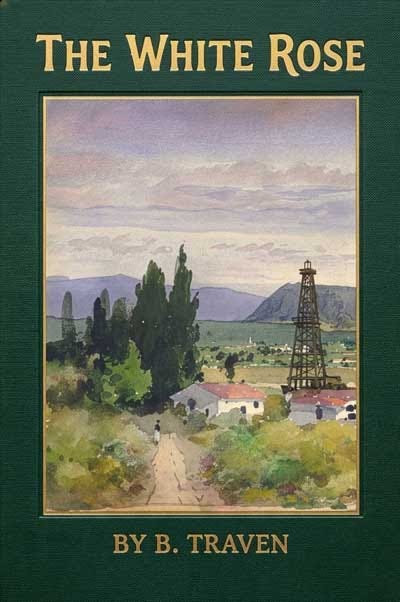
The White Rose (1929) is a novel by B. Traven, the mysterious author of The Treasure of the Sierra Madre. An American oil tycoon wants a Mexican family’s hacienda because it sits on an ocean of oil, and the owner won’t sell at any price. It hasn’t been in English print for decades, so I made a new translation from the German.
This is the fourth Deep Cut Book Club Edition. Paying subscribers can download the free ebook using the button at the bottom of this issue.
About The White Rose
The novel moves back and forth between Jacinto Yáñez, a farm owner in Mexico, and Chaney Collins, the president of an American oil company who wants Yáñez’s property because it sits on an underground ocean of oil. Yáñez refuses to sell, even for millions of dollars. The hacienda is called the Rosa Blanca, and it has been passed down to him through a long line of ancestors. He feels he has no right to sell the land, and he believes the farm is worth more than any amount of money the oil company could offer. It is literally priceless. Yáñez feels responsible for the many interrelated families who live on the hacienda and make a living growing crops and raising livestock. He thinks it’s ludicrous to trade a food-producing homestead for a sack of gold coins.
Collins is enormously rich but spends a fortune on four mistresses, and he thinks Yáñez is just holding out for a higher price. When Yáñez keeps refusing to sell, Collins sends one of his henchmen to Mexico to bring Yáñez to San Francisco, where Collins believes he’ll have a better chance of making him see why he ought to take the deal. I won’t spoil what happens next.
Collins is widely considered a stand-in for the oil tycoon Edward L. Doheny, who in 1921 sent $100,000 in cash to the U.S. Secretary of the Interior, Albert Fall, in what became the Teapot Dome scandal. Doheny’s son delivered it in a black bag. (That’s about $1.8 million in today’s money.) Fall then leased Doheny the Elk Hills naval oil reserve in California without competitive bidding. Fall went to prison for taking the bribe. Doheny was acquitted of paying it.
Who was B. Traven?
The Treasure of the Sierra Madre is one of my favorite novels, and John Huston’s 1948 movie, starring Humphrey Bogart, won three Academy Awards. A few years after reading it, I read Traven’s The Death Ship (1926), about an American sailor who loses his ship and his papers in Antwerp and gets deported from one country to the next until he ends up shoveling coal on a rotting smuggling ship. After that, I wanted to know who Traven was. The more I tried to find out, the more confused I became.
He used multiple pseudonyms, including Hal Croves, Traven Torsvan, and Ret Marut. Most Travenophiles agree that he was a German actor and anarchist who fled Germany in 1919 after he was accused of helping establish the Bavarian Soviet Republic and threatened with execution. When British police questioned him in 1923, he said he was Hermann Otto Albert Maximilian Feige. When Huston tried to meet him before filming The Treasure of the Sierra Madre, Traven showed up claiming to be Traven’s agent, a man named Hal Croves, and worked on the set as a consultant.
Traven didn’t think his identity should matter to anyone. “The creative person should have no other biography than his works,” he said.
The Mexican director Roberto Gavaldón made the novel into a film, Rosa Blanca, in 1961. The Mexican government decided its oil politics were too touchy and kept it out of theaters for eleven years. It wasn’t released until 1972.
About this translation
The White Rose wasn’t translated into English until 1979, 50 years after it was first published in Germany. Cedric Belfrage's translation is now out of print. I found a copy of the German edition at Project Gutenberg, and as an experiment I used Claude to translate it into English. I told it to stay close to the German and avoid smoothing it into idiomatic English, and to build a glossary so the names stayed consistent. I was surprised by how well it did the translation. It’s a hell of a good read.
Download the Book Freak Edition
This is the fourth book in the Deep Cuts Reading Club, a benefit for paid subscribers. Every month, I take an interesting and obscure public-domain book and turn it into an ebook in EPUB and PDF formats, with a short introduction.
You can access a copy ofThe White Rosebelow.
If you’re reading this as a free subscriber, the club is part of a paid subscription ($5/month or $45/year). Join the club here. And if money is tight, email me at editor@cool-tools.org, and I’ll comp you...