Book Freak #220: The Mind’s I
Hofstadter and Dennett on the Strange Loop of Self and Consciousness
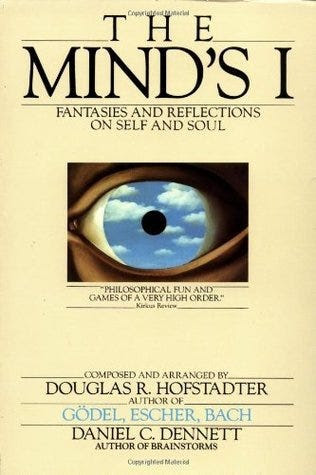
The Mind’s I, edited by Douglas Hofstadter and Daniel Dennett, collects 27 stories and essays that explore three questions: “What is the mind?” “Who am I?” and “Can machines think?”
It has pieces by Jorge Luis Borges, with a man dreamed into existence in “The Circular Ruins” and the vertiginous “Borges and I.” Stanisław Lem contributes “The Seventh Sally,” about tiny beings who beg their maker not to switch off their world. Alan Turing asks whether a machine can think; Richard Dawkins writes on selfish genes and memes; and Thomas Nagel wonders what it is like to be a bat. Dennett narrates his own brain being separated from his body in “Where Am I?” After each piece, the two editors add a “Reflection.” This is one of my favorite books, and one I have returned to for over 40 years. Sadly, all the essays were written by men.
Core Principles
1. What Is It Like to Be You?
Thomas Nagel’s famous essay asks: “What is it like to be a bat?” His answer: we can’t know, because consciousness has an irreducibly subjective character. There is “something it is like” to be a conscious creature — and that something can’t be fully captured from the outside. The same mystery applies to every other mind, including the person sitting next to you.
2. The Self Is a Strange Loop
Who is the “I” that thinks your thoughts? Hofstadter suggests the self is a kind of strange loop — a pattern that refers back to itself, emerging from the brain’s physical processes but not reducible to them. You are not your neurons, but you are not separate from them either. The self is something the brain does.
3. Thought Experiments Reveal Hidden Assumptions
Can a computer think? Could you be a brain in a vat? What if you were teleported —would the person who arrives still be you? These questions expose hidden assumptions we carry about mind, soul, and identity. The book uses fiction and fantasy to crack open questions that dry philosophy can’t reach.
4. The View from Nowhere Is Incomplete
Science seeks objectivity — a “view from nowhere.” But when applied to the mind, this approach leaves out something essential: the view from somewhere, the fact that experience is always someone’s experience. Any complete account of reality must include the subjective, not just the objective.
Try It Now
- Try to imagine what it’s like to be someone radically different from you (even a bat) — not what you would experience in their situation, but what they experience.
- Ask yourself: who is the “I” that is reading this sentence? Can you locate it? What happens when you look?
- Consider a thought experiment: if a perfect copy of you were made, would it be you? What does your answer reveal about what you think identity is?
- Notice something you’re certain about regarding your own mind. Now ask: how would you prove it to someone else?
Quote
“An organism has conscious mental states if and only if there is something that it is like to be that organism—something it is like for the organism. — Thomas Nagel’”
Book Freak is published by Cool Tools Lab, a small company of three people. We also run Recomendo, the Cool Tools website, a YouTube channel and podcast, and other newsletters, including Recomendo Deals, Gar’s Tips & Tools, Nomadico, What’s in my NOW?, Tools for Possibilities, Books That Belong On Paper, and Book Freak.
07/31/26