Book Freak #226: What you find when you look for your own head
Douglas Harding's guide to discovering who is doing the looking
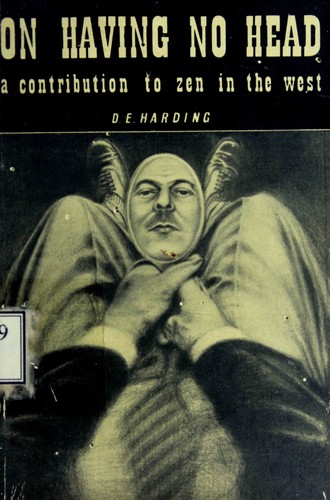
Chapter 2 of The Mind’s I, an anthology of philosophical essays and stories about the mind and existence, is an essay by Douglas Harding called “On Having No Head.” It begins:
“The best day of my life — my rebirthday, so to speak — was when I found I had no head. This is not a literary gambit, a witticism designed to arouse interest at any cost. I mean it in all seriousness: I have no head.”
I remember being bemused by the essay and thinking, “He can’t really believe that.” But 40 years later, I did a meditation series on the Waking Up app, taught by Richard Lang, one of Harding’s students, and it won me over. It’s more fun to think of the stuff above my shoulders as space for the world and room for others.
Harding realized that he didn’t have a head in 1943, when he was 33. He was walking in the Himalayas and thinking about the question “What am I?” He saw that he could see his body up to his chest, but everything above it was a boundless empty space, filled with the mountains and the sky.
His book, On Having No Head: Zen and the Rediscovery of the Obvious (1961), is about shifting the way you perceive yourself, others, and reality. I recommend trying the headless way. You might be astonished, like I was when I did the workshop. Richard Lang’s video The Man with No Head is a good place to start.
Core Principles
You Lose a Head and Gain a World
“It was a vast emptiness vastly filled, a nothing that found room for everything.”
Where Harding expected to find his head, he found open space with everything in the universe.
Go by What You See
“This is not a matter of argument, or of philosophical acumen, or of working oneself up into a state, but of simple sight.”
Harding asks you to report only what you see right now. Ignore your memory and other people’s opinions.
It Is the Easiest Thing in the World
“Though down the centuries this in-seeing has been made out to be the most difficult thing in the world; the joke is that it is really the easiest.”
You don’t need years of practice. The space where your head should be is ready for you now.
Look Both Ways at Once
“You are becoming adept at two-way looking — at once looking in at Nothing and out at everything.”
The practice is to keep the empty space here in view while you go about your day out there.
Try It Now
- Point at something across the room. Then turn your finger around and point at the place you look out from. Notice what your finger points at, if anything.
- Shut your eyes for ten seconds. Check whether you have any evidence of a head: a shape, a size, a color, a boundary. How many toes can you count if you go only by what you feel right now?
- In your next conversation, notice that you see the other person’s face, but on your side there is no face, only room for theirs. Harding calls this “face to no-face.”
Quote
“I had lost a head and gained a world.”
Book Freak is published by Cool Tools Lab, a small company of three people. We also run Recomendo, the Cool Tools website, a YouTube channel and podcast, and other newsletters, including Recomendo Deals, Gar’s Tips & Tools, Nomadico, What’s in my NOW?, Tools for Possibilities, Books That Belong On Paper, and Book Freak.
11/27/26