Become a Patron!Support our reviews, videos, and podcasts on Patreon!
Cool tools really work.
A cool tool can be any book, gadget, software, video, map, hardware, material, or website that is tried and true. All reviews on this site are written by readers who have actually used the tool and others like it. Items can be either old or new as long as they are wonderful. We post things we like and ignore the rest. Suggestions for tools much better than what is recommended here are always wanted.
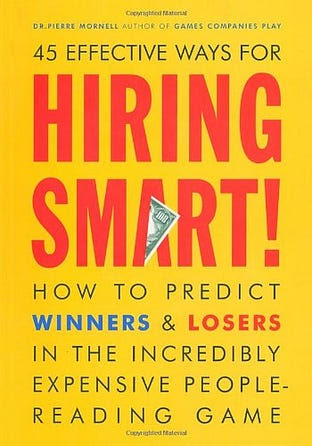
Hire smart, your company wins; hire dumb, you die. People are the scarce resource in the new economy, but no one teaches employees how to hire people. Successful fast-growing companies have caught on. They now hire people who are good at hiring others. Between these book covers is a million dollars worth of hiring advice, the best anywhere. If you are in business, ignore at your peril. — KK
You can’t spend too much time or effort on “hiring smart.” The alternative is to manage tough, which is much more time consuming.
The best predictor of future behavior is past behavior.
Strategy No.3: Give an assignment before the interview. Ask the candidate to visit one of your stores, plants, campuses, offices, or Web pages before the interview. Then ask for the candidate’s observations.
Strategy No.5: Read resumes in teams if possible. It’s helpful--and faster--to read the top candidates’ resumes in teams of three to five people. Teams that work well together are more accurate and insightful about potential employees than individuals are.
Strategy No.6: Cast the widest net possible. Microsoft assumes that the best candidates are not looking for jobs. In fact, candidates who approach Microsoft are actually less attractive to the company.
Strategy No.13: Ask all your questions at once. That's right. Put all your initial questions on the table up front. This strategy accomplishes three things. First, in a manner of speaking, you pass the baton. You've asked the questions, now the candidate must respond. Performance depends upon the candidate, not selling yourself and the organization. Second, more importantly, this strategy directly confronts the most common problem in interviewing: not listening, and talking too much...Third, this technique forces you to listen. If there's one practical tip you should try in your next interview, I suggest this one. Asking all your questions at once, and following up later in the interview, allows you to settle back and watch a candidate's behavior as well as listen to his or her words.
Strategy No. 15: Assign a mini-project to finalists. Three quarters of the way through the interview, give the candidate a task to perform. Not only does this demonstrate the candidate's behavior--it also breaks up the monotony of most interviews.
Strategy No. 32: Ask the references to call you back. Here is the simplest, most effective reference check that I know. It’s also fast and legal. Call references at what you assume will be their lunchtime--you want to reach an assistant or voice mail. If it’s voice mail, leave a simple message. If it’s an assistant, be sure that he or she understands the last sentence of your message. You say: “John (or Jane) Jones is a candidate for (the position) in our company. Your name has been given as a reference. Please call me back if the candidate was outstanding.”The results are both immediate and revealing. If the candidate is outstanding or excellent, I guarantee that eight out of ten people will respond quickly and want to help....However, if only two or three of the references selected by the candidate return your call, this message is also loud and clear. And yet:No derogatory information has been shared.No libelous statements have been made.No confidence or laws have been broken.
Strategy No. 39: Invest in people, not ideas.
Unfortunately, an employer’s ability to hear bad news about a potential employee is inversely proportional to the time spent courting that employee.
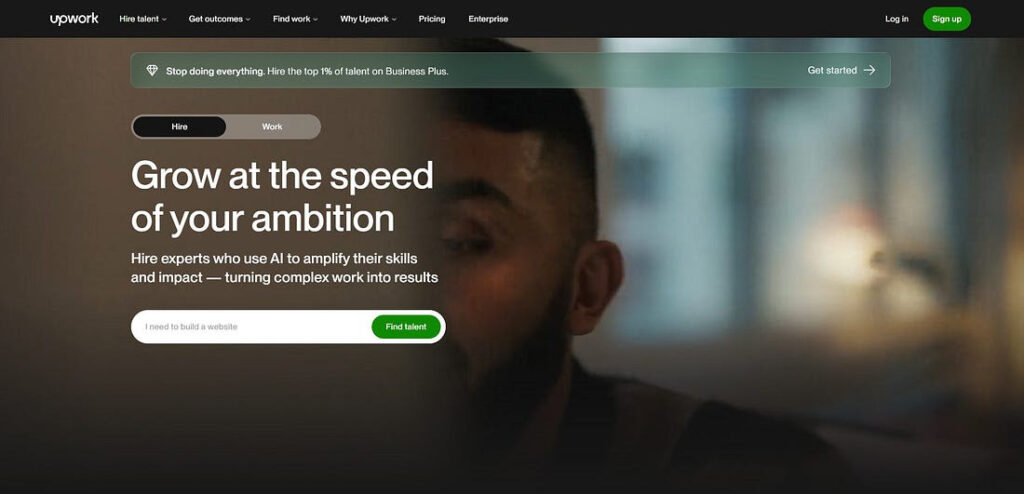
Elance is a global marketplace for freelancers. You post a job you want done, and freelancers around the world will bid on it in a matter of hours. Once the price and deadline are agreed upon, the work will be delivered to you very rapidly. Because of its global nature, your costs may be very low.
Elance has a pool of 135,000 pros expert in programming, design, writing, and legal matters. People use them to design a logo, create marketing materials, tweak a database, code a website, create an iPhone app.
I’ve used Elance to outsource projects at least 8 times by now and have had fantastic results. I’ve been most surprised by the high quality and professional management, particulary from overseas workers. It’s indeed inexpensive, but also great work. For one scripting job I got estimates from US shops as high as $6,000; it would take months from specs to testing. We went on Elance, got a bid for $250 to do it manually (without scripts) and it was done perfectly in a week. I’ve used Elance for Photoshop work, to hire designers, artists, and proofers. A lot of the work on this book was done by free-lancers hired through Elance. You could start a company with them. In fact Kevin Rose hired an Elancer to code the first version of the now popular website Digg.
Elance’s escrow service holds the payment and protects both the work provider and you the employer. The site provides status updates on work done, and plenty of communication between the parties. Workers must pass a competency test to qualify to be listed. Some freelancers can also pass expertise tests in a mild form of certification, say for working on java or ajax, etc. Elance freelancers did about $200 million of work last year and less than 1% of the jobs had any kind of dispute, and most of those were self-resolved by the fact that the entire transaction correspondence is logged.
While I first went to Elance for cheap labor, I now also go to get jobs done in a hurry, or to find expertise I can’t find locally. (Fifty percent of Elancers live in North America.) If you have work, and you know what you want, this is a great service.
The real trick in using Elance, or its competitors like oDesk, is in being able to specify the deliverable you want without spending more time that it would take to do the project itself. This kind of outsourcing is best for bite-sized chunks of work. The more precise you can detail your job the better that Elance or the others will work for you. It’s not good for consulting, hand-holding, or mind-changing assignments. But it can be cheap enough that you can try lots of things. It costs you nothing to post a job on Elance.
The way this work is: If you accept a bid, you pay the amount agreed up front and the site places your fee in escrow. (You can pay with PayPal.) They pay the talent when you are satisfied the work is complete and good. This protects them and you. The site’s commission comes out of the talent side; The winning free-lancer will pay a 8.75% fee to Elance. (You don’t pay the site anything).
It works very well. BTW, the bidders are often small companies rather than just individuals. Fees I’ve paid for work have ranged from half to one tenth of what we might otherwise have to pay. And it is not just for coders. I hired a guy to run ethernet cable in our home, and others have found a videographer for their wedding, or a translator for their manual, etc. Some of the folks I have hired live in Turkey, or India, Argentina. Like any remote relationship, you get what you put into it.
It’s a great tool when you need to hire expertise.— KK
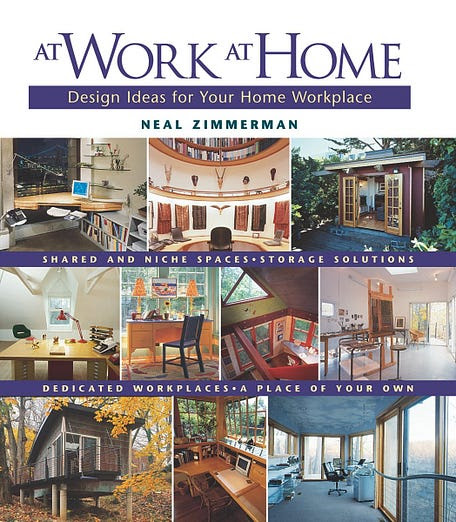
Not all home-office work is typing at a keyboard. That’s why this home-office design book is heads above the others. Maybe you are a weaver, or a landscape architect, or antique toy restorer. When I had a chance to design my own home office attached to our house I found the clear advice, helpful design ideas and visual inspiration in this portfolio to be the best of the bunch. —KK
Why do some of these spaces work and others fall short? I’ve reviewed hundreds of home workplaces, and I’ve concluded that those that are the most successful have three basic features in common. First, they help their occupants balance the two sides of their lives — work life and home life — in a way that is harmonious not just for them, but also for the people with whom they share their living and working space. Second, the workplace is well planned and well organized; it allows the user to work in a CEO environment — that is with Comfort, Efficiency, and Organization. Third, a successful home workplace has a personal spirit about it, which is a reflection of its occupant. It’s this personal spirit that stimulates home workers to do their best work.
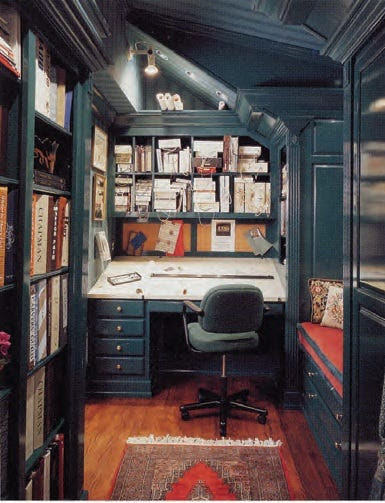
Well-planned drawers, storage cubbies, and bookshelves are synonymous with organization and efficiency, hallmarks of a successful home workplace. In this shared space, the execution of the design is simple and the result elegant.A niche within a converted attic is stylized to the max. Niches within the niche are used to their fullest extent for the odd-shaped storage items that are stock-in-trade for an interior designer. The window seat provides some relief in the tight space and also incorporates flat drawers for plans and large drawings.
Once a week we’ll send out a page from Cool Tools: A Catalog of Possibilities. The tools might be outdated or obsolete, and the links to them may or may not work. We present these vintage recommendations as is because the possibilities they inspire are new. Sign up here to get Tools for Possibilities a week early in your inbox.