






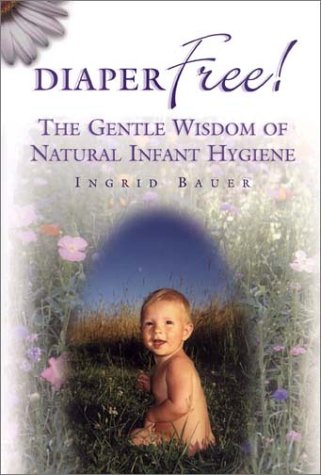
How to toilet-train before two
In my many years traveling throughout Asia I saw almost no babies with diapers. Yet I commonly saw infants who would seem to eliminate on command. Their moms would hold them over a gutter with their pants down, whistle a quiet hiss, or grunt, and then the baby would go. At one year! Two-year olds would find their own place to squat. The real story behind this magic is that the child communicates their elimination needs to the mom, who learns to understand their unique signals, and then she communicates back whether all is ready or not. The result is a baby toilet-trained long before anyone in developed countries believes is possible, or even healthy. And this diaper-less, yet mess-less, state is common in parts of Africa and Latin America as well.
But I never imagined it would work in the modern world of carpeting, cars, and obsessive sterility. I’ve had my mind changed by this book and a growing movement meeting online, where pioneering parents have figured out how to translate this very natural approach into contemporary lives. They call it natural infant hygiene to emphasize that this is not about training, discipline, or being strict. Instead, its success depends on a very close bond between baby and parents. Indeed, most parents who adopt this style claim that the incredibly close communication with the baby is worth far more to them than no pampers, and being diaper free is simply a mere bonus.
So does it really work? Yes. But what about….? Those are questions this book does a pretty good job at answering, or at least beginning to answer. Much of the modern version is still being sorted out. For instance for some families, diaper less mean less diapers rather than no diapers. But in all cases it requires a pretty big commitment of time (natural elimination does not work in full time day care), and a different way of thinking (pee is sterile, not dirty).
The natural baby hygiene program reminds me a lot of the early breast-feeding movement, with which it shares many attributes. Both practices were common in developing countries, both demanded an intense bond with the mother, and both required a re-education of the modern public to accept. It’s going to be a long struggle to get folks used to carrying chamber pots around, or having their baby pee on your lawn, but I think it will happen in small numbers. Our family is long past the diaper age, but if we were doing it again, this way makes a whole lot of sense.
For those so inclined, this is the best book to date. There’s a corresponding active website as well. — KK
- Babies who are consistently in diapers are not as comfortable or hygienic, don’t have their elimination needs responded to in the moment, maintain less awareness of their body functions, and must relearn not to use their clothing as a toilet. Infants and active toddlers often become upset and resist diapering, and parents and pre-schoolers may become frustrated during the process of toilet learning, whether it is “taught” or not. The costs, both personal and environmental, can be significant.
Natural Infant Hygiene takes the best of both these options and adds a few benefits of its own. The child enjoys the comfort, respect, body awareness, and hygiene of being diaper-free from infancy. The parent appreciates the convenience, and saved labour and expense. Best of all are the benefits that both parent and baby share: closeness, intimacy, mutual responsiveness, awareness and communication, and environmental sustainability. Diaper freedom!
- From watching many babies and talking to their parents, I have come to the conclusion that individual babies signal their needs in many different ways. However, signals that the caregiver picks up and responds to, are often the ones that become reinforced and used most. It's like a natural feedback loop. This may be the reason why babies in some cultures reportedly exhibit specific signs, while in other cultures different signs are considered common.
- In traditional societies, cueing sounds for peeing often resemble the sound of flowing water, or urination itself. It’s interesting that these sounds are quite similar from continent to continent. From India to Botswana to Peru, a “sss, sss” sound had become an almost universal mothering signal. In places, a sharp “pssss” or a softer “shhh” or “shuuss” is used. In Japan, the childhood euphemistic equivalent of pee-pee is “shii shii”. A low whistle is also sometimes used in Japan, and a steady whistling sound is the primary signal in China. As these cultures move towards urbanisation, a running faucet sometimes replaces the gentle hissing-type vocalizations, for example when peeing the baby over a sink.
Cueing for defecation is common as well. A grunting or straining imitation, such as “uhh” or the “ung-ga” used in Korea, is a frequent cue. Low humming or simply saying “hmmm” is also quite common. - It's not at all impossible to make longer journeys, for example by plane or in foreign countries, while practicing Natural Infant Hygiene. In airplanes or foreign travel situations where I was unsure how well I would be able to accommodate my baby's elimination needs, I put him in an easy-to-remove cloth diaper with snaps. On an extended trip abroad when my son was 11 months, we manage to travel for an entire day by plane, bus and ferry, with the same diaper. I still continued to "pee" him regularly, as though he were diaper-less, simply taking the diaper off and putting it back on when he was finished. That way if we got stuck in a customs or airplane bathroom line-up, or otherwise couldn't make it to a bathroom, it was not an emergency. Had this happened, I would have explained to my child that he could go in the diaper, while holding him in position and making the cueing sound, and then changed him a promptly as possible.
- It's unlikely that you'll be able to practise Natural Infant Hygiene and never have an "accident." It's just as unlikely with a conventionally trained 3 or 4 year old. What is likely is that a baby, whose elimination needs are responded to from infancy, will stop having occasional lapses long before they are three.
- For example, numerous parents have told me that it helped them to learn that pee was sterile when it leaves the body. We are so conditioned to think of urine as “dirty” that many people are unaware of this fact.Basically, urine is a sterile fluid containing approximately 96% water. The rest is made up of valuable mineral salts and trace elements that the body needs for proper functioning, but which, at that moment in time, are available in excess and therefore discarded.
- Although a natural hormone causes the kidneys to produce less urine at night, most babies do pee during the night, at least for the first weeks or months. Most diaper free infants will stay dry during naps by a few months, especially if they urinate not long before. They can then be taken to pee as soon as they awaken. Some diaper-free babies will also be dry all night by about the middle of their first year. Some children, like some adults, continue to use the bathroom during the night as they grow.
- An American ethno-medical researcher once commented to me that Natural Infant Hygiene wouldn’t be considered remarkable anywhere outside of North America or Europe. Only here is it absolutely astounding and fascinating.Yes, Natural Infant Hygiene is amazing. Just as a mother’s breast, producing the perfect quantity and quality of milk for a unique baby at a specific time, is amazing. Like breastfeeding, Natural Infant Hygiene strikes parents as unbelievably magical, awe-inspiring, and miraculous. And like breastfeeding, it is utterly practical, concrete, and down-to-earth doable.
When my son was newborn, I first noticed clear body signals for pooping, and relied mostly on general timing patterns for peeing (and watched for signals). Soon this shifted, as I became aware of the timing of regular bowel movements. Catching on to the process, my son also made increasingly clear signals when he needed to pee. Before long, it became mostly an intuitive process, whereby I just knew when he needed to go whether I was watching him or not. I still used after sleep timing as well. It remained this way, until he grew old enough to begin using the cuing language himself, and was able to signal me vocally and through movement, and finally go independently. I still relied on timing and intuition for backup and nights. All three tools, both separately and interwoven, were invaluable at different phases.
The fourth tool, the one that is universally important across cultures, is cueing the baby. Cueing consists of holding the baby in a specific position, and using a specific “trigger” sound or action. This “cues” your child for the opportunity to relieve him or herself in a comfortable, secure, and hygienic way and provides the essential physical support your baby still needs. Just as you bring a baby to your breast to nurse until they can come themselves, you hold the baby in a comfortable way to eliminate until they can do so independently. - Sample excerpts from the FAQ at
Diaper Free Baby: http://www.diaperfreebaby.org/Why Elimination Communication (EC)?
A few common reasons that parents choose to practice EC are: to recognize and respond to baby’s self-awareness; to promote close communication between child and parent; to prevent diaper rash; to avoid struggles often associated with diaper changing and toilet training; and, as side benefits, to save money and use fewer environmental resources.
Don’t the experts warn against potty training babies before they are ready?It’s important to note that this is Elimination Communication, not training. This is a gentle process that follows the infant’s cues and needs, and is never coercive or punitive. As such, this practice is consistent with the baby’s development and maturity.
Easy cloth diapering
We buy cloth diapers for our baby, as a greener, cheaper and healthier alternative to disposables. Several companies make cloth diapers with snaps or Velcro fasteners, but those can hit $20 apiece or more.
Flat diapers are much cheaper, and can be folded to fit any size baby, but there’s no built-in fastener. The traditional approach used to be safety pins, but it’s a daunting task to pin a diaper without stabbing the baby or yourself with the sharp point.
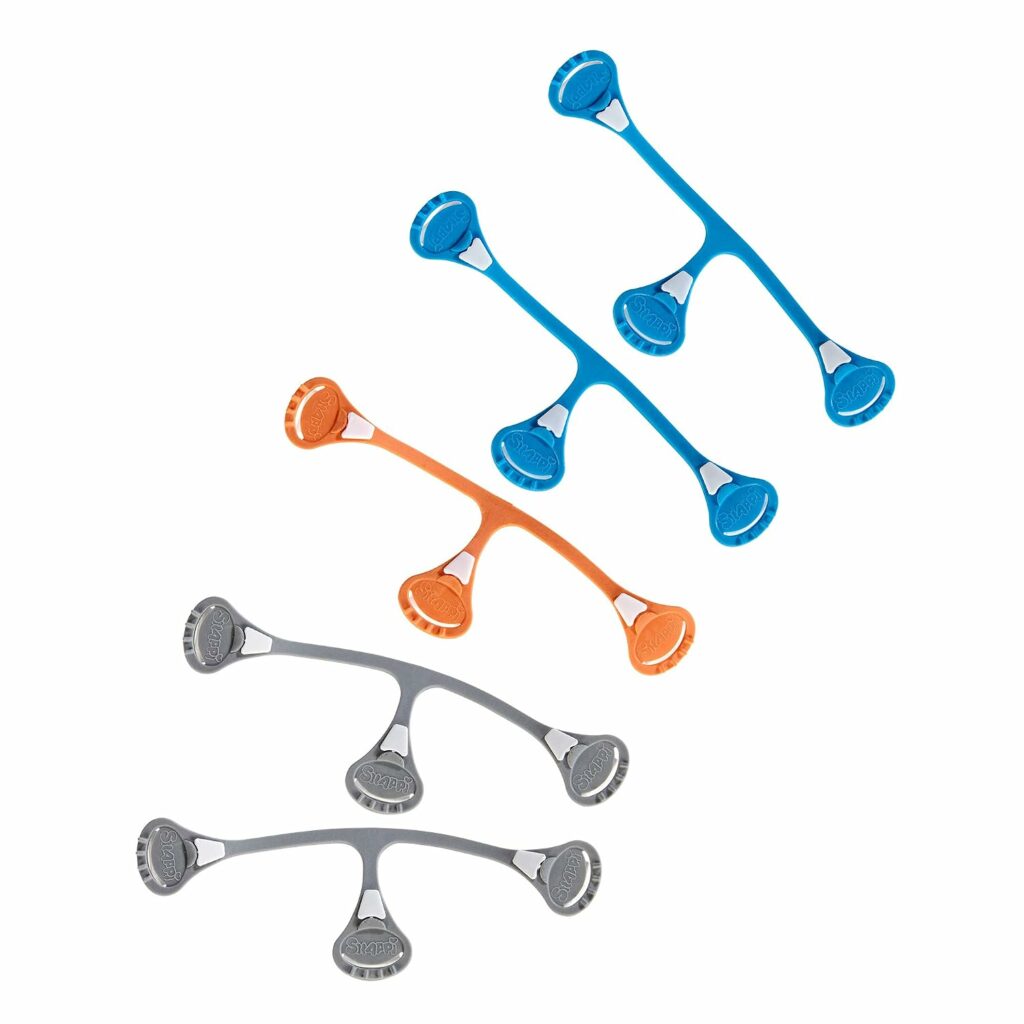
The Snappi diaper fastener is a rubber elongated “T” with plastic teeth at each of the three ends. The teeth hold the diaper securely, but are too short to go through the diaper and into the baby. Putting the Snappi on is about as easy as using Velcro, and taking it off is even easier. It’s simple to clean and has a lifespan of about six months.
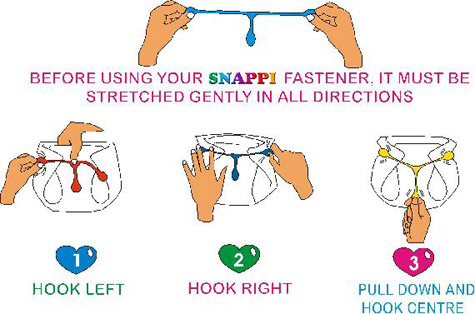
We tried an off-brand version first, and it nearly sent us back to pins — the teeth wouldn’t hold, and the plastic bits that connect the teeth to the stretchable body of the “T” always separated from the rubber. The Snappi brand fasteners never gave us any trouble. — Scott Noyes
Once a week we’ll send out a page from Cool Tools: A Catalog of Possibilities. The tools might be outdated or obsolete, and the links to them may or may not work. We present these vintage recommendations as is because the possibilities they inspire are new. Sign up here to get Tools for Possibilities a week early in your inbox.
