Nature Study
Tools for Possibilities: issue no. 206
How to hear the natural world
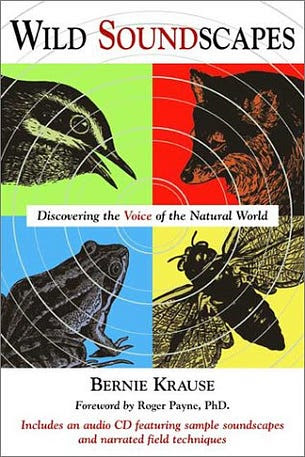
Wild Soundcapes
What a rare gem: a how-to book that changed my mind. Or at least my hearing. Audio recordist Bernie Krause has captured the sounds of ants eating, of sand dunes shifting, of frogs croaking in duets with airplanes, and the winds sweeping over prairie grass. This subtle yet omnipresent universe of natural sound was something I had mostly ignored. Krause’s practical guide is a fantastic re-education. Using a tiny digital recorder as my new ears, under his guidance nature is reborn into ever-changing radio-stations of novel sounds. His how-to advice is among the best how-to I’ve read; smart, specific, just the right level of detail and backed by 30 years of doing it. Since sounds often trigger more memories than snapshots, recording soundspaces should be as easy and satisfying as photography, and with Krauses’ advice it is. His book is dense with sonic adventures in the wild, and a 55-minute trophy CD. It’s the ultimate guide: every page compels you to get up and do it. See with your ears! — KK
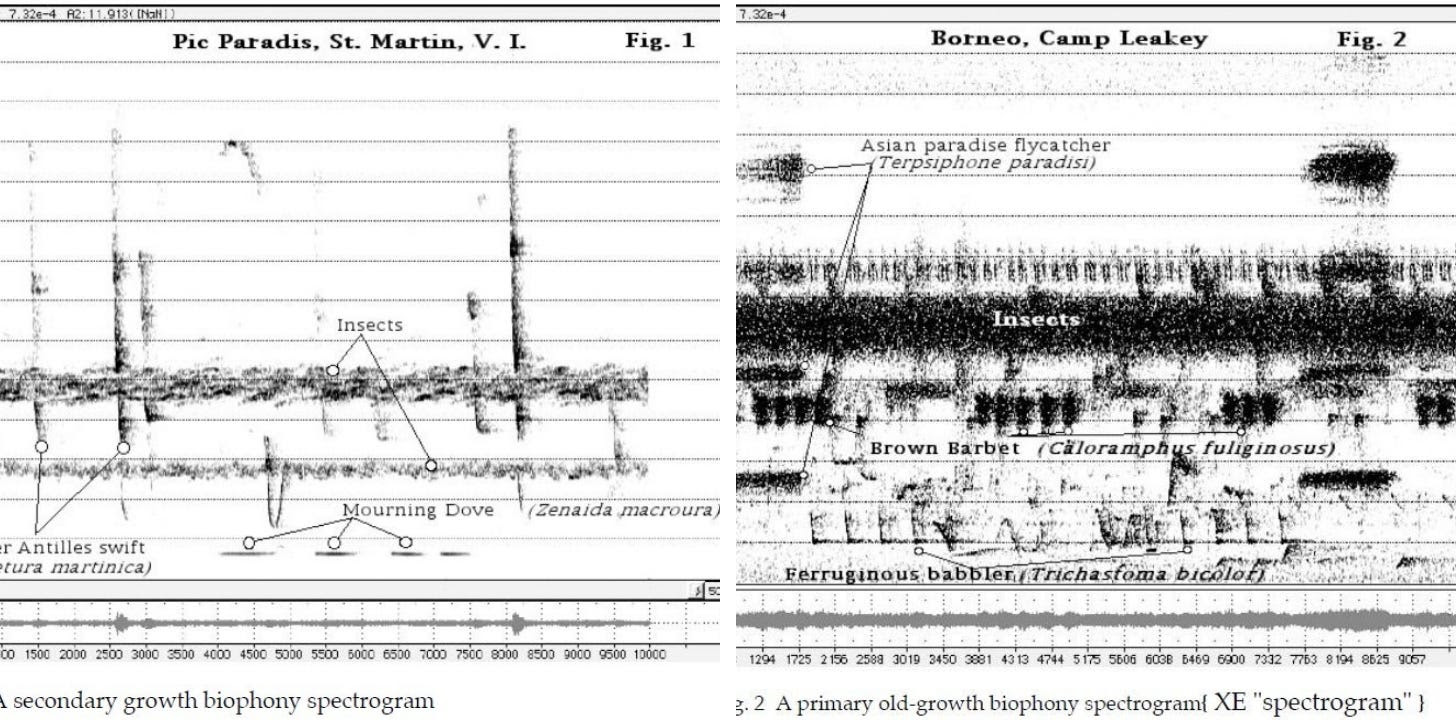
- Every living creature has a sound signature––from the smallest microorganism to the largest megafauna. Even vegetation! Once, I was sent to record corn growing in Iowa. I sat in a remote field for two hot August nights with my recorder and mics, swarmed by mosquitoes and fighting off flies. Around midnight, I heard slight popping sounds which grew into lots of popping sounds as the stalks of corn telescoped and grew in length almost perceptibly in the moonlight. The friction caused them to squeak and pop, hence the sound signature of corn growing. Every sound connected in a vibrant interrelationship magnified by the use of my recording gear. I’m still trying to find words to describe the voice of growing corn.
Bargain superior binoculars
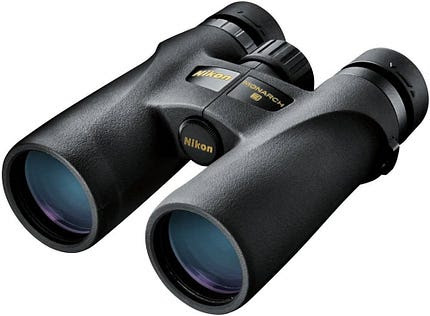
Do high-priced optics really make much difference in a pair of binoculars? Yes. Great optics create a very bright image within a large viewing area, so that if feels as if you are looking through a magic window rather than squinting through a tiny peephole. Your eyes scan the scope easily, as if there were no glass in front of them — except everything is closer. You can watch longer, in dimmer light, without fatigue, which is what you want for birding, sporting, or boating. If great optics are squeezed into a lightweight waterproof small object you can hold this magic window longer without the shakes. In short, superior optics make distance viewing clearer, easier, weather tolerant and all around better. According to the Cornell Ornithology Lab and Birder’s World, the best buy for high-quality optics birding binoculars are the Nikon Monarchs. The go for about $216 on the street.
These are startlingly bright, wide-eyed, and lightweight (21.5 oz), which has made the Monarchs a best seller. Because they are waterproof and shockproof — with an amazing 25-year warranty — they are also very popular with hunters. They can also focus as close as 8 feet — ideal for dragonfly and butterfly viewing (thus the name Monarch).
If you have not examined binoculars recently they are undergoing a performance curve similar to cameras, getting better and cheaper each year. These $250 binocs would have cost $1,000 only 5 years ago. When friends view these Nikon Monarchs, they go “Wow! It’s like a movie screen!” I’ve found the ease of viewing — sort of like watching a flat screen rather than peering through a tube — encourages me to use them more. I also like the fact they are waterproof so I can use them in the rain and mist without worry. I wear prescription sunglasses and these work perfectly fine with them. They also feel well-balanced in my medium hands. I find I can hold them fairly steady for long periods of time with one hand. None of this was true with my inexpensive binoculars in the past.
The very best binoculars today go for $2,000. But for only $216 (what I paid ), or one tenth the price, you can get a pair of these Nikon Monarch binoculars and get 95% of the same performance. Sure, in a one-to-one comparison, a pair of $2,000 binoculars may be a little better, but they are not 10 times better.
Other new models share many of the same features of these 8×42 Monarchs, including sealed optics, waterproofing, coated glass, and bright viewing, but these others cost a minimum of $500-600. There are certainly cheaper binocs (you can get decent ones for $50) but they suffer from dim views, narrow fields, short lives. The Nikon Monarchs make a fantastic tool: You get most of a thousand-dollar view for a bargain price. — KK
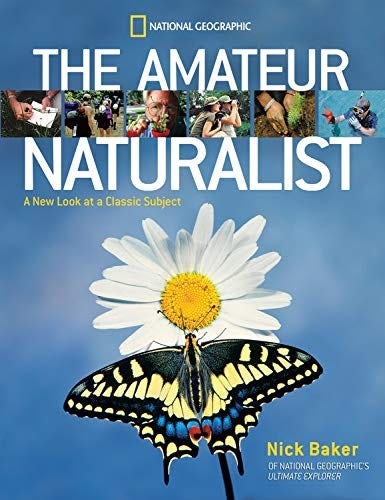
Best nature how-to
The best hands-on-guide to nature experiments in print. Chock full of projects doable in a few hours to a day, whether you are an adult or kid. Just outside your door, no matter where you live, is the largest laboratory available anywhere. Hello, living neighborhood! — KK
Mounting and displaying bones.
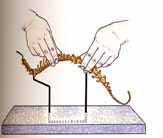
Forget plastic model-making – this is the ultimate model kit!
- Resist the temptation to collect lots of spawn or tadpoles. Although you often come across huge quantities in the wild, only a few percent of it will survive. So collect a small quantity of newly laid spawn – it should be quite firm and easy to separate with your finger. Half a cupful is an ideal quantity to achieve a ratio of three to five tadpoles for every liter of water (14-22 per gallon).
Take spawn from garden ponds wherever possible – it keeps your impact and disturbance of wild populations to a minimum. It is also good practice not to risk contaminating a habitat by introducing spawn, pond weed, or any other form of life that you have collected elsewhere. This is commonsense herpetological hygiene. Frogs in particular suffer from contagious diseases that may be spread unnecessarily in this way.
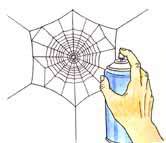
- Although the very fragility of a spider’s web is part of its attraction, it is a shame to think that these phenomenal feats of design and construction rarely last longer than a day. However, if you find a web without a spider in residence, it is possible to collect and preserve one of these fabulous structures. Choose a still day and make sure the web is dry, with no droplets of dew.
You will need:the most gorgeous orb web you can finda sheet of newspapera can of white or black spray painta can of artist’s fixative (available at art shops) or hair spraya sheet of cardboard large enough to fit the web on and in a color that contrasts well with the paint
scissors
1. Position the newspaper behind the web so that you don’t get paint all over whatever is behind it, then spray the web evenly and lightly on both sides from a distance of about 40 cm (16 in) – much closer and the pressure of the paint will damage the web. Leave it to dry for a while and repeat.
Once a week we’ll send out a page from Cool Tools: A Catalog of Possibilities. The tools might be outdated or obsolete, and the links to them may or may not work. We present these vintage recommendations as is because the possibilities they inspire are new. Sign up here to get Tools for Possibilities a week early in your inbox.
09/7/26