* Talk to me. Tell me a story. Share me a tip. * Support my work by buying my tips books (Vol. 1, Vol. 2). * Take out an Unclassified in this newsletter to reach fellow makers.
Pry Bar Tips and Tricks
Image from Family Handyman
Through an article in Family Handyman on pry bar tricks, I learned of something called an inflatable pry bar. Maybe this is a tool common to others, but I’d never heard of it, and now I think I need one in my life.
Beginner’s Tips for Using an Oscillating Multi-Tool
I recently broke down and bought my first oscillating multi-tool. If you’re also new to this strange-looking type of tool, here are 20 basic tips for getting more out of it. I especially agree with the tip about buying cheap accessories first, finding out which ones you use most often, and then investing in better quality versions. That’s what I did. Here’s a follow-up video on sharpening multi-tool blades. And the Project Farm video he refers to on the best multi-tool blades (TL;DR: Get the EZARC blades, $7.60 each in pack of 3).
Great Collection of Sewing Tips
I am working on a special project that has me going through the archives of Makezine.com. In doing so, I’m unearthing some gems, like all of the sewing tips that were posted over the years by Haley Pierson-Cox and others. Sewing is one of those foundational DIY skills that everyone should at least know the basics of (both hand and machine sewing).
Using a Hobby Polishing/Sanding Tool to Smooth 3D Prints
I have long been a huge fan of the Mr. Hobby Polisher Pro sanding tool. This is a simple (and a bit overpriced) battery-operated disc polisher/sander sold to the hobby market for sanding off sprue material and finishing models. It’s basically an electric toothbrush with a sanding disc head. The Polisher Pro comes with 3 sheets of sanding pads in 600, 800, and 1000-grit. There are 45 pads in all. I’ve had my tool for several years now, use it often in game modeling, and still have plenty of pads left. There are also replacement sanding pads available on Amazon (and there are pads available in other grits). This video introduces a use I hadn’t thought of: sanding layer lines and joins in resin and FDM 3D prints. The video doesn’t have a lot of content beyond that basic idea, but I was happy to discover another use for a tool I already own. I know many will say: Just use a Dremel tool! You can if you have a mini Dremel, but for modeling, this tool is better sized and not as aggressive as a Dremel. And, don’t be like the guy in the video. Always wear a mask when sanding resin and plastic.
The Creative Process in a Nutshell
1. This is awesome 2. This is tricky 3. This is shit 4. I am shit 5. This might be OK 6. This is awesome
This was posted on film/theater director Marcus Romer’sTwitter feed. This is a riff (to put it kindly) of an original list by Kazu Kibuishi. I like the above saltier expression of the idea, but your mileage may vary.
TOYS! Carhartt Work Shirts
For years, I’ve seen other people wearing Carhartt work shirts and for some reason never thought of buying one myself. I recently bought two, one in charcoal and one in denim blue. Man, do I like these shirts! Super well-made, comfortable, nice fabric, rugged, and good looking. And I love the pencil/pen slit in the right pocket. I think these shirt will be my go-to garment forever more. Carhartt work shirts are also available in women’s sizes.
Shop Talk
I got the following message from reader John Baglio. I don’t recall such a playlist crossing my transom, but it sounds great. If this rings anyone else’s bells, please message me.
“I was just thinking back over some of the better engineering videos I’ve seen in the past, and I was thinking of a playlist that I thought I saw in one of your newsletters. It was done by an engineer who I think was either Russian or Israeli and it was a whole series of pieces of wisdom for people fabricating parts. One of the things that I remember him saying was design captive hardware whenever possible. I was wondering if you might remember what that playlist was. If so, is there a way you could either send it to me or posted in one of your upcoming newsletters? I remember it being chock-full of amazing advice for fabricating parts.”
Become a Patron!Support our reviews, videos, and podcasts on Patreon!
Cool tools really work.
A cool tool can be any book, gadget, software, video, map, hardware, material, or website that is tried and true. All reviews on this site are written by readers who have actually used the tool and others like it. Items can be either old or new as long as they are wonderful. We post things we like and ignore the rest. Suggestions for tools much better than what is recommended here are always wanted.
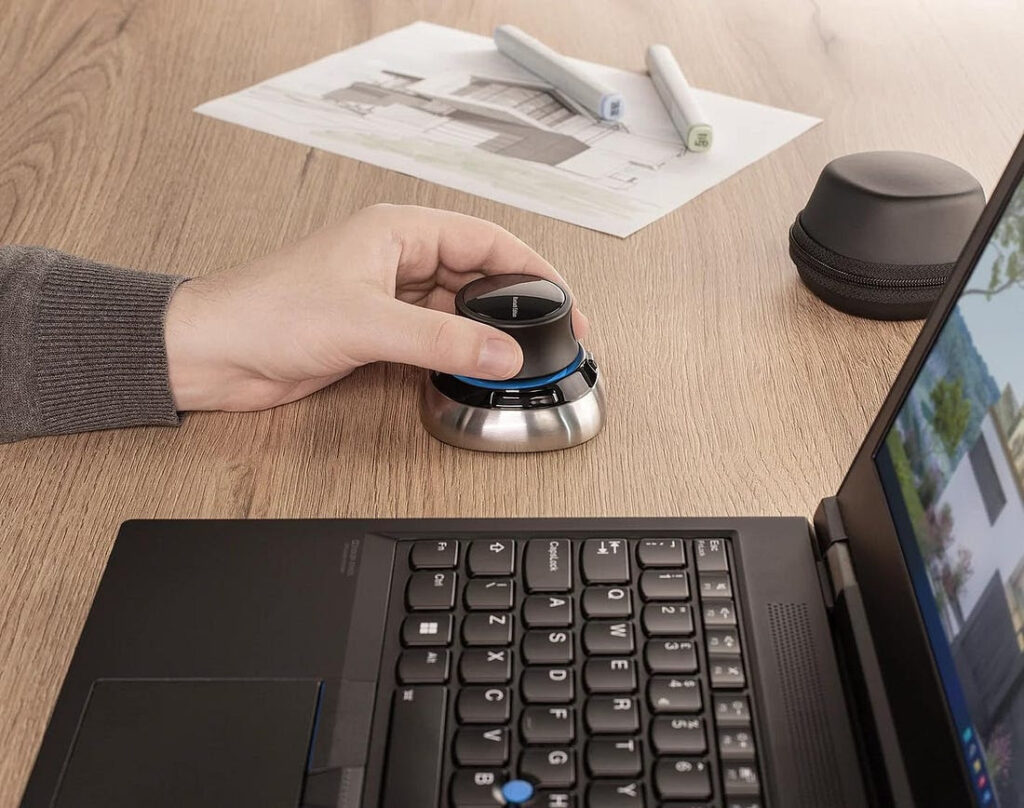
Logitech now sells a low-cost, very high quality, 3D controller called the SpaceNavigator. When I bought mine, you could get an edition for personal use that is only $59 (instead of $99 for the pro edition). This increases Sketchup productivity and fun factor by 2-3 times. If you like SketchUp you have to have this!
The SpaceNavigator is a six-axis controller that you use in conjunction with the mouse and keyboard. With it you can move around the model in three dimensions, intuitively and without changing from one mode to another (e.g. pan to rotate to zoom). You can also configure it to work in what ever fashion is easiest and most intuitive for you. With a little practice you can move through and around the model using the mouse and SpaceNavigator, never touching the keyboard. It provides a huge increase in productivity and, frankly, fun. I’m designing an addition to our house and my kids (6 & 8) have learned to fly through the model without my help. Of course you can use it with other 3D applications, like AutoCAD, Rhino and Maya.
This is one of those things that you purchase and fall in love with because it’s useful, high-quality, and inexpensive. (It works in Windows, Linux, Unix — but not Mac!)— Mike Green
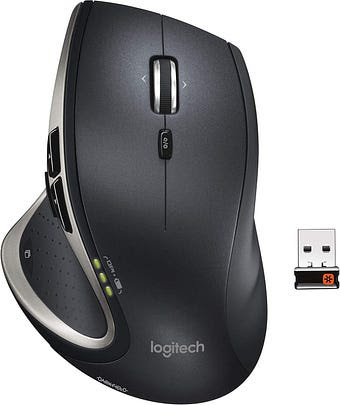
I’ve been using Logitech’s Performance Mouse MX and its former model for about four years. They all have one important feature: hyper fast scrolling. Since I’m an engineer who has to deal with source code files that easily contain thousands of lines, I have to scroll an ordinary mouse hundreds of times to browse a file. With hyper fast scrolling, it only takes one single scroll as the wheel spins with minimal friction. This really reduce the stress on my fingers. It can also easily be switched back to normal scrolling behavior (by pushing down on the scroll wheel) when I’m not dealing those gigantic files. — Jordan Cherng
Similar to Jordan’s Logitech Performance Mouse MX is the Anywhere Mouse MX that I’ve been using for the past two years. Unlike the Performance model, the Anywhere model is significantly smaller, and is easily packed in the included carrying case. Despite the small size, I find it to be one of the most comfortable mice I’ve ever handled which is especially surprising as I have large hands!
Outside of size, the two mice are remarkably similar. Like its bigger brother, the Anywhere Mouse also features “hyper-scrolling” which is very useful when dealing with large documents or long web pages. The scrolling (among other features) is customizable with the included Logitech software (that works for both PC and Macs). Outside of scrolling, they both feature programmable buttons, and most importantly very accurate tracking. Logitech calls their technology Darkfield which they claim is better able to respond to irregularities on a surface (and thus respond more accurately during tracking). I’ve used mine on many shiny surfaces which normally confuse optical mice without any problems, with the biggest surprise coming when I used it on a glass countertop which is normally a no go for laser-tracking mice.
The only other significant differences between the two are that the Performance Mouse can be charged via micro-USB, and that it has a few more buttons for those who want to maximize the customizability of their mice. Both use Logitech’s unifying receiver (which we’ve reviewed in the past) and have excellent battery life. My Anywhere Mouse gets about 4-6 months of use from two rechargeable AAs.
Despite being significantly more expensive than other mice on the market, I have found that these higher end Logitech mice are worth it. They are comfortable and reliable pieces of technology that seem to disappear in use, and for that I’m incredibly grateful. — Oliver Hulland
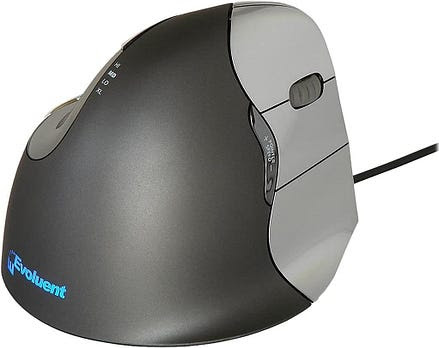
From a relaxed standing position with your arms at your side raise your right hand while holding your elbow still until your fore arm is level with the floor. Spread you fingers apart and rotate your hand until your palm is facing down – keeping your elbow at your side. Now if you are anything like me your hand is rotated about as far as it can. In mechanical parlance, the wrist is “hard against the stops.” When you are using a conventional mouse it is in this rather tense and uncomfortable position that your hand remains. As a designer I often spend days on end at the computer modeling in 3D – left hand on the space ball and keyboard with right hand on the mouse. Over time I began experience a myriad of painful symptoms from fore arm throbbing to thumb tenderness to shoulder aches. These discomforts grew into debilitating pain to the point I wondered if I could continue in my chosen profession. And then I discovered the Evoluent Mouse – and instantly the pain and discomfort tailed away to nothing.
Repeat the previous exercise but this time place your hand in a vertical – hand shake like – position. You will find that your hand is now very relaxed residing as it does pretty close to halve way between hard right rotation and hard left. The Evoluent mouse looks like a mouse turned on its edge with the laser tracking business on the edge of the mouse. This configuration positions the hand and wrist in a basically neutral position thereby avoiding the stresses rotating the hand to a palm down position induces.
I cannot overstate how drastic an improvement this mouse is from all others. Both Microsoft and Logitech make products which rotate the hand partially toward the vertical but these are partial measures and do not afford the total neutral ergonomics provided by the Evoluent. If you are fighting soreness or pain from you mouse arm-hand – please give your body a break and give the Evoluent mouse a try. — Donald Ansley
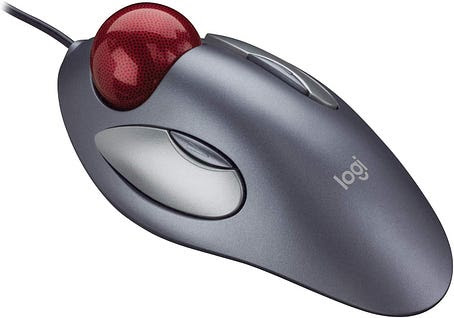
While I’ve always spent a lot of time computing, the precise, all-day cursor movements of professional writing and designing (a recent switch) got me vexed with my previous mouse’s lack of control and an aching wrist. After borrowing a friend’s $70 trackball and enjoying the fingertip control and comfort, I set out to get tracking at the lowest possible cost and highest possible comfort. I settled on the Logitech Marble Mouse.
Shaped like a low, oval hill, this $20* mouse is a nice inverse of the natural curve of a hand. The trackball sits naturally under the index and middle fingers and moves very smoothly. The sizable left and right buttons are situated directly under your thumb and ring finger, while the two smaller buttons above them can be designated for a variety of functions like scrolling and zoom. The symmetry also makes it ambidextrous, which is great for any left/right-handed families that share a home computer.
I did try a few thumb-operated trackballs, but a slight weirdness in my right thumb joint causes some discomfort when I move it a lot. Every time I put my hand on the Marble Mouse, I’m able to keep it totally relaxed. The mouse is large enough for comfort, but still relatively small enough to take on the road. The build quality is solid, and it’s easy to clean. Best of all, my wrist no longer smarts after a long day’s editing.
Bonus: the heavy, low-friction ball makes a nice desk toy when you need a break. — George Cochrane
Once a week we’ll send out a page from Cool Tools: A Catalog of Possibilities. The tools might be outdated or obsolete, and the links to them may or may not work. We present these vintage recommendations as is because the possibilities they inspire are new. Sign up here to get Tools for Possibilities a week early in your inbox.

 Image from Family Handyman