Become a Patron!Support our reviews, videos, and podcasts on Patreon!
Cool tools really work.
A cool tool can be any book, gadget, software, video, map, hardware, material, or website that is tried and true. All reviews on this site are written by readers who have actually used the tool and others like it. Items can be either old or new as long as they are wonderful. We post things we like and ignore the rest. Suggestions for tools much better than what is recommended here are always wanted.
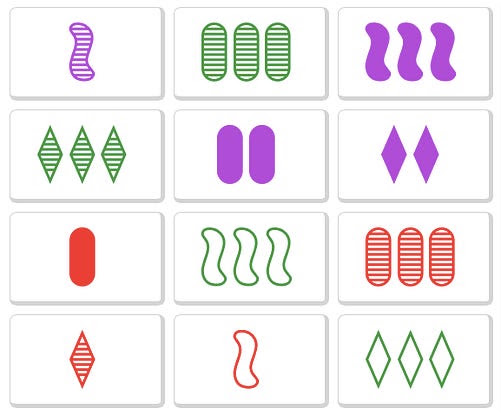
A simple game in a class by itself. You get a deck of cards with colored symbols. These are laid out, face up. To play the game you need to organize the symbols into sets of three “un-alikes” — but they can be grouped in more ways than one. Many more ways. Everyone else is trying to group them into sets faster than you. This game exercises a unique part of your brain that few other activities do. Half math, half intuition, all concentration. It’s fun, loud, fast-moving, and very challenging to do well, yet easy enough for small kids to join in meaningfully (that is, do better than you). After several years of playing the game, here is what I’ve observed:
1) It can’t be explained; it has to be shown.
2) Some folks are more gifted than others at finding patterns fast.
3) But *everyone* improves, often within the span of a game.
I hear that many schools use this game to teach sets and logic in math class, and that’s great. We use it as a raucous parlor game. Like the game Go, Set possesses the kind of simplicity which keeps expanding, never growing old. And as far as games go these days, it’s cheap.— KK
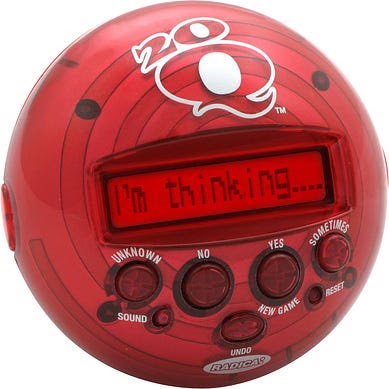
This tennis ball-size orb knows what you are thinking. Most of the time it will guess what you have in mind after asking you twenty yes/no questions. It is eerily smart, and slightly addictive.
The toy is remarkable. Because it is so small, so autonomous, its intelligence is shocking to the unprepared. Most children can’t stump it, and if you stick to objects it will stump smart adults about 80% of the time with 20 questions and most of the time with an additional 5 questions. I love to watch people’s reactions when they think of a “hard” thing, and after a seemingly irrational set of questions you are convinced are dumb, the sly ball tells you what you had in mind. (For instance, it can correctly guess “flying squirrel”without asking “does it fly?”) People who play chess machines won’t be surprised, but just about everyone else is tickled. It feels like the future.
But right now, for ten bucks, you can get an amazing little artificial intelligence, about as smart as an insect — but an insect which specializes in guessing what object you are thinking of. And in that part of the brain, it’s smarter than you are. — KK
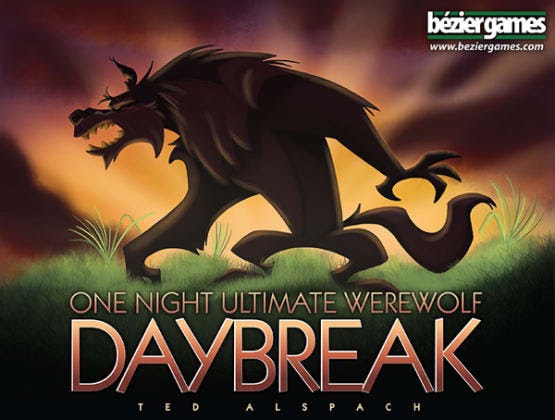
No recent game has given me as much pleasure as the parlor game known as Werewolf.* Whenever my extended family gathers for holidays, we play Werewolf over and over. I’ve played the game on company retreats, at tech gatherings, on group vacations. At Foo Camp, a rendevouz for nerds, epic sessions of Werewolf will run all night long till dawn. It is that addictive.
Werewolf can be played with as few as 6-8 folks and as many as 30 or more. A game can last 30 minutes to an hour, and even very young kids can play. It’s a game of bluff and deduction. Think of poker, but without any cards or money. Some fans call it a “mind game.” In brief, the game assigns roles to players at random and in secret. One emergent group — the werewolves — must kill the innocent villagers, but no one knows who is who because the deed is done “at night” in a secret way. On each round of the game, the innocents will lynch a supposed werewolf as voted by the group after accusations and debate but they are never sure they have the right person. Maybe it’s the werewolfs leading the pitchforks!? Both the best and worst of human behavior is activated: lying, leadership, mob psychology, democracy, persuasion, deception, deduction logic, and imagination.
Because of the intense social dynamics, the game is eternally surprising and addictive. Werewolf is the only non-sport game I know of that is as much fun to watch as to play. Players who die early in the game will always stick around till the end, watching in fascination.
Like Charades, you don’t need any equipment, other than some index cards, or a deck of playing cards to distribute in order to assign roles in secret. But over years of playing we’ve found this dedicated deck of cards by Ted Alspach makes it much easier to introduce newbies, and to remember roles. The deck contains 40 or so cards printed with Werewolf roles and instructions. It also contains about 25 additional roles that can be added to the typical 5 main roles, which is why Alspach calls it Ultimate. As you play more often or the groups get bigger, you can keep the game exciting by experimenting with these additional roles.
A pretty good free rule set for Werewolf can be found online here. Grab a regular deck of cards, assign different picture cards to roles, and you are off. If you want a bit more help this Ultimate Werewolf deck includes a fantastic sheet of very clear rules and instructions (the best I’ve seen), with great tips on how to be a good moderator. And the rules stay handy with the ready-made cards. We’ve found that having the roles explained on each card is really helpful for new players. — KK
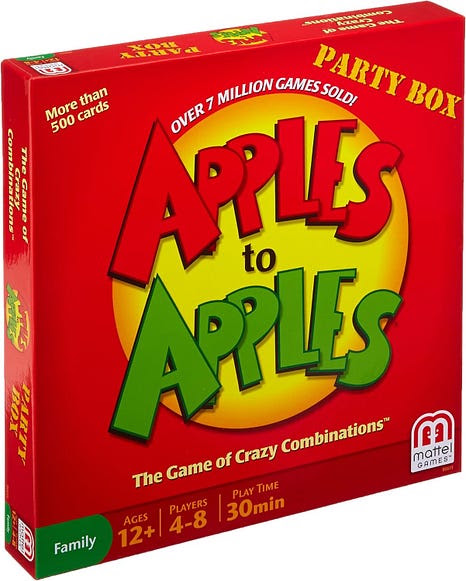
We’ve been playing this word-based card game for the last three years and it continues to be an enlightening ice breaker. There are two types of cards: nouns (red) and adjectives (green). Each player is given a small stack of nouns. The game begins when one player (the judge) draws an adjective. Each player then anonymously lays down one noun he/she believes the judge will associate with the adjective. Players can try to sway the decision, but ultimately, the judge’s power is absolute. Some people are inherently literal, sarcastic, wishy-washy, optimistic, stubborn or dryly humorous. The challenge lies in figuring out what type(s) of judges surround you and what kind of judge you want to be. Discovering who’s on the same wave length is always interesting. What’s more “magical” — a sunset, Thomas Edison, the Pyramids, surfing the net, or Barney the dinosaur? Subjectivity rules! — Steven Leckart
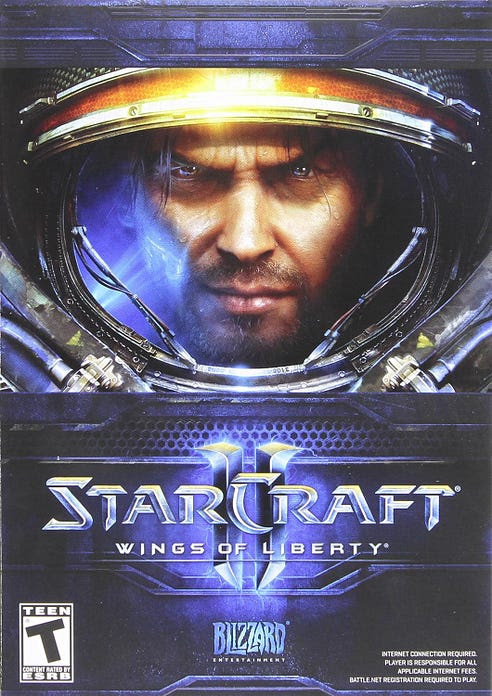
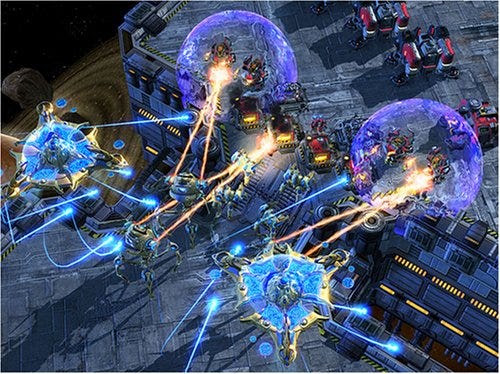
It’s best to think of StarCraft as more of a sport than a game. It’s played professionally, with televised matches, in Korea. The goal in StarCraft is to build a base, in order to create an army, which you then send over to destroy the opponent’s base. Your opponent, of course, is trying to do the same thing to you -- like chess. Besides athletic reflexes you also need lots of experience to know which strategies to use immediately. For newbies the nice thing is that as you get better, the server dutifully serves up better opponents. StarCraft is probably the most popular game in the “real time strategy” (RTS) genre; it is far more strategic than just a shoot-em up game but it is much faster than any strategy board game. A typical game duration is like chess -- most games probably last 30 to 45 minutes, with outliers that last more than an hour. It is so well-designed, and fast-paced that it is possibly the first real “digital sport.” It’s one of the few games I can imagine someone still playing in 5 years. Runs on Windows or Mac; requires internet connection. — Mark Hurst
Once a week we’ll send out a page from Cool Tools: A Catalog of Possibilities. The tools might be outdated or obsolete, and the links to them may or may not work. We present these vintage recommendations as is because the possibilities they inspire are new. Sign up here to get Tools for Possibilities a week early in your inbox.





Author and Editor Gareth Branwyn
07/10/14 Picks and shownotes