Become a Patron!Support our reviews, videos, and podcasts on Patreon!
Cool tools really work.
A cool tool can be any book, gadget, software, video, map, hardware, material, or website that is tried and true. All reviews on this site are written by readers who have actually used the tool and others like it. Items can be either old or new as long as they are wonderful. We post things we like and ignore the rest. Suggestions for tools much better than what is recommended here are always wanted.
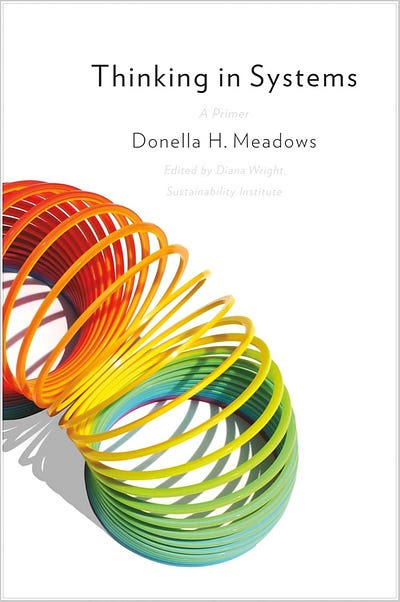
From the lead author of the landmark Limits to Growth report, Thinking in Systems offers a powerful framework for understanding complexity — revealing that war, hunger, poverty, and environmental destruction aren’t isolated problems but system failures that can’t be solved by fixing one piece in isolation.
Core Principles
Systems Generate Their Own Behavior
A system is a set of interconnected elements that produces its own pattern of behavior over time. The behavior emerges from the structure — the feedback loops, delays, and connections — not from external events. Stop looking for who’s to blame; instead, ask “What’s the system?” The system itself causes its own behavior.
Stocks and Flows Drive Dynamics
Every system has stocks (accumulations like water in a bathtub, money in an account, or carbon in the atmosphere) and flows (the rates at which stocks change). Understanding which stocks are critical and what controls their flows reveals why systems behave as they do — and why they often resist our attempts to change them.
Feedback Loops Create Stability or Growth
Balancing feedback loops push toward equilibrium (a thermostat maintaining temperature). Reinforcing feedback loops amplify change (compound interest, viral spread, erosion of trust). Most real-world systems contain both types interacting in complex ways. Finding and understanding these loops is key to understanding any system.
Find the Leverage Points
Not all interventions are equal. The highest leverage often lies not in pushing harder but in changing the system’s goals, rules, or underlying paradigms. A small shift in the right place — like changing what gets measured, or who has information — can produce large changes in behavior.
Try It Now
Pick a problem you’re struggling with. Instead of asking “Who caused this?”, ask “What’s the system that’s producing this outcome?”
Identify the stocks involved (what’s accumulating or depleting?) and the flows (what’s increasing or decreasing those stocks?).
Look for feedback loops: Is there a balancing loop keeping things stuck? A reinforcing loop making things worse?
Ask: Where is information missing? Often system malfunctions stem from key players not having access to the right information.
Consider: What would happen if you changed the goal or what gets measured, rather than just pushing harder on the current approach?
Quote
“Let’s face it, the universe is messy. It is nonlinear, turbulent, and chaotic. It is dynamic. It spends its time in transient behavior on its way to somewhere else, not in mathematically neat equilibria. It self-organizes and evolves. It creates diversity, not uniformity. That’s what makes the world interesting, that’s what makes it beautiful, and that’s what makes it work.”