
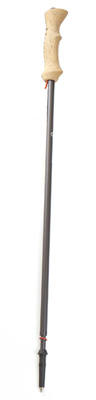
LT4 Trekking Pole
Lightest pole
Insanely light trekking pole. The lightness (less than 4 oz) means you can twitch it really fast to catch yourself because the pole doesn’t have a lot of inertia to overcome. It means your arm and hand tire far less in a day of swing-and-place. It means when you lash it to your pack, it adds little to your burden.
This pole has proved its durability for me on a range of hikes from casual to intense, in a variety of terrains. Adjusting the length with an untwist and retwist to lock is easy and reliable. Since they’re usually sold by the pair, you have a spare in reserve. (Trekking with two poles feels like skiing without snow for me; awkward and hand-encumbering. I like to be a three-legged creature in the bush, always able to brace for stability, striding like a pilgrim with staff.)
09/5/12LT4 Trekking Pole (adjustable) $80/pole Available from Gossamer Gear LT4S (adjustable, with strap) $88/pole Available from Gossamer Gear LT3C Fixed poles $110 per pair Available from
Core Principles
Genius Is Trained
In 2009, Nelson Dellis had an ordinary memory. Then he watched Alzheimer’s disease take his grandmother’s memory away. He decided that would never happen to him. He found a memory champion willing to teach him the tricks of the trade. Today he holds six national championships and two Guinness World Records. His message: what looks like genius is the result of training.
Memory Is the Foundation
Every skill in this book — fast reading, quick math, effective problem-solving — depends on memory. Dellis uses three simple tools to keep everything straight: pictures, associations, and something he calls the “memory palace.” These are the same techniques the ancient Greek orators used to memorize long speeches.
Focus Is the Multiplier
Your brain can’t multitask. It switches from one job to the next, and switching slows you down. But you can train your focus. A few minutes of meditation, slow breathing, and the discipline of finishing one thing before you start the next will get you there.
Break Impossible Questions into Answerable Ones
Someone once asked physicist Enrico Fermi: “How many piano tuners work in Chicago?” Fermi didn’t know the answer, so he broke the question into smaller ones. How many people live in Chicago? How many of them own a piano? How often does a piano need tuning, and how many can one tuner handle in a year? His guess was remarkably close to the real number. It’s a trick worth remembering the next time a problem looks too big to tackle: break it down into pieces that you already know or can look up.
Try It Now
- Walk through your house in your mind — the front hall, the kitchen, the stairs. Now place five things you need to remember in five different spots along that path. Later, take the same mental walk, and you’ll find them waiting for you. Memory experts call this a “memory palace.”
- The next time you’re introduced to someone new, don’t just nod and forget. Build a quick mental picture that ties their name to their face — the stranger the picture, the better it sticks.
- Set a timer for 25 minutes. Put the phone in another room. Work on one thing, and only one thing, until the timer rings. You’ll be surprised how much you get done.
Quote
“I would forget things just like anybody else. And I trained this skill. I learned it from another memory champion and practiced the hell out of it until I was able to do it.” — Nelson Dellis, interviewed on Here & Now, March 2026
Book Freak is published by Cool Tools Lab, a small company of three people. We also run Recomendo, the Cool Tools website, a YouTube channel and podcast, and other newsletters, including Recomendo Deals, Gar’s Tips & Tools, Nomadico, What’s in my NOW?, Tools for Possibilities, Books That Belong On Paper, and Book Freak.
