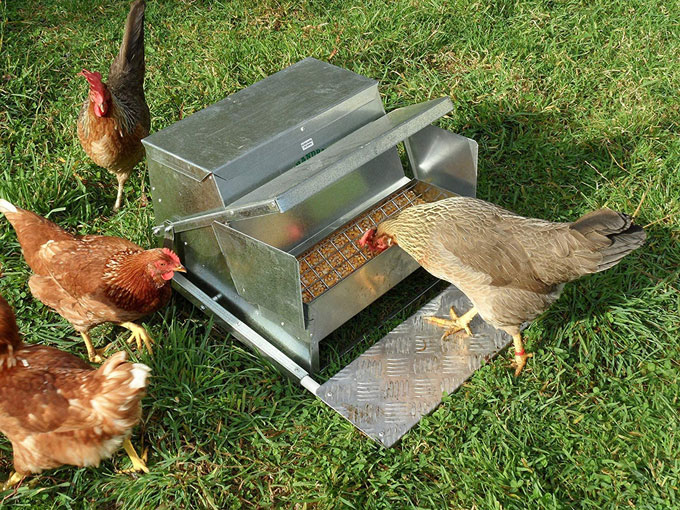
EcoGlow Chick Brooder

We bought this brooder last year after starting with the standard red heat bulb and metal reflector. We had some questions and problems with it:

  • How high do I have to hang the bulb? The answer is “low enough to keep them warm.” That height changes every few days to a week. Companies sell tripod like devices to hold these lights.
  • How long do I need to use the light? Until the chicks no longer need it. Again something you have to learn from observation and watching a thermometer.
  • We were raising our chicks in a cardboard box in the house. The light (which was on 24/7) was annoying. The heat was even worse. Plus we have two young children so we had to watch them to ensure they did not burn themselves.

The EcoGlow Brooder solved all of these issues. You set the height to allow the chicks to fit under it comfortably. As they get taller you just remove the legs and then move it up a notch and reattach them. Easy and obvious. When the chicks stop hanging out under the brooder they no longer need it. Again, simple and obvious. There is no garish light and it is impossible for the kids to hurt themselves since the device is cool to the touch everywhere but the area where the chicks are. It also uses less power than the typical 150-Watt bulb based brooder.

When it came time to store the device I first cleaned it and popped off the legs. Then I stuck it in a box on the shelf with the rest of our supplies where it quietly awaits the next batch of chicks. No need to worry about broken bulbs.

Yes, there are negatives, but they are minor. As the chicks age you have to clean the device. They will eventually perch on it and will do what chickens do. No big deal — you just unplug it and wipe it down with a bleach wipe. Despite the word “Glow” in the name this device does not emit light so you will likely need some form of light unless you have a window handy. But any old light will do and it only needs to be on a few hours a day. It can be a little hard to see the chicks huddled under the brooder but we never found it to be an issue.

Like other Brinsea products this one is a little expensive. We feel it paid for itself in convenience and long term usefulness.

-- Sean Perry  

Brinsea EcoGlow 20 Chick Brooder
$70

Available from Amazon

Manufactured by Brinsea


Snap-E Rat Trap

There are certain less-than-glamorous homesteading chores that I am really good at. Shoveling, doing dishes, and trapping rats. Sigh.

Rats around here are not the loathsome Norwegian variety, but rather wood rats, or pack rats, which look like a big mouse — kinda cute. In the woods, rats build pyramids of twigs 3 feet or so high — rat architecture — always in secluded spots, so you have to be bushwacking to come upon them. In semi-rural areas like mine they cruise human habitations for easy pickins. One year I trapped over 40.

For years I used the standard wooden Victor traps and would put peanut butter in a little piece of plastic (with punched holes), tied to the trigger with baggie ties. Then I started sheet-metal-screwing a 1/2″ copper pipe cap to the trigger, which I filled with peanut butter.

I went through maybe 4 types of other traps until I discovered these. They have a bait cup so the rat has to tug at it, thereby releasing spring—plenty strong enough to ensure fatality.

I’m writing this after getting one last night that had been eluding me for a week. Outwitted by a rat night after night.

Method: I washed 3 traps (getting rid of scent), smooshed some bacon in the cups, surrounded by smears of Skippy peanut butter — mwah!

And whack! Mighty hunter.

-- Lloyd Kahn  

Snap-E Rat Trap
$7

Available from Amazon

Manufactured by Kness


Amazon Subscribe & Save

I started using Amazon Subscribe & Save for ECGc (Green Tea) supplements initially out of frustration with my local health food store. They’d be out, only have small quantity options, pricing was all over the place.

Now a couple bottles ship to me every couple months at a good price, with free shipping even without Prime. I get an email in advance so I can skip a shipment, and I can also do an emergency “ship now” if I run out unexpectedly.

I’ve since gradually started putting other regular consumables into the Subscribe & Save queue to save money, time and effort.

-- Richard Viets  

[When you buy things using Subscribe and Save, Amazon gives you a 15% discount. I have been using Subscribe and Save for years. I'm surprised so many of my Amazon-using friends have never heard about it. I use it to buy vitamins and supplements, trash bags, cat food, toilet paper, batteries, paper towels, ziploc sandwich bags, Magic Erasers, and dishwasher detergent. - Mark Frauenfelder]

Amazon Subscribe & Save

Available from Amazon


Compression Pipe Repair Coupling

(Large photo) Rigid copper water pipe is generally sturdy stuff but it is not indestructible. Errant nails and screws will pierce it and deep freezes in uninsulated spaces can split it. Consequently, when copper pipes do fail, they tend to do so at the most inopportune times and in the most unforgiving places. (I once gutted an 1826 post-and-beam schoolhouse in the frozen depths of a Vermont winter, so I know whereof I speak.)

Rigid copper pipe is typically joined by soldering — using an open-flame torch in tight spaces next to wood framing — so replacing damaged pipe sections can be perilous. Unless, that is, you use a copper compression repair coupling, also called a copper slip-repair coupling.

A repair coupling is a straight length of pipe (typically 12″ long) with a compression fitting at each end. Each fitting contains a brass ferrule which, when compressed, creates a watertight seal. (Lavatory risers typically use compression fittings.)

Repair couplings are available for both ½″ and ¾″ copper pipe. For example, Home Depot sells a 7/8″ x 12″ copper compression repair coupling that fits over ¾″. pipe. In other words, the coupling’s inner diameter is essentially the same as the ¾″ pipe’s outer diameter. No-solder repair couplings cost roughly $25 at Sears or Home Depot; Amazon offers a ½″ repair coupling for about $15.

Replacing the damaged section of pipe with the repair coupling is straightforward. Turn off the water, open taps to drain the water pipes, and heed these four tips:

1. Note the length of the repair coupling — including the depth of its sockets — and remove exactly that length of the damaged pipe.

2. Use a wheeled pipe cutter to produce a clean cut that is square to the length of the pipe. If space is limited, use a close-quarters cutter. Ream inside the cut to remove barbs, and use emery cloth to lightly sand the outside of the pipe ends.

3. Use a pair of adjustable wrenches to tighten each end of the coupling.

4. Turn the water back on and test the repair coupling for leaks before you replace the section of drywall you removed to access the damaged pipe.

Compression Coupling
Price varies by size and source

Available from Amazon


Kwikset Smartkey

I installed this lockset system on my last property, and love it so much, I’ll never use another. You can re-key an entire house literally as fast as you can walk from door to door! For landlords, this is dream: a tenant moves out, you “change the locks” and the next folks feel secure because they have a new key. The system works with both knobs and deadbolts, so there’s only a single key to the entire house. You pay a bit more up front, but you never have to change the hardware or call a locksmith for an expensive house call!

To re-key, you put in the existing key and give it a quarter-turn. Then, stick the special Kwikset Smart Key tool into the little hole next to the lock’s keyhole. Remove the first key and stick in the new key, remove the tool, and you’re golden! You have to have the working key to re-key, so security is maintained.

Here’s a hint: When you buy a quantity of these locksets, be sure that the lock serial numbers on top of the box DO NOT match. You pick a key from one of the sets, and have dupes made from that. Match the rest of the sets to this key. File the rest away — that way, you have your next master key ready when you want to change the locks.

-- Doug Barnard  

Kwikset Smart Security System
Juno Entry Knob and Single Cylinder Deadbolt
$50

Available from Amazon

Manufactured by Kwikset


Blackout Buddy

The best way to deal with emergencies is to be prepared for them. The Blackout Buddy emergency light is a flashlight that plugs into a wall socket to remained charged.  When the power is lost, due to a utility outage or other unexpected event, the emergency light comes on.  This illuminates the room immediately with enough light to get safely to the emergency light. After pulling it from the wall, it acts as a regular flashlight. Inexpensive and long-lived, I put one in each bedroom, hallway, and kitchen, where they sit quietly until needed.

Blackout Buddy Emergency LED Blackout Flashlight and Nightlight
2-Pack: $20

Available from Amazon

Manufactured by the Eton Corp


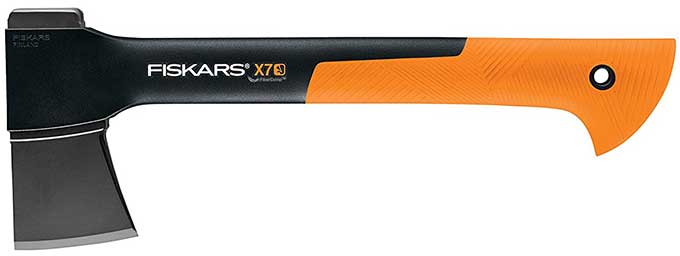
Fiskars Splitting Axe

I recently moved to a small farm on the outskirts of Baltimore. My favorite feature of our new humble abode is the outdoor fire place. However, I have been run ragged keeping up with splitting enough logs. The backbreaking labor was not helped by the older axe that came with the place. After that handle broke I decided to look for a better solution.

The Fiskar’s 36″ Splitting Axe is like night and day when compared to other splitting tools I’ve used in the past. While I’m envious of those who have a hydraulic wood splitter, I can’t emphasize enough how painless this splitting axe makes the process. Where as my previous axe would get stuck, and require swing after swing, the Fiskar’s cuts like butter. I don’t know why I was so surprised given Fiskar’s stellar reputation (or the fact that they’re designed in Finland, a country where forestry is a religion). The head, unlike a traditional axe blade, is closer in design to a splitting wedge which helps cleave through wood with ease.

Unlike my old axe, the Fiskar has a permanently fixed head. While this may worry some diehard woodsman, it’s a boon for the rest of us. After several long days splitting wood, the head remains as tight as the day I started using it, and shows no sign of letting up. If it does, it’s covered by the generous lifetime warranty. Another distinguishing feature is the plastic handle which is very comfortable and seems to reduce some of the post-strike vibration. My version is 36″ long which is just the right size for my 6’3″ frame; they do, however, produce a smaller model for those shorter in stature.

One nice design feature of the axe is the non-stick coating. I’ve only had the axe get stuck a few times, and even then the wood was wet and it only took a bit of wiggling to remove (which was nothing compared to when it would get lodged with my older axe). I also use Fiskars’ axe and knife sharpener to keep the edge sharp as that was recommended by several resources online.

Splitting wood can be unpleasant backbreaking work. This axe makes it a lot more pleasant.

-- Oliver Hulland  

[Note: This replaces the previously reviewed Chopping Axe that Fiskars no longer produces.--OH]

Fiskars Splitting Axe
36″, 28″, 23 1/2″, and 17″
$47

Available from Amazon

Manufactured by Fiskars


Belkin WeMo Switch

Home automation is finally plug-and-play. Setting up this wifi-connected box takes minutes:

1) Plug the WeMo into a three-prong outlet

2) Download an iPhone app (Android is rumored to be on the way)

3) Type your wireless password into the app to connect the switch to your home network

4) Plug a device into the WeMo (lamp, TV, fan, etc.)

That’s it.

You can toggle the switch on/off by pressing a button in the app. You can also quickly set an automated timer that automatically turns the switch on/off at different times on different days.

My WeMo Switch controls a huge floor lamp in the corner of our living room. It’s programmed to shut off every night at 9pm. No more playing footsie with the floor dimmer! Also, a nice reminder to stop watching TV and go read in bed. Typically, we turn on the lamp via an iPad in our kitchen. Dinner guests love it.

$50 isn’t cheap. The company sent me a complimentary switch to test, because I write about technology. That said, I’m buying another switch at the full price for my office. I don’t mind paying for the convenience.

If you’re handy with a soldering iron, go ahead and hack your own Arduino-powered switch. Or, assuming you don’t mind playing with wires, you might find a cheaper alternative in the Smarthome catalog. Up until now, most of the previously-available gear I’ve seen has been a combination of too complicated, cost-prohibitive, and/or aesthetically blah.

This thing works. It looks cool. And whenever my lamp automatically turns on, it feels magical.

Belkin WeMo Switch
$44

Available from Amazon

Manufactured by Belkin


Domerama

Burning Man chill-out dome

Domes are the most efficient way to build a shelter, covering the most space with the least material. But all domes leak in the rain (ask anyone who has lived in one). Yet, because they can be erected quickly, cheaply, and make wonderful, uninterrupted, open, almost magical, spaces inside, domes are perfect where it does not rain. Or on a temporary basis. Or both. Like Burning Man.

Once popular in the 1970s as alternative housing, then abandoned as impractical a decade later, domes are now in a resurgence because they are nearly ideal structures for arid and temporary shelters at Burning Man. This instant city now sports more domes than anywhere else in the world, and many of these are quite large. Considering how vast they are, it is amazing they can be thrown up in a few days by a small dedicated crew. And then be re-erected the next year.

You can use any set of long uniform pieces for the structs of a dome, from 2x4s, to electrical conduit pipe. The key critical pieces are the hubs which connect the structs, and the strut lengths. These must have a mathematical precision, and their dimensions vary by the size and variation of the dome species.

Therefore if you want to build a geodesic dome structure, you need to be able to construct strong hubs accurately. Domerama is the guide you need. This website shows you how to calculate struct lengths and how to make (or where to buy) dependable hub connectors. Using this site many amateurs have successfully built domes that worked the first time; you’ll need help: remember this is a very math-intensive endeavor.

The site has tons of materials on the varieties of domes, erecting domes (not as easy as you think), designing them, what to use as coverings, and introduces global dome culture. It is the best place to keep up on dome innovations: one cool new idea is to shrink wrap domes. Find out how here. Domerama is better than any current book on domes by far.

-- KK  

Sample Excerpts:

Advantages of shrink wrap covering:

• Will hold up under extreme weather conditions
• Translucent to let a large amount of light inside the geodesic dome structure
• Easy to repair, simple to create ventilation in the form of windows
• Strong enough to handle freeway and railway speeds
• Seams bond through heat, creating a seamless containment
• Will last up to 2 years in fully exposed outdoor conditions
*

Tyvek for covering geodesic domes:

Noise factor: when the wind hits the Tyvek® covered dome there may be flapping and so a lot of noise at high winds. Hard structure Tyvek® (the one you normally find at the hardware store) is stiff and noisy when new, but if you put the Tyvek® in a washing machine on the delicate cycle with no detergent for 2-3 cycles, it comes out soft and much more fabric-like. Washing this type of Tyvek® does not seem to affect the water resistance but can cause some shrinkage. 5% should be added to measurements to allow for shrinkage if you are going to wash your Tyvek® .

*

This is the classic way to connect geodesic struts together. A hole is drilled in the flattened ends then bolted together.To accommodate a drilled hole into your struts, the length of the strut needs to be longer.For example a 36 inch pipe/conduit strut will need to be extended at both ends to drill holes. A rule of thumb is to add 2 X 3/4 inch = 1.5 inches (or about 8cm) more to all struts. That means the center of the holes would need to be drilled 3/4″ from each strut end.


Domekit.cc is a project looking to make dome building simple and fun. They developed a hub connector featuring a robust ball-and-socket joint and an integrated thumbscrew that securely locks the strut to the node.These 3D-printed connectors are made in small batches in workshops and garages across the USA by fabricators with open-source 3D printers like the Makerbot. The principal fabricator for the 3D-printed connectors is Mark Cohen, who operates five 3D printers out of his garage in Brooklyn:

This is the Starplate system offered by Stromberg’s. Starplates are steel plates, with channels to hold 2×2′s, 2×3′s or 2×4′s. You simply drill holes in each end of 25 struts of equal length and bolt them into the 11 star plates to build a solid, mini-dome framework in a couple of hours.


Philips L-Prize Bulb

This is the best household LED bulb at the moment. It runs on only 10-watts, gives off the light of a 60-watt tungsten, delivers a soft white light, with the even distribution of the old bulbs. It’s dimmable. And it is promised to last 22-years.  I can confirm all these claims except the last (too early to tell). It is exactly the same shape and size of a 60-watt tungsten bulb, which many other LEDs are not. This makes it easy to swap out. Also, this one is brighter than most other LED replacements that I’ve used, including the previously reviewed Lemnis 40-watt LED bulb. It is more energy efficient than other 60-watt LED equivalents. Believe it or not, at $40 it is among the cheaper hi-powered LED bulbs — although the price is still too high for me to swap all my household bulbs (most of which are compact fluorescents).

Beside the price, two minor caveats. The bulb is heavy. It seems to be made of solid ceramic. It may not work in a counter-balanced fixture like an extended arm lamp. And if the bulb is exposed it shows bright yellow-orange markings when off, which may (or may not) be distracting design-wise.

Compared to tungsten bulbs, this is crazily expensive at $40. But it’s a steal if it lasts 22 years. (By Philips’ calculation you’ll save $137 in the end.) Compared to other LED lightbulb replacements, this one is brighter, more efficient, better color light, smaller, easier to swap, and more affordable. It won the US Department of Energy L-Prize for bulbs, hence its name. In short, the Philips L-Prize bulb is the best bulb if you want to start replacing those 60-watts or higher that you use a lot.

-- KK  

[Make sure to check with your local utility company as they often feature rebates on LED bulbs. Home Depot is known for selling this bulb cheaper in-store than they do online for this reason.--OH]

Philips L-Prize LED bulb
$15
Available from Home Depot

Also available from Amazon for $25

Manufactured by Philips