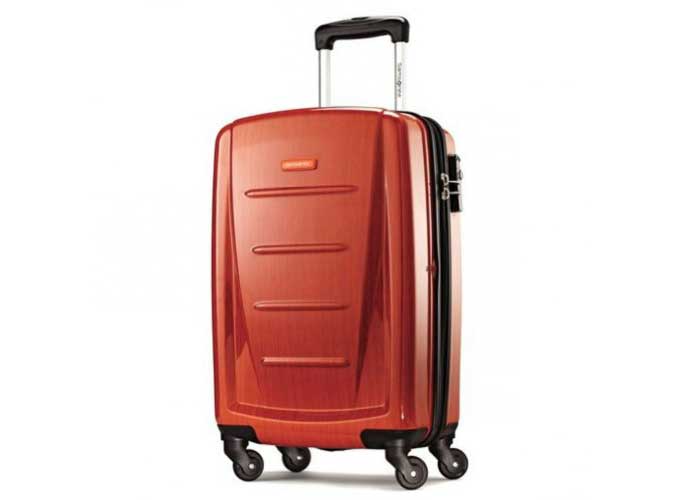

L.L. Bean Carryall Rolling Underseat Bag

One of the perks of my job as a television news & documentary producer is I get to travel a lot. Then again, when I’m waiting in an airport security line, I’m reminded that travel is also the worst part of my job…

So, when I hit the road I try to pack as much business into the shortest amount of time possible — and pack all my clothes into the littlest bag possible. And this little LL Bean suitcase is ideal for trips 2-3 days long: I can fit a toiletry kit, Keen’s sandals [which I wear as exercise shoes in hotel gyms], socks/underwear/t-shirt/shorts, 2 dress shirts, a sweater, and a pair of dress pants. There’s even room for a full-size laptop. My reading material, sunglasses, chargers, snacks, water bottle, DSLR, and sundry gadgets go into a Patagonia Lightweight Travel backpack — though the Bean bag can usually hold most of these items too.

If I need dressier clothes, I go with an Eagle Creek 22″ roll-aboard with a Pack-It suit folder. But 90% of the time this little bag does the trick — and there’s never a problem finding room for it in the overhead bins. With regional jets taking-over more and more short routes, traditional carry-ons almost always have to be gate-checked; I can often slip this one on-board.

For that reason, I can’t speak to how this thing will hold-up to regular abuse by baggage handlers. But I’ve flown with mine at least twice a month for the last three years without any sign of wear on the fabric or wheels.

I know that many will object to having wheels on a small bag, but the fact is I’m rarely moving across unpaved surfaces. Why schlep when you can roll?

Compared with other big-name brands (Travelpro, Briggs & Riley, Tumi, Eagle Creek, Victorinox, Delsey etc), I’ve found this bag has the best weight-to-size ratio and the most useful features for the money. It’s looks are kind of frumpy – hardly a cool design. But as a tool that quietly performs a vital job for me, it’s very cool.

-- Ed Forgotson  


Casio Pathfinder Solar Atomic Watch

I’ve owned a Casio Pathfinder Solar Atomic series watch for about 5 years. The best things about it: 1) it’s solar powered (I don’t like replacing batteries) and 2) it’s linked to an atomic clock.

I only have to change the time zone when I travel, which can be done at the push of a button.

It’s waterproof and does the things most digital watches do (alarms, stopwatch, etc.). It also has a compass, barometer, altimeter, and thermometer, all of which get used when I go backpacking. The compass gets used the most. The barometer is good for predicting weather changes.

I have one small gripe about this watch. It recently needed to be repaired because it displayed “OPEN” on the front. A metal plate inside had shifted. I was able to fix it easily with a PH000 screwdriver.

Its a very tough watch that has been through a lot. After 5 years I still enjoy it immensely.

-- Carl Mixon  

Casio PAW1100-1V Pathfinder Atomic Solar Watch
$145

Available from Amazon

Manufactured by Casio


TripIt

Keeping track of travel arrangements — hotels, flight schedules, rental car reservations — is a problem for me. I make mistakes writing down the information, I lose printouts, I resent the time it takes to stay on top of everything. That all changed a few years ago when I started using TripIt, an online travel organizer that keeps all my trip plans in one place.

Here’s how I typically use it: I purchase a flight on Southwest’s website. I reserve a rental car on Hertz’s website. I book a hotel through hotels.com. When I get the confirmation emails I forward them to plans@tripit.com. TripIt parses the information and produces an easy-to-read itinerary. It’s easy to add meeting and other plans. I can email the itinerary to other people and refer to it while I’m traveling, via the TripIt’s free mobile app. TripIt also adds the information to my calendar (I use iCal but it works with everything else, too).

TripIt is free, but I pay for TripIt Pro because I like getting text messages about canceled or delayed flights and gate changes. This feature makes it worth $49 a year for the pro account.

-- Mark Frauenfelder  

TripIt, Free
TripIt Pro, $49/year


Campbell Hausfeld 12-Volt Tire Inflator

I have a Campbell Hausfeld 12-volt tire inflator that has kicked around in the back of my car for years. I’ve lost count of the number of times I’ve re-inflated a tire with a slow leak, and then gone on my way. The brand isn’t nearly as important as the fact that it runs off your car battery; it has a tire pressure gauge built in, and it has a work light.

Small 12-volt compressors like this run from between 15 to 30 bucks new, and will do a fine job of re-inflating tires or rubber rafts or volleyballs.  Most compressors come with attachments that will do all of these things.  In my case, we often travel on industrial roads that lead to the local dump, so we tend to pick up more than our share of nails and screws. My little compressor has lasted through several cars and many tires.

-- Amy Thomson  

Campbell Hausfeld 12-Volt Inflator and Worklight
$28

Available from Amazon

Manufactured by Campbell Hausfeld


Tritium-lit U.S. Military Wrist Watch

military watch.jpg

These days, wrist watches are hard to justify wearing; digital clocks are everywhere, and they’re generally always correct.

But a Mil-Spec watch, made specifically for our military personnel, that’s got clean looks and pure function as its purpose, along with Tritium gas-lit phosphor tubes marking the time in complete darkness (for years!) is very hard to beat. Light-weight and comfortable, I use mine in place of much more expensive world-nameplate Swiss watches that sit unused (a special kind of tragedy).

These watches are tools and, I think, very cool, and I believe they fit under the Cool Tool umbrella with their own unique panache. The dial has “US Government” and a radiation symbol, too. Hard to beat.

-- Wayne Ruffner  

Military Wristwatch
$135
Available from County Comm
Manufactured by Marathon Watch Company


Destination Art

destination art.jpeg

Some of the best art is a destination; you must travel to it. This lavish guide book is chock full of art that can only be experienced in place, beyond four walls. Some of this destination art is monumental, some architectural, some is art rooted in the physical landscape, some is found in open air art parks. There is a refreshing mix of choices from around the world, each of which is worth making a trip to see. Like the previously reviewed Geek Atlas, having a specific unusual destination can enhance ordinary travel.

-- KK  

Destination Art
Amy Dempsey
2010, 272 pages
$29

Available from Amazon

Sample Excerpts:

destination art 1.jpeg
Spiral Jetty in Great Salt Lake in Utah has been covered with water for most of its existence. It recently re-emerged to reveal its new brilliant, salt-encrusted state, as seen in this photograph, taken in 2004.
*
destination art 2.jpeg
As you approach Le Palai Ideal, near the rural village of Hauterives in France, the stunning moss-covered, highly ornamented and intricately carved palace emerges from the ferns and trees surrounding it.


One Highly-Evolved Day Bag

I asked Charles Platt, former editor of Cool Tools, what he is packing these days and he replied with this list. It’s not your usual selection:

I like to be fully prepared when traveling, but I hate excess weight. This has led to a computer bag containing not just a computer but as many small items as possible, packaged in such a way that they don’t fall to the bottom in an undifferentiated mess.

The key to the packaging is to use a modular system based on Darice Mini Storage Boxes (available with or without compartments–I prefer those without). These parts boxes measure about 3.5″ x 5.7″ x 1.2″. They have durable metal hinges and can be stacked edge-to-edge. My computer bag holds five of them in its main compartment. Amazon sells an assortment, or you can buy individual styles from CraftAmerica.

31f2QugOvsL SL500 AA300

Inside the storage boxes I keep:

1 1487122670 1348161089 128

* Retractable Rosewill ethernet connector, about 1.5″ x 3″.

* Mini-USB to full-USB wire adapter, 6″, for uploads from camera to laptop.

* Mini-mouse. I don’t like trackpads.

* Spare laptop battery.

* Medications. To save space, I transfer pills into little 3″ x 4″ zip-lock plastic bags. I peel the prescription labels from pill bottles and stick them to the bags. (but cheaper from eBay).

318EhoIwEpL SL500 AA300
* One 50mm diameter concave mirror, so that I can examine my own eye if I get a foreign object in it and there’s no one else to assist. The concavity allows very close-up focusing.

* Cell phone charger.

* Camera battery charger.

41RtIrT3+UL SL500 AA300
* Earbuds and wire-mounted microphone with USB plug, for Skype calls via laptop. Especially useful when traveling internationally.

* Miniature 3-foot measuring tape in 1″ x 1.5″ enclosure.

437197
* Plastic lightweight miniature camera tripod, folds to 1.5″ x 6″ x 0.6″, so that I can take time exposures almost anywhere.

* SD data card reader with USB connector. Just in case image transfer from camera to computer fails.

* Miniature LED flashlight.

Screen Shot 2012 01 31 at 11 26 19 PM
* Aegis Padlock 500GB external USB drive, with 256-bit hardware encryption. The nice thing about this drive is that you enter your password on a numeric keypad built into the drive. Thus, no software drivers are necessary, and you can plug it into any computer. And if you leave it behind in a motel room, your data are secure (supposedly there is no backdoor to bypass the encryption). Can you plead the 5th Amendment if an inquisitive US immigration agent wants to see what’s saved on it? The last I heard, that issue is being litigated in a couple of test cases.

All these items fit inside the five storage boxes. In addition of course the bag has its own set of storage pockets containing pens, blank sheets of paper, two pairs of eyeglasses, paper printout of all addresses and phone numbers, business cards, passport, a printout of all online passwords using a simple cipher that I can decode in my head, and a pocket digital camera, currently a Canon S100. And, of course, there’s a computer (Sharp MP30, no longer made unfortunately).

The bag itself is quite small: 12″ x 14″ x 5″. Even when it’s fully loaded, I find the weight tolerable.

– Charles Platt


VW Vagabond

This couple penny-pinched their salaries for several years, bought a VW Van, and drove it around the world (US, South America and Africa). They share what they have learned on one of the most helpful websites I’ve seen for this sort of thing. I really like their sensibility and advice. Very reasonable and very wise. They also “review” the tools and stuff they found vital in their small traveling home on this page. Click on a tool to see more.

They give good advice about shipping vehicles (very complex) and even saving up enough to make the journey. They have a book, too.

While living in a VW Van for three years, they got the idea that even this lifestyle was too complex so they get simpler for the next stage. They are now bicycling across Asia, another adventure and great idea. They are riding recycled 1980 mountain bikes. As usual they have all kinds of great tool reviews (water filters and the like).

Part of the reason their advice and website is so useful is that they have no sponsors — a rarity for ambitious trips like this these days. It keeps them honest and useful. Check ‘em out.

Sample excerpts:

Screen Shot 2012 01 30 at 5 35 37 PM

Screen Shot 2012 01 30 at 5 34 55 PM

Rain gear has proven to be pretty
much useless here in Southeast
Asia. To wear even the thinnest,
most breathable layer in this heat
creates a sauna-like effect. We
have taken to simply riding in the
rain… it’s refreshing, really! If it
pours too hard to see, then we
pull over in a bus stop and wait
for the drizzle to return.

Bangkok Station 4 am Rich Bike 313x230

This is Rich preparing to cycle out of the
Bangkok railway station at 4 a.m. Notice
the reflective vest and reflective tape stuck
all over the bike. Reflective vests are
available from almost any bicycle shop. The
3M tape is the stuff used on highway guard
rails in the U.S. We purchased strips of it on
eBay for a few dollars.

We purchased our down bags at the Veterans
Thrift Store. They are a few years old and
needed a good washing but are as functional
- albeit with less status – than their adventure
store counterparts. Rich paid $10 for his and Amanda’s was only
$1.65. We washed them on the delicate
cycle then ran them through the dryer on low
heat for a few cycles. If you put a running
shoe (make sure it’s clean) in the dryer with
the bag it will keep the down from clumping.
We hung them on the line for two sunny days
and now they look and smell brand new – or
close enough.


Rush 72 Backpack

rush72_lg2.jpeg

As solid goes, 5.11 Tactical is about as good as it gets. Tested by Viking Tactics for the manifold stresses of modern warfare (no, not the video game), the RUSH 72 will hold up to just about anything you can throw at it, water included. I wouldn’t submerge it, of course, there are drain points in bottom of the hydration compartment as well as the main compartment, but in rain, there’s very little risk of damage if you’ve closed the zippers fully.

The reason I recommend the 72 variant instead of the 24 is simple: there’s more space if you need it, and if you don’t need it, then you don’t have to use it. The compression straps pull tourniquet-tight in a few seconds, and you can loop them into the attached MOLLE webbing to keep them that way. Though the 72 is a bit wider than its smaller cousin, it’s not nearly as noticeable as it seems in the pictures, even when packed. I use my 72 as a Bug-Out-Bag, with the two side pockets functioning as compartments for items that might draw a few questions if packed in more accessible areas. And despite the considerable amount of gear I’ve managed to fit, it’s still about the same as my old SwissGear pack. That is to say, fairly mid-sized, as backpacks go.

The 72 is also perfect because it’s multipurpose, and fulfills various roles without needing any pouches tacked on (although I did find a MOLLE-compatible organizer for pens, an external hard drive, and other such tools; see the previously reviewed Pocket Field Organizer). It has sternum straps and hip pads that take the load significantly off your shoulders, and also features an aluminum hard-plate in the back both for support and so any pointy items in the pack won’t dig into your spine. A recent design update now features underside attachment points, so a rolled sleeping bag or tent can be carried under the pack with the aid of a bit of twine or paracord. Of course, you could also just stuff it into the compression pocket.

Oh. And did I mention pockets? Because there are a lot of those. It doesn’t look like it from the picture above, but there are tons of pockets: a sunglasses pocket, an organizer pocket, a main compartment, a water bladder compartment, two side compartments, and additional mesh and closed-nylon pockets within nearly every one of those. If you’re not the kind of person to use a hydration bladder, you can consider using the hydration pocket as laptop storage. It fits my 15″ Macbook Pro just fine with space to spare, so if you’ve got something like a gaming computer, then it will probably fit. The aluminum hard-plate doubles as extra protection.

I won’t lie, it’s pretty expensive as everyday packs go, especially if you aren’t used to paying for them. I was lucky enough to receive mine as a gift from those who knew which pack I wanted, so I was ecstatic. But every other pack I’ve owned (a lot of SwissGear, some generic brands) has suffered from ripped handles, zippers that catch and come apart, torn outer shells, and other flaws which significantly reduced the quality of the product. The 72 has every indication of being as battle-ready as Viking Tactics claims, and even with the heavy loads I’ve carried on and off for about three months, it has held up superbly and shows no sign of wear.

-- Nathaniel Gage  

RUSH 72 Backpack
$160 (price and stock fluctuates)

Available from Amazon

Manufactured by 511 Tactical


ResQMe

resqme_orange.jpeg

The ResQMe tool is something that I believe everyone should own, but I pray that no one will ever need to use.

I have been fortunate enough to have never needed to use this tool myself, but through my work as an EMT I have come across more than one situation where my patients may have benifited from this tool, and one situation where I honestly believe that this tool could have been lifesaving.

When you have been involved in a serious motor vehicle collision your adrenaline starts flowing and, if you are like the large majority of people, your fight or flight instincts kick in and thinking rationally can become a challenge.

If it is safe to remain in your vehicle, that is certainly your best course of action. But in some situations this is simply not an option. If for example the vehicle has entered water, if chemicals or fire are involved, or if you are in an isolated area and assistance is simply not going to find you in your current location it may be necessary to vacate your vehicle. Seatbelt mechanisms may become jammed and pushing the release button may no longer work. Electric windows may no longer work if the electronics were damaged by the collision.

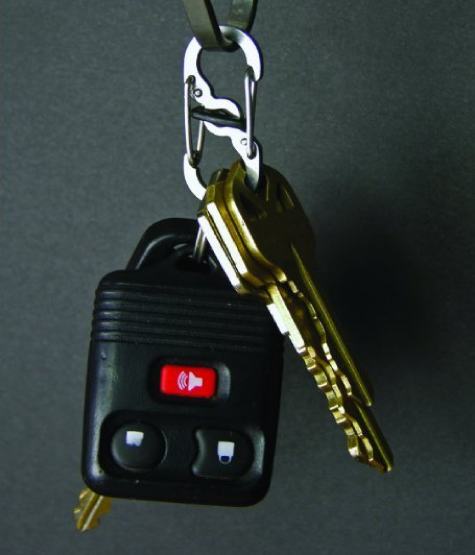
In order to get out of the vehicle you need to find not only an alternate way to undo your seatbelt, but a means of breaking a window specifically designed not to be easily broken, and you must do both these things while in a near panicked state. With other tool combinations that I’ve used the seatbelt cutter and the window punch have been separate and have had no means of attaching to a keychain.

As a rescuer, these independent devices work well. However, if you are the person trapped inside the vehicle you don’t have time to be reaching around looking for one tool, let-a-lone two. Having the ResQMe attached you key chain means that you will almost always be able to escape from your vehicle.

-- Caity  

ResQMe Keychain
$10

Available from Amazon

Manufactured by ResQMe

This video demonstrates the seatbelt-cutting function and the window-breaking function in a simulated under water emergency, and in dry conditions: